Jul23

This is a story about a potential Greek tragedy waiting to unfold. I analyses some causes, adresses some elements but in the end it is a call to action for leaders.
For decades, the working assumption inside most organizations was simple and comfortable. You managed what was inside the walls of the shop. You set the targets, you built teams to execute, you monitor performance against internal metrics. As long as the internal machinery ran well, you could make a credible argument that you were doing a great job. That assumption is now genuinely dangerous, not because the world became more complicated overnight, but because leadership in many organizations still operates as if those walls are intact and sovereign and therefore not an issue. Dream on!
The borders of organizational responsibility have expanded, shifted, and in some cases dissolved altogether. The pace at which this has happened has far outrun the capacity of traditional leadership information models to keep up, yet this is not yet part of the average leadership MBA. What happens at the edge of your supply chain, at the boundary between your organization and the world it operates in, matters just as much as what happens in your boardroom. I might argue that matters considerably more because you are freaky dependent on others.
The supply chain conversation has for too long been treated as a logistics and procurement problem, something appropriately handed to operational staff and monitored through a spreadsheet dashboard with a convenient traffic light system. Senior leadership glanced at delivery lead times and unit costs, occasionally panicked when a key supplier went under, and considered that sufficient oversight. That era is over. What sits beyond the organizational boundary is no longer a set of transactional relationships that can be managed at comfortable arm's length. It is a web of interconnected risks, each one capable of transmitting shock waves into the core of your business in ways that cannot be absorbed by a revised procurement policy or a hastily scheduled supplier review meeting. The complexity is not the problem. The problem is that most leadership structures were never designed to see it. So stop treating procurement as a cost savings center.
Consider what that actually means. ESG risk alone has fundamentally rewritten what leadership must understand about its supply base. Regulations such as the Corporate Sustainability Due Diligence Directive in Europe are not aspirational guidelines for organizations that care about optics. They carry legal weight, and they require organizations to demonstrate that they know what is happening not just with their direct suppliers but several tiers deep into those suppliers' own supply chains. If a company three steps removed from your organization is using labor practices that violate basic standards, or sourcing materials through channels that create environmental liability, the reputational and legal exposure can land at your door regardless of how many layers of contract separate you. The contract you signed with your immediate supplier does not insulate you from that liability. In many jurisdictions and under many emerging regulatory frameworks, it actually defines the extent of your responsibility.
Geopolitical risk has become similarly impossible to quarantine in a separate analysis function. The tensions between major trading blocs, the fragility of certain raw material supply lines, the imposition of tariffs and export controls with minimal notice, these are not abstract macroeconomic concerns for economists to debate at industry events. They are realities that determine whether your production capacity holds next quarter and at what cost structure. When a critical component becomes suddenly unavailable because of a diplomatic deterioration between countries that had no geopolitical relevance to your business model three years ago, the question leadership will face is why no one was tracking that exposure. The honest answer, in most organizations, is that nobody was structurally responsible for it, because the governance model was built for a more predictable world.
Client default risk is another dimension that tends to get parked in the finance function and treated as a credit management problem, largely disconnected from the commercial relationship management function. But client default is rarely an isolated financial event. It is usually the downstream effect of a chain of deteriorating conditions, sector stress, regulatory pressure on the client's own business model, shifts in their customer base, contractual obligations they can no longer fulfil, and leadership changes that affect strategic direction. When you look at client default through the combined view of contract management and account health over time, you start seeing the warning signals earlier. The problem is that those signals are typically scattered across separate functions that do not share a common information architecture or reporting rhythm, which means by the time any coherent pattern is visible to anyone with the authority to act, the situation is already genuinely difficult to recover from.
Regulatory pressure deserves particular attention because its velocity has increased to a degree that most compliance functions were not designed to handle. Governments and supranational bodies are legislating at pace, and the intersection of those regulations with existing commercial contracts is becoming a specialist discipline in its own right. Standard contract terms that were entirely adequate two years ago may now create compliance exposure that neither party anticipated when they signed. Leadership cannot be expected to read and synthesize every regulatory development across every jurisdiction in which they operate, but they absolutely can and should be expected to have a governance structure that surfaces the contractual and commercial implications of those developments before they materialize as a problem rather than after the damage is already visible.
This is precisely where the information challenge for leadership lives, and where almost all organizations are genuinely failing. The answer is not to add more reports to an already overloaded inbox, more dashboards, more data without interpretation. The answer is aggregation, standardizing, crossfunctional and coherence. Leadership needs to understand the total picture of organizational exposure and performance across the entire commercial relationship lifecycle, on both sides of the equation. And that requires something that most organizations have still not properly built or invested in seriously: a connected information architecture that draws from delivery performance, contract management, relationship health, sector dynamics, and portfolio strategy into a single coherent view that enables decisions to be made with appropriate context and appropriate speed. The absence of that architecture is not a technical problem. It is a governance problem, and ultimately a leadership problem.
Contracts sit at the foundation it is worth being clear about that. They are the legal and operational recordings of every commercial commitment the organization has made or received. They define what is owed, when, under what conditions and with what consequences when those conditions are not met. Ignoring them therefore treating them as administrative (usually pdf in an inbox) artifacts after signature, is one of the most expensive habits organizations maintain yet fail to see. Contracts alone are not sufficient for leadership-level insight, and they were never meant to be. They need to be read in combination with the relational, financial, and strategic layers that surround them. A contract with a financially stressed client in a sector under regulatory pressure in a geopolitically unstable region carries a fundamentally different risk profile than a contract with identical commercial terms in a stable context. Leadership needs to see that difference structurally, not infer it from instinct.
On the sales side of the business the chain runs from delivery through contract management to account management, through sector management and into product and portfolio management. It describes a continuum of commercial stewardship and continuity. Each function holds a piece of the picture. Delivery knows what is actually happening operationally. Contract management knows the legal and financial commitments and whether they are being honoured. Account management understands the relationship health and the client's evolving intent. Sector management reads the market dynamics that affect the client base as a whole. Product and portfolio management shapes what the organization offers and where it is positioned strategically. When these functions share information and operate within a common information architecture, leadership gets a coherent view of commercial performance and risk that allows them to act rather than react.
On the buying side, the structure is remarkably similar. The chain runs from delivery through contract management through supplier management through category management and into product and portfolio management on the procurement side. The same continuum, the same logic, the same fundamental need for aggregation and coherence at the top. It is about Supplier health, contractual compliance, category dynamics, and portfolio positioning. They all feed into the same question that leadership must be able to answer clearly: do we know what our obligations and exposures are across our supply base, and are we managing them with the same intelligence and discipline we apply to our customer base?
The symmetry here is striking yet largely unacknowledged in the way most organizations are structured. The governance architecture that would make a sales operation genuinely world-class is structurally identical to the architecture that would make a procurement and supply operation genuinely world-class. The information flows required, the governance mechanisms needed, the skill profiles demanded, the quality of leadership attention both sides need to perform at a peak level. All of it mirrors the other.
This all makes it worth asking a question that I will leave with you. The answer says more about organizational culture and inherited assumptions than any strategy document ever will. Why is it that in most organizations, the sales side is substantially better resourced, better governed, better led, and better remunerated than the buying side? If the architecture is the same, if the risks are comparable in magnitude, if the organizational need for genuine competence on both sides is equivalent, where exactly does that persistent imbalance come from? And what does your answer reveal about what your organization actually values?
In the age of AI and Ecosystems ignoring this will lead to the end of your organization, so better act now.
Keywords: Agentic AI, Business Strategy, Ecosystems
 The Corix Partners Friday Reading List - October 16, 2026Friday’s Leadership Reflection Quote – Saeculum Leadership Leaders Separate Known Facts from Fear
 You are not your diagnosis
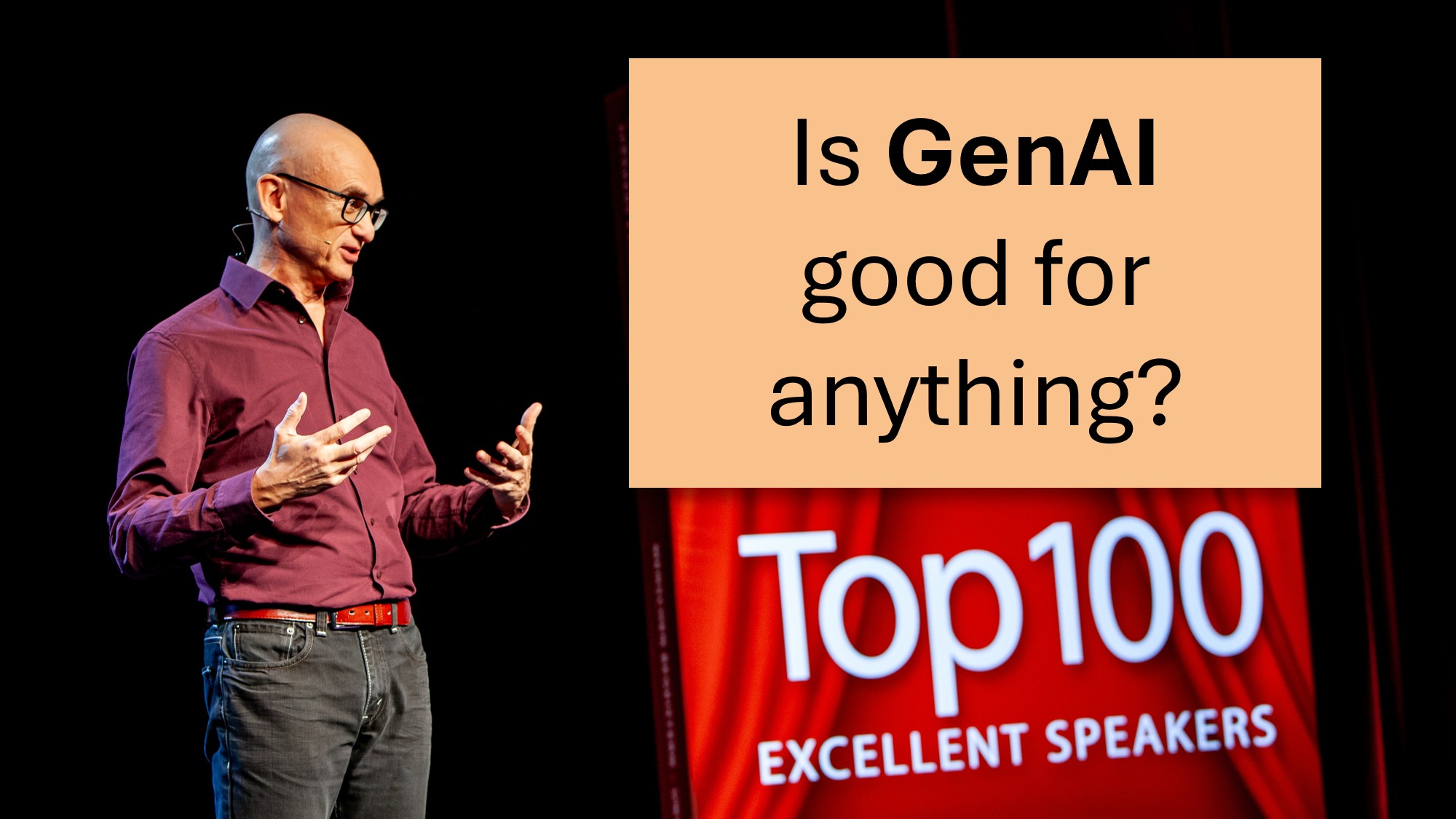 Is GenAI good for anything?
 “I didn’t write an award acceptance speech because I didn’t expect to win.”