Jun26
FCRQ204 Leadership Learning!
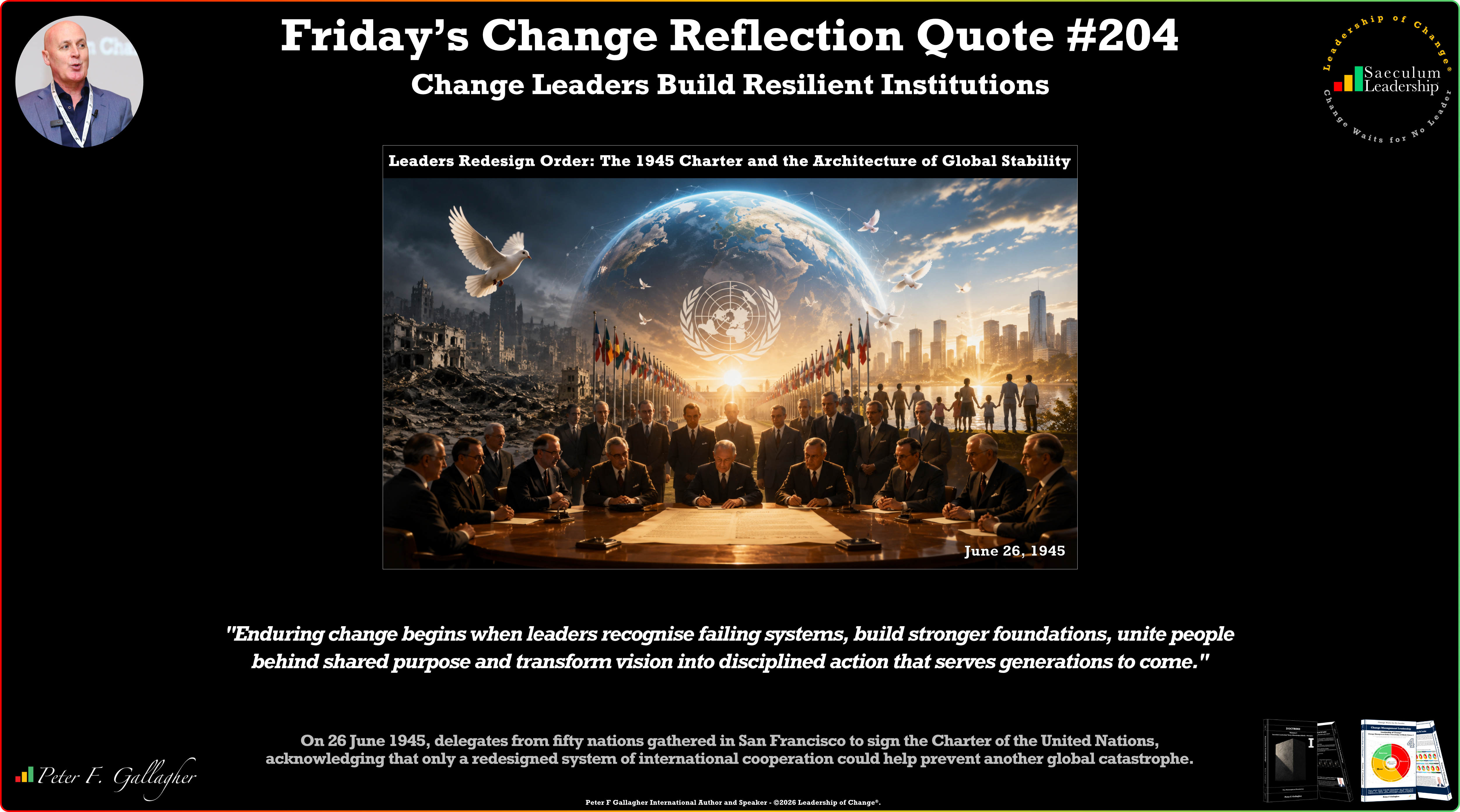
On 26 June 1945, delegates representing fifty nations gathered in San Francisco to sign the Charter of the United Nations, marking a decisive moment in which world leaders acknowledged that only a fundamentally redesigned system of cooperation could prevent a return to global catastrophe. This established a new international organisation designed to promote collective security, peaceful cooperation and long‑term global stability through a new rules‑based order following the Second World War.
The events surrounding the signing of the United Nations Charter demonstrate that meaningful transformation begins when leaders recognise that existing systems have reached the limits of their effectiveness. The devastation of global conflict exposed structural weaknesses that could not be resolved through isolated reforms or temporary agreements. Instead, sustainable progress required the deliberate creation of new governance capable of supporting a fundamentally different future.
One enduring lesson is that effective leadership distinguishes between repairing systems and redesigning them. Incremental improvement has value, yet there are moments when changing circumstances demand entirely new operating models. Recognising that distinction requires judgement, foresight and the willingness to challenge accepted assumptions before crisis becomes permanent.
The Charter also demonstrates the importance of aligning diverse interests behind a common purpose. The participating nations represented different political systems, cultures and priorities, yet they recognised that long-term stability depended upon cooperation rather than individual advantage. Shared purpose became a stronger foundation than competing national ambitions alone.
Another important insight concerns institutional resilience. Durable organisations are not created simply by responding to immediate problems. They are designed with principles capable of adapting to future uncertainty. Leaders who invest in governance, accountability and collaboration create institutions capable of remaining effective as external conditions evolve.
The signing further demonstrates that credibility is established through commitment rather than aspiration. Agreements become meaningful only when supported by institutions, processes and sustained engagement. Vision must therefore be translated into practical mechanisms that encourage consistency, trust and responsible decision making over time.
Finally, the Charter reminds leaders that significant turning points often emerge from periods of profound disruption. Crisis can become either a catalyst for transformational improvement or an opportunity lost through hesitation. Those who recognise emerging signals early are better positioned to shape the future rather than merely react to unfolding events. The enduring influence of the United Nations reflects the importance of designing institutions that outlast individual leaders and continue serving future generations. From a Saeculum Leadership perspective, this was far more than an historic agreement. It was a powerful Signal that enduring change begins when leaders recognise that new institutional architecture is required rather than attempting to restore the past. This was a clear Knowledge Architecture Signal: the deliberate design of new governance to stabilise a fractured world.
Change Leadership Lessons: The signing of the Charter demonstrates that enduring transformation depends not only upon vision, but upon leaders creating institutions capable of sustaining that vision across generations. Leaders of change recognise when existing systems have reached their limits and create stronger foundations for future success. They unite diverse stakeholders behind a clear purpose that extends beyond immediate interests and short-term pressures. Change leaders design resilient institutions capable of adapting confidently to future uncertainty and complexity. They transform strategic vision into disciplined action through governance, accountability and sustained commitment. Leaders of change recognise emerging signals early and act decisively before circumstances force reactive decisions. Change Leaders Build Resilient Institutions.
“Enduring change begins when leaders recognise failing systems, build stronger foundations, unite people behind shared purpose and transform vision into disciplined action that serves generations to come.”
Application - Change Leadership Responsibility 1 – Articulate the Change Vision: The signing of the United Nations Charter demonstrates that transformational change begins when leaders recognise that existing structures can no longer deliver future stability. Following unprecedented global conflict, the responsibility was not simply to restore what had failed, but to articulate a compelling vision of a different international order founded upon cooperation, shared responsibility and long-term peace. An effective change vision explains why current arrangements are no longer sufficient, describes the future capability that must be created, and provides people with confidence that a better outcome is both credible and achievable. It establishes strategic direction before detailed implementation begins.
Leaders of change must communicate why fundamental change is necessary, what new governance, behaviours and capabilities are required, and how disciplined collaboration will enable sustainable progress. This responsibility extends beyond announcing ambition or defining objectives. It requires presenting a coherent future state that aligns diverse stakeholders behind a common purpose, particularly when uncertainty and competing interests threaten progress. When leaders consistently articulate a clear and believable vision, they reduce ambiguity, strengthen trust and create the alignment necessary for coordinated action. In doing so, they establish the strategic foundation upon which enduring institutional change, resilience and sustainable performance can be achieved.
Final Thoughts: Saeculum Leadership reminds us that civilisations advance when leaders recognise structural turning points and build institutions capable of serving generations rather than merely addressing immediate circumstances. AI reinforces this lesson by revealing patterns, connections and emerging signals with increasing speed, yet leadership must still interpret their significance and determine direction. Leaders of change must therefore articulate a compelling vision before uncertainty becomes crisis, transforming recognised signals into coordinated action that creates resilient and enduring capability.
Further Reading: Change Management Leadership® - Leadership of Change® Volume 4 and Saeculum Leadership®: Doctrine – Volume I.
Peter F. Gallagher, a 20‑book author, consults, speaks, and writes on Saeculum Leadership® and Leadership of Change®. He works exclusively with boards, CEOs, and senior leadership teams to prepare and align them to effectively and proactively lead their organisations through transformation in a rapidly evolving epoch.
For insights on navigating organisational change, feel free to reach out at Peter.gallagher@a2B.consulting.
Further Reading: Change Management Leadership® - Leadership of Change® Volume 4 and Saeculum Leadership®: Doctrine – Volume I.
Peter F. Gallagher, a 20‑book author, consults, speaks, and writes on Saeculum Leadership® and Leadership of Change®. He works exclusively with boards, CEOs, and senior leadership teams to prepare and align them to effectively and proactively lead their organisations through transformation in a rapidly evolving epoch.
For further insights please visit our websites: https://www.a2b.consulting https://www.peterfgallagher.com Amazon.com: Peter F Gallagher: Books, Biography, Blog, Audiobooks, Kindle
Saeculum Leadership® Body of Knowledge (SLBoK): Volumes 1-10.A-E & I-V
~ Leadership of Change® Volume 1 - Change Management Fables
~ Leadership of Change® Volume 2 - Change Management Pocket Guide
~ Leadership of Change® Volume 3 - Change Management Handbook
~ Leadership of Change® Volume 4 - Change Management Leadership
~ Leadership of Change® Volume 5 - Change Management Adoption
~ Leadership of Change® Volume 6 - Change Management Behaviour
~ Leadership of Change® Volume 7 - Change Management Sponsorship
~ Leadership of Change® Volume 8 - Change Management Charade
~ Leadership of Change® Volume 9 - Change Management Insanity
~ Leadership of Change® Volume 10 - Change Management Dilenttante
~ Leadership of Change® Volume A - Change Management Gamification - Leadership
~ Leadership of Change® Volume B - Change Management Gamification - Adoption
Keywords: Leadership, Change Management, Business Strategy
 Consumer vs. enterprise AI agents
 Best Supply Chain AI Tools in 2026: SCM SENSEI AI and Ask Lora Compared
 Making Silos Permeable
 The Corix Partners Friday Reading List - October 2, 2026
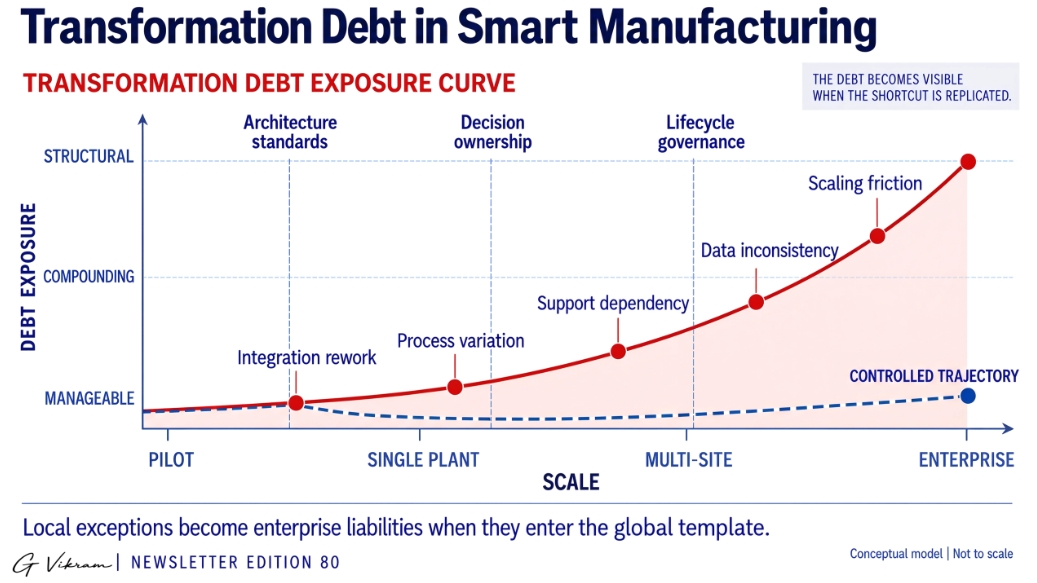 The most dangerous debt in a smart factory isn’t financial.