Jul16
What if conflict isn’t the problem… but the signal that something deeper is out of alignment?
Conflict has been mischaracterized.
In most organizations, it’s treated as something to:
avoid
suppress
resolve quickly
But in coherent systems, conflict serves a different role.
It reveals where alignment breaks down.
Just as friction in physics signals interaction between surfaces, conflict in human systems signals divergence in:
expectations
incentives
information
perception
The presence of conflict doesn’t indicate dysfunction.
The misinterpretation of it does.
When trust is low, conflict escalates.
Not because the disagreement is larger— but because the system interprets it as risk.
Biologically, this is immediate:
threat detection activates
attention narrows
defensive behavior rises
At that point, the conversation is no longer about the issue.
It becomes about protection.
Positions harden. Listening drops. Outcomes degrade.
In high-coherence environments, something different happens.
Conflict doesn’t disappear. It becomes usable.
Because:
trust stabilizes the field
shared purpose contains the tension
communication remains open
Disagreement becomes data.
Not about who is right— but about what is misaligned.
Most decisions are made under constraint:
time pressure
incomplete information
competing priorities
Under these conditions, misalignment becomes costly.
Low coherence leads to:
slow decision cycles
repeated conversations
risk avoidance
diluted accountability
It’s not a lack of intelligence.
It’s a lack of integration.
When alignment is present:
Information flows without distortion
Expertise integrates instead of competes
Decisions move faster—without recklessness
Feedback loops tighten naturally
The difference is subtle, but profound.
Decisions don’t feel forced. They feel clear.
There’s a persistent belief in organizations:
More pressure = more performance
Short-term, that can work.
Long-term, it breaks systems.
Because pressure without coherence:
increases friction
reduces creativity
accelerates burnout
But when coherence is present:
resistance drops
coordination improves
energy redirects toward contribution
Performance doesn’t need to be extracted.
It shows up.
Not all friction is bad.
In fact, some is necessary.
Constructive friction:
challenges assumptions
sharpens thinking
drives innovation
Destructive conflict:
fragments trust
slows execution
drains energy
The difference isn’t the intensity.
It’s the containment.
For friction to be productive, four conditions must exist:
Shared purpose → Why this matters
Stable trust → It’s safe to engage
Clear communication → No hidden signals
Adaptive feedback → We adjust as we go
Without these, friction becomes damage.
With them, friction becomes fuel.
When conflict arises, most leaders ask:
“Who’s responsible?”
But that question rarely leads to resolution.
A better question is:
“What’s misaligned?”
Are incentives pulling in different directions?
Is information incomplete or distorted?
Has trust degraded?
Are expectations unclear?
Fix the alignment…
…and the conflict often resolves itself.
You can measure system health by how quickly decisions happen.
Slow decisions often indicate:
low trust
high uncertainty
poor alignment
Fast, effective decisions indicate:
clarity
cohesion
shared understanding
Speed isn’t the goal.
Alignment is. Speed follows.
This is where the deeper shift begins.
If:
conflict signals misalignment
decisions reflect integration
performance emerges from coherence
Then organizations are not machines.
They are living systems.
Adaptive. Responsive. Relational.
And living systems don’t respond to force the way machines do.
They respond to conditions.
Stop asking:
“How do we eliminate conflict?”
Start asking:
“What is this conflict revealing about our system?”
Because friction isn’t the enemy.
It’s the messenger.
When coherence is present:
conflict informs
decisions clarify
performance accelerates
Not because pressure increased—
but because resistance decreased.
Where in your organization is friction trying to tell you something… that no one has slowed down enough to hear?
By Zen Benefiel
Keywords: Business Strategy, Change Management, Leadership
 Consumer vs. enterprise AI agents
 Best Supply Chain AI Tools in 2026: SCM SENSEI AI and Ask Lora Compared
 Making Silos Permeable
 The Corix Partners Friday Reading List - October 2, 2026
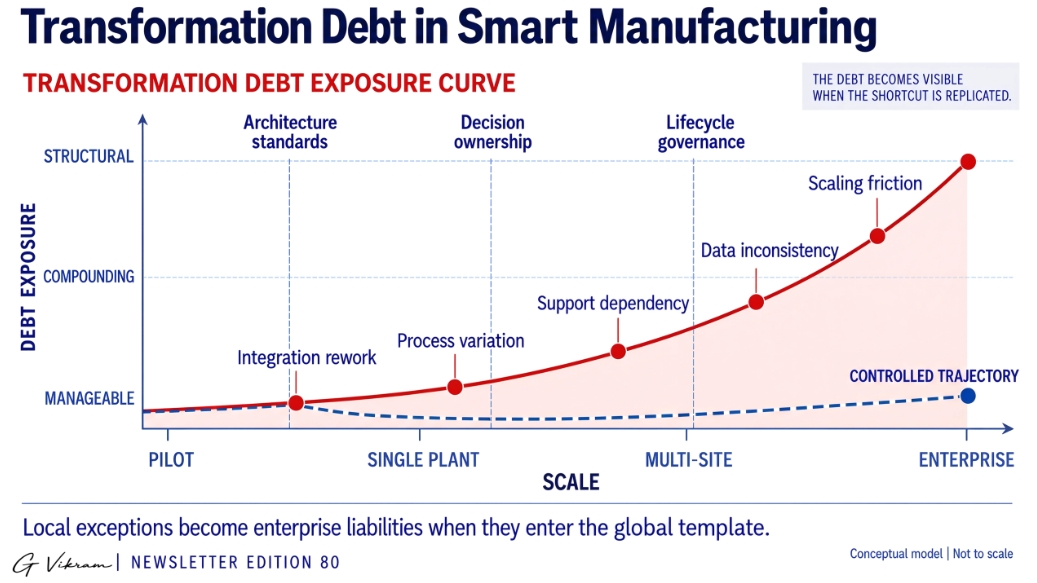 The most dangerous debt in a smart factory isn’t financial.