Jan03
In many large organizations, FP&A is expected to do more than ever before. Beyond budgeting and variance analysis, it is asked to support strategy execution, inform capital allocation, and provide forward-looking insight in increasingly volatile environments.
Yet at enterprise scale, the outcome is often paradoxical.
Despite heavy investment in tools, data platforms, and reporting capabilities, FP&A teams frequently find themselves overwhelmed by volume rather than empowered by clarity. Analysts spend significant time reconciling numbers, explaining discrepancies, and preparing extensive materials, while senior leaders receive more information than they can realistically absorb or act on. The result is a function that is operationally busy, yet strategically constrained.
In my experience, this is rarely a talent problem or a technology problem. More often, it is a design problem.
This article builds on my recent publication in the World Financial Review, where I introduced an integrated framework for designing Financial Planning & Analysis (FP&A) as a source of decision advantage at enterprise scale. Here, I expand on the practical implications of that framework and explore why traditional FP&A models tend to break down as organizations grow in size and complexity.
A recurring issue in large FP&A organizations is that success is implicitly measured by analytical sophistication or reporting completeness. More models, more scenarios, more dashboards are assumed to equate to better decisions.
In practice, that assumption often fails.
What ultimately matters is not how much analysis is produced, but whether insight reaches decision-makers in time, with credibility, and in a form that is directly relevant to the decision at hand. I refer to this capability as decision advantage.
Decision advantage is not synonymous with forecasting accuracy or advanced analytics. Highly accurate forecasts that arrive after decisions are locked in, or insights that are not trusted due to inconsistent definitions, do little to shape outcomes. At scale, decision advantage emerges only when information production is intentionally linked to decision execution.
Viewing FP&A through a decision-advantage lens shifts the transformation question. Instead of asking how to optimize individual components, the focus becomes how to design FP&A as an integrated enterprise capability.
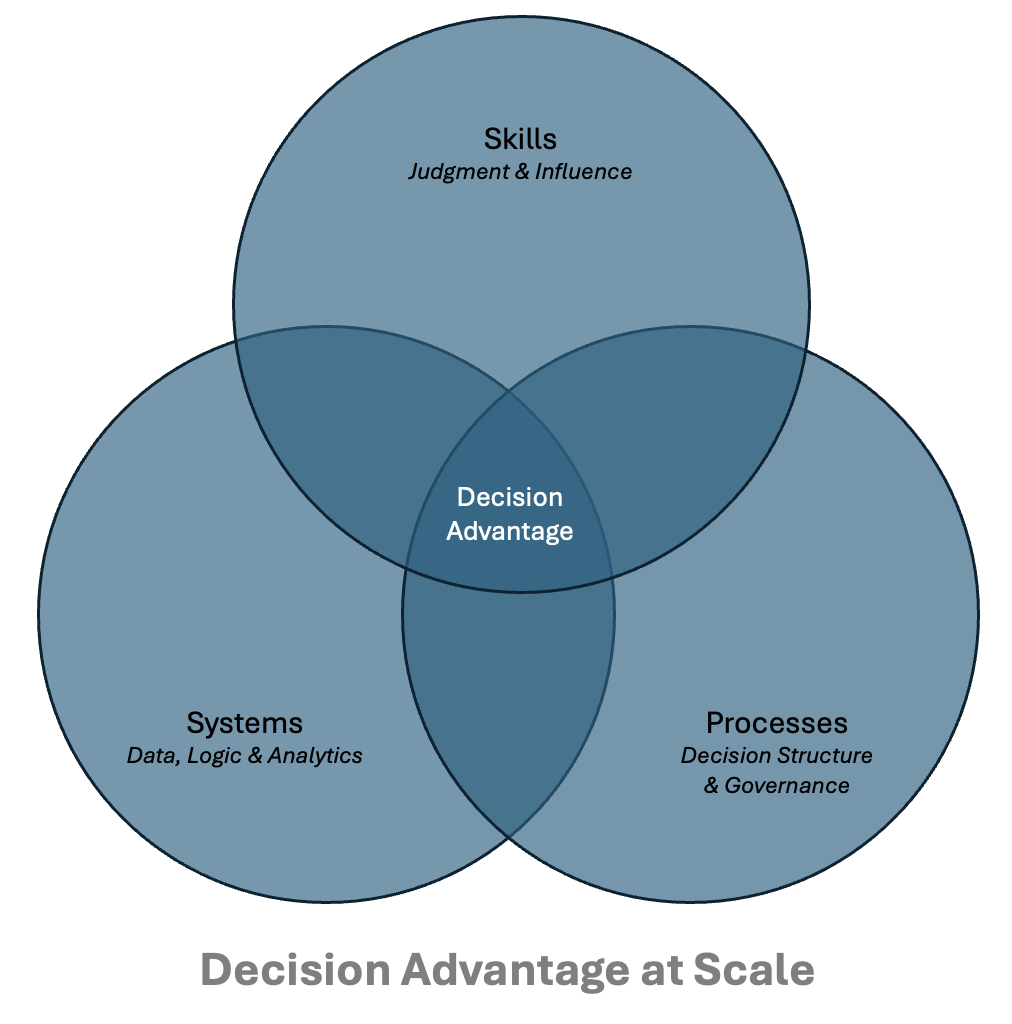
I find it useful to frame this design challenge around three interdependent pillars:
Processes - how decisions are structured, sequenced, and governed
Systems - how data, calculation logic, and analytics are enabled and scaled
Skills - how people interpret information, exercise judgment, and influence outcomes
At enterprise scale, none of these elements can be optimized in isolation. Improving tools without redesigning decision processes often shifts effort from analysis to reconciliation. Standardizing processes without investing in professional judgment increases control at the expense of insight. Developing talent without fixing system fragmentation limits impact.
Decision advantage emerges only when these pillars are deliberately aligned.
As organizations grow larger and more complex, decision latency and fragmentation tend to increase. Governance layers multiply, local requirements accumulate, and analytical effort drifts toward explaining the past rather than shaping future choices. What works in a single business unit rarely scales cleanly across a global, multi-business enterprise.
Designing FP&A for decision advantage is therefore not a technical exercise. It is a leadership choice about what the organization chooses to plan, measure, review, and escalate - and just as importantly, what it chooses to stop doing.
For a deeper, structured treatment of this framework, the full article is available via the World Financial Review: Designing Enterprise FP&A for Decision Advantage - The World Financial Review
Keywords: Digital Transformation, Finance, Transformation
 You are not your diagnosis
 Is GenAI good for anything?
 “I didn’t write an award acceptance speech because I didn’t expect to win.”
 AI Is Exposing the Data Problems Humans Used to Hide
 "The AI may in fact be conscious." Really?