Feb27
FCRQ187 Leadership Learning!
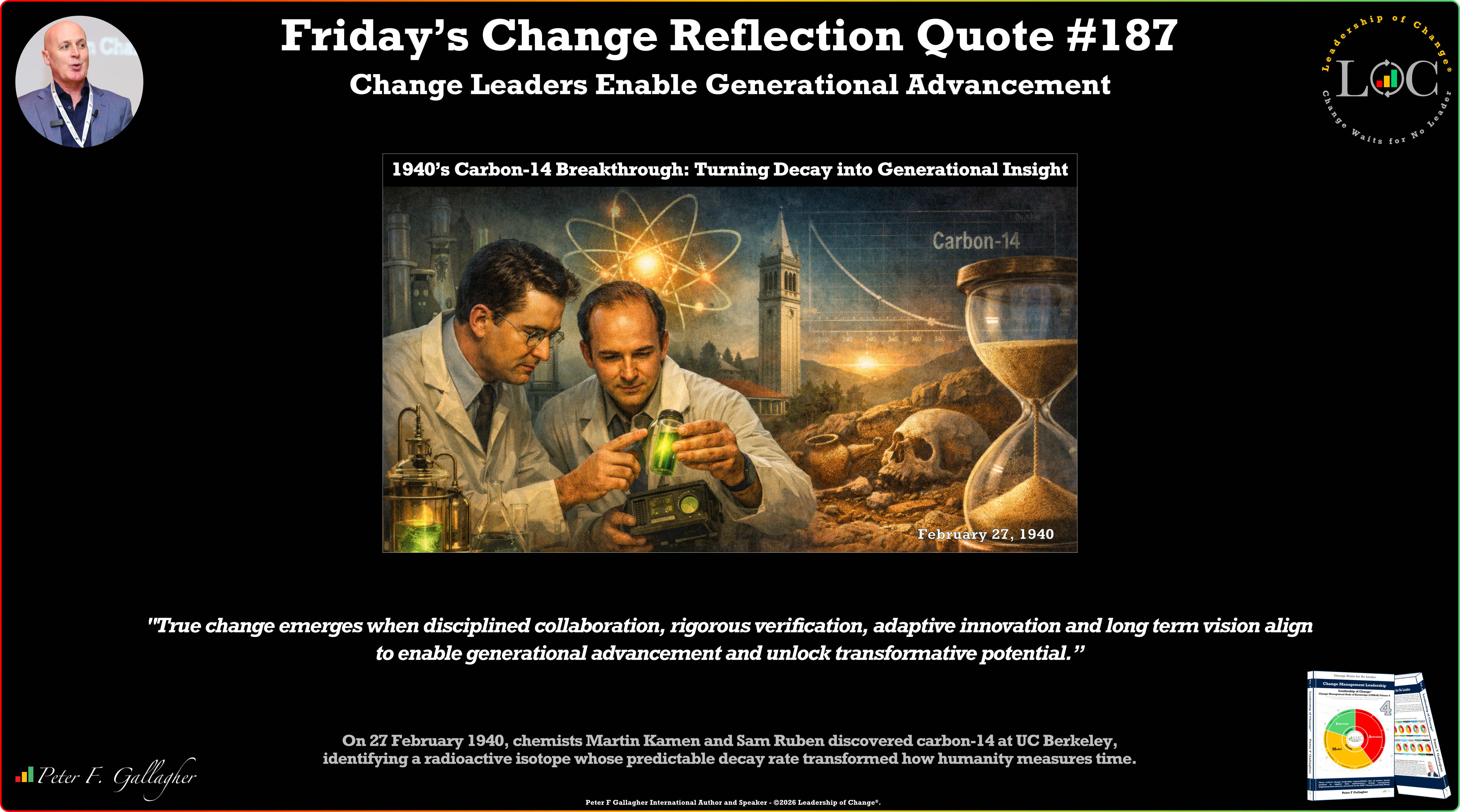
On this day, 27 February 1940, chemists Martin Kamen and Sam Ruben discovered carbon fourteen at the University of California, Berkeley, identifying a radioactive isotope whose predictable decay rate would transform humanity’s ability to establish objective chronological measurement. This discovery created a scientifically grounded dating framework that reshaped disciplines dependent on chronological accuracy, including archaeology and environmental science. Their laboratory experiments demonstrated a radioactive carbon isotope formed through deuteron bombardment in a cyclotron, enabling the development of radiocarbon dating and new methodologies for determining the age of organic material. This discovery emerged from a broader scientific effort to understand atomic structure and isotopic behaviour during an era of accelerating nuclear research. Scientists were exploring how elements transformed under neutron bombardment, seeking to expand theoretical and practical knowledge of atomic processes. The identification of carbon fourteen was initially a technical achievement within nuclear chemistry. Its profound implications were not fully realised until later, when its decay properties were harnessed to measure the age of organic material with unprecedented precision. Before this discovery, archaeology relied on systematic methods such as stratigraphy and typological comparison, but these approaches provided relative rather than universally calibrated absolute dates. This isotope introduced a universally applicable scientific reference. It allowed scientists to determine the age of ancient artefacts, environmental samples, and biological remains using measurable decay intervals rather than inference alone. This transformed archaeology from a largely interpretive discipline into one supported by measurable scientific evidence. The scientific environment at Berkeley played an essential role. It combined experimental rigour, institutional capability, and intellectual openness to explore questions whose practical applications were uncertain. The discovery reflected the importance of persistence in experimental investigation and the role of well structured research environments in enabling foundational breakthroughs. The long-term implications extended far beyond nuclear chemistry. Radiocarbon dating reshaped archaeology, allowing civilisations to establish accurate chronologies. Environmental science gained tools to reconstruct climate history and ecological change. Forensic science acquired new capabilities to analyse biological evidence. Even technology and industrial research benefited through improved understanding of isotopic processes. This moment demonstrates how foundational discovery restructures knowledge systems over time. The significance lay not merely in identifying an isotope, but in redefining how society validated historical truth. Such developments influence institutional priorities, knowledge frameworks, and the trajectory of technological advancement across generations. Saeculum Leadership teaches that foundational discoveries become generational inflection points when leaders recognise their long‑horizon significance. Such breakthroughs act as a signal—clarifying direction, reducing uncertainty, and revealing the next horizon of progress.
Change Leadership Lessons: What began as experimental nuclear chemistry became a generational catalyst for institutional transformation. Leaders of change recognise that sustained investment in foundational research enables transformational progress whose applications emerge across generational time horizons. They model disciplined experimentation to establish credibility and transform uncertainty into measurable, reliable and operationally useful knowledge. Change leaders cultivate institutional environments that support persistence, collaboration and rigorous intellectual challenge to enable structural breakthrough and scientific advancement. They intervene by replacing assumption based interpretation with verifiable frameworks grounded in objective, repeatable and measurable evidence systems. Leaders of change enable environments committed to pursuing truth despite unclear immediate outcomes, ensuring enduring progress and long term societal advancement. Change Leaders Enable Generational Advancement.
“True change emerges when disciplined collaboration, rigorous verification, adaptive innovation and long term vision align to enable generational advancement and unlock transformative potential.”
Application. Change Leadership Responsibility 1 - Articulate a Change Vision: The identification of carbon fourteen emerged from disciplined inquiry where immediate application was uncertain but conceptual significance was undeniable.. A credible change vision establishes the intellectual foundation that sustains progress when outcomes remain uncertain and institutional validation has not yet materialised. Modern organisations secure long term commitment when leaders articulate a future state grounded in evidence, disciplined reasoning and coherent explanatory frameworks. This clarity enables stakeholders to understand what new understanding is emerging, why existing assumptions require re-evaluation, and which institutional constraints must be confronted rather than avoided. A well articulated vision does not depend on immediate utility for legitimacy; it creates the conditions where emerging knowledge can be recognised, examined, and developed with intellectual seriousness. When leaders communicate vision with precision, credibility and disciplined reasoning, they reduce uncertainty driven resistance, discourage premature abandonment and enable structured exploration before full operational value is realised. This responsibility ensures that transformational progress remains anchored in rigorous thought, empirical investigation, and purposeful direction, allowing new knowledge to mature into enduring scientific and institutional advancement.
Final Thoughts: Enduring transformation requires leaders who articulate possibility grounded in disciplined scientific reasoning before practical application becomes fully evident or accepted. In an era shaped by artificial intelligence, accelerating data capability and scientific convergence, leadership responsibility is to articulate emerging truth with intellectual courage. Leadership excellence lies not in reacting to immediate utility, but in recognising foundational discoveries early and enabling their maturation into enduring systems that reshape understanding across generations.
Further Reading: Change Management Leadership - Leadership of Change® Volume 4.
Peter F. Gallagher consults, speaks, and writes on Leadership of Change®. He works exclusively with boards, CEOs, and senior leadership teams to prepare and align them to effectively and proactively lead their organisations through change and transformation.
For further reading please visit our websites: https://www.a2b.consulting https://www.peterfgallagher.com Amazon.com: Peter F Gallagher: Books, Biography, Blog, Audiobooks, Kindle
Leadership of Change® Body of Knowledge Volumes: Change Management Body of Knowledge (CMBoK) Books: Volumes 1, 2, 3, 4, 5, 6, 7, 8, 9, 10, A, B, C, D & E available on both Amazon and Google Play:
~ Leadership of Change® Volume 1 - Change Management Fables
~ Leadership of Change® Volume 2 - Change Management Pocket Guide
~ Leadership of Change® Volume 3 - Change Management Handbook
~ Leadership of Change® Volume 4 - Change Management Leadership
~ Leadership of Change® Volume 5 - Change Management Adoption
~ Leadership of Change® Volume 6 - Change Management Behaviour
~ Leadership of Change® Volume 7 - Change Management Sponsorship
~ Leadership of Change® Volume 8 - Change Management Charade
~ Leadership of Change® Volume 9 - Change Management Insanity
~ Leadership of Change® Volume 10 - Change Management Dilenttante
~ Leadership of Change® Volume A - Change Management Gamification - Leadership
~ Leadership of Change® Volume B - Change Management Gamification - Adoption
Keywords: Business Strategy, Change Management, Leadership
 You are not your diagnosis
 Is GenAI good for anything?
 “I didn’t write an award acceptance speech because I didn’t expect to win.”
 AI Is Exposing the Data Problems Humans Used to Hide
 "The AI may in fact be conscious." Really?