Feb24
Most HR departments are built to maintain the status quo.
They keep the organization moving.
And in today’s environment, that’s no small task.
Between economic uncertainty (do we ramp up hiring or shift to overtime?)…
Ongoing labor and skills shortages (how do we replace a 20-year veteran?)…
And relentless technological change (was that résumé written by AI? How do we manage hybrid teams?), HR leaders are running at full speed just to keep up.
But succession planning doesn’t thrive in a performing HR function.
It requires a transforming one.
Performing HR focuses on the now.
Transforming HR focuses on what’s next.
That’s a fundamental mindset shift.
When HR is stuck in performance mode, most decisions are reactive.
Each action solves a current pain point.
Succession planning, however, demands proactive design.
It asks different questions:
Those questions cannot be answered in crisis mode.
In many mid-market companies, HR is still measured primarily by operational efficiency: time-to-fill, retention rates, compliance accuracy, benefit utilization. Those metrics matter. But they don’t tell you whether the company can survive leadership turnover.
That’s where transformation begins.
A transforming HR function expands its lens from “talent management” to “talent architecture.”
For example, replacing a 20-year veteran isn’t just a hiring challenge. It’s a systems warning. If one person holds institutional knowledge, key customer relationships, and informal influence, the organization doesn’t have a talent gap — it has a structural vulnerability.
Similarly, economic uncertainty shouldn’t only trigger workforce reductions or hiring freezes. It should prompt scenario planning.
Succession planning is not about predicting the future; it’s about preparing leadership capacity for multiple futures.
Technology is an inflection point. AI, remote work, and digital collaboration tools are changing how work gets done. A performing HR team updates policies. A transforming HR team asks: Which of our future leaders can lead through digital disruption? Who understands both operations and technology? Who can influence in a distributed workforce?
Transformation does not mean abandoning performance responsibilities. Compliance still matters. Payroll still matters. Hiring still matters.
But succession planning requires HR to step into a strategic architect role.
That shift involves three commitments:
First, clarity on critical roles. Not every position needs a formal successor. But mission-critical leadership roles must be identified and assessed for readiness and risk.
Second, intentional development. High performers are not automatically high-potential enterprise leaders. Stretch assignments, cross-functional exposure, and decision-making ownership must be designed — not left to chance.
Third, partnership with the CEO and executive team. Succession planning is not an HR project. It is a business continuity strategy. HR may facilitate it, but ownership must sit at the top.
When HR moves from performing to transforming, the organization’s posture changes. Leadership transitions become less disruptive. Talent decisions become less reactive. Growth becomes more sustainable.
The pressures facing HR today are real. Economic swings. Labor shortages. Technological shifts. Those forces aren’t going away.
But if HR remains consumed by performance alone, succession planning will always feel like “one more thing” on an already full plate.
When HR embraces transformation, succession planning becomes what it was meant to be: not a document in a drawer, but a deliberate strategy for ensuring the company can outlast any single leader — including the one at the top.
Keywords: Entrepreneurship, HR, Leadership
 “I didn’t write an award acceptance speech because I didn’t expect to win.”
 AI Is Exposing the Data Problems Humans Used to Hide
 "The AI may in fact be conscious." Really?
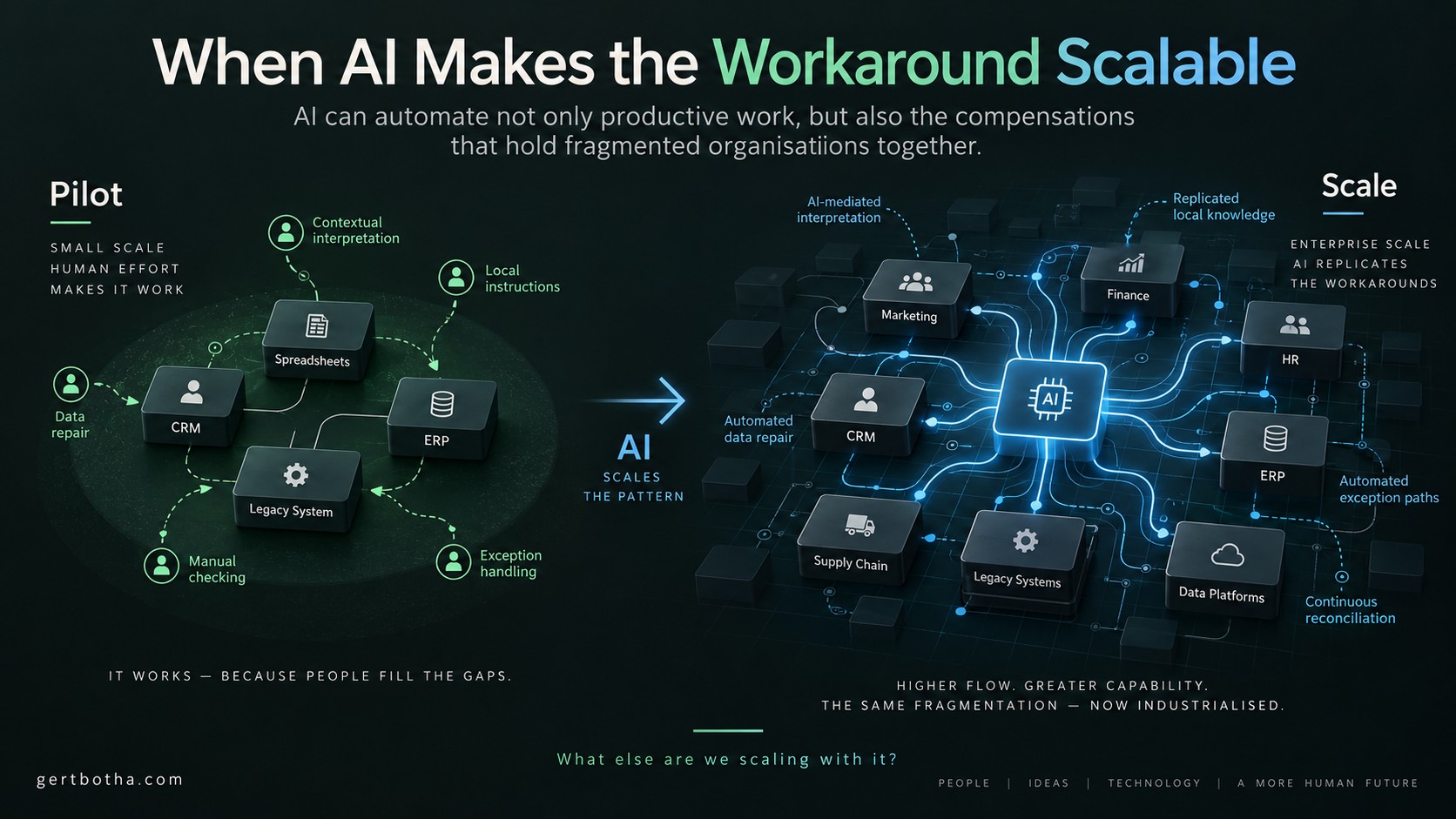 When AI Makes the Workaround Scalable
 The Age of Continuous Shocks: Why the coming downturn will be decided in your supply chain