Mar16

In February of 2026, a company that got its start as a manufacturer of karaoke machines managed to destroy $17.4 Billion in freight market value in under 24 hours.
Their solution, SemiCab, is an AI-enabled technology that promises to reduce wasted freight miles. They released a whitepaper explaining the model and the potential benefits - and turned the freight market upside down.
They may only be a $3 Million company, and they may not have any U.S. based customers, but that didn’t matter.
Listen here: https://artofprocurement.com/blog/supply-how-a-3m-company-destroyed-17b-in-freight-market-value
Dropping ‘Deadhead’ Miles
If SemiCab can really solve the waste associated with carriers running “deadhead” or unused miles, freight companies could find themselves operating at nearly 100% capacity without adding drivers or purchasing additional equipment. The problem is, it would also commoditize freight services and erase any pricing leverage the companies might hold.
Deadhead miles are not a new problem - or a small one.
As CNBC reported, trucks are driving empty nearly one out of every three miles. That leads to the loss of over $1 Trillion in potential freight spending each year. (Source: https://www.cnbc.com/2026/02/12/trucking-and-logistics-stocks-tumble-on-release-of-ai-freight-scaling-tool.html)
When Forbes interviewed Algorhythm CEO Gary Atkinson about the model and its potential economic impact, he said, “In trucking, especially food, inefficiency is invisible because it’s diluted. You’re spreading the cost across millions of grocery items, so no one sees the waste directly. But consumers still pay for it.” (Source: https://www.forbes.com/sites/daphneewingchow/2026/01/31/how-an-airline-analogy-is-reframing-the-cost-of-food/)
How could a change that sounds like great news be such bad news for carriers?
Multi-Industry Disruption
Logistics is not the only industry that has been hit by an AI-fueled optimization shock in recent weeks. Software and commercial real estate have seen similar dynamics.
CNBC reported that software firms, “once valued for their sticky subscriptions and dependable renewals are now under scrutiny as AI threatens to automate workflows, squeeze pricing, and lower the barriers for new rivals to enter the market.” The Financial Times described a broad two-week period of elevated AI-related trading volatility, with investors “selling first and asking questions later.” (Sources: https://www.cnbc.com/2026/02/04/software-stocks-plunge-us-ai-disruption.html, https://www.ft.com/content/d52b97ba-8199-4877-b210-e7575cbdcaf2)
Established companies and their CEOs are giving up easily. Most of them are trying to stay positive (at least publicly) about the impact of AI on their business models, market share, and profitability.
CBRE is the world’s largest commercial real estate services and investment firm. Their CEO, Bob Sulentic insists that his team can create value despite the disruption of AI: “We’ve become quite confident that that business really is driven by this strategic creative thinking that our brokers do. [...] And we think that’s going to continue to be the case, and we haven’t seen any evidence to the contrary.” (Source: https://www.cnbc.com/2026/02/12/office-real-estate-stocks-tumble-as-ai-disruption-casualties-in-the-stock-market-grow-by-the-day.html)
C.H. Robinson released a similar statement in the aftermath of the February 12th freight market selloff: “We believe AI will only continue to strengthen our performance and widen our competitive moat.” (Source: https://www.wsj.com/business/logistics/meet-the-former-karaoke-company-that-sank-trucking-stocks-018ddde1?st=21WjbA)
No well-run company is ignoring the potential impact of AI, whether positive or negative. Scale, experience, relationships, and data still matter, but if markets are going to undergo these serious swings in response to relatively straightforward marketing content, we’re in for a very bumpy ride.
But will it work?
Reaching 100% capacity utilization would ultimately redistribute uncovered value across the freight ecosystem. If it uncovers that value all at once because the optimization is driving at the speed of AI, the effect can clearly be destabilizing without having shown any results.
As The Wall Street Journal noted in their coverage of this story, “SemiCab founder and CEO Ajesh Kapoor said the firm is facilitating thousands of loads a month in India. By comparison, C.H. Robinson manages more than 100,000 shipments a day.” (Source: https://www.wsj.com/business/logistics/meet-the-former-karaoke-company-that-sank-trucking-stocks-018ddde1?st=21WjbA)
When you look at the disruption in that context, it seems like maybe people are putting too much faith in the ability of AI to drive results and maybe not asking enough questions about whether it will work at scale.
In my opinion, the SemiCab whitepaper went viral because someone figured out they were linked to a karaoke manufacturer. That is just quirky enough to seize everyone’s imagination. But does the SemiCab solution work?
We will have to wait to get the answer to that question.
As Brendan Hopkins, investor relations for Algorhythm said, “No publicity is bad publicity.” He was certainly right under the circumstances. (Source: https://www.wsj.com/business/logistics/meet-the-former-karaoke-company-that-sank-trucking-stocks-018ddde1?st=21WjbA)
By Kelly Barner
Keywords: AI, Supply Chain, Transportation
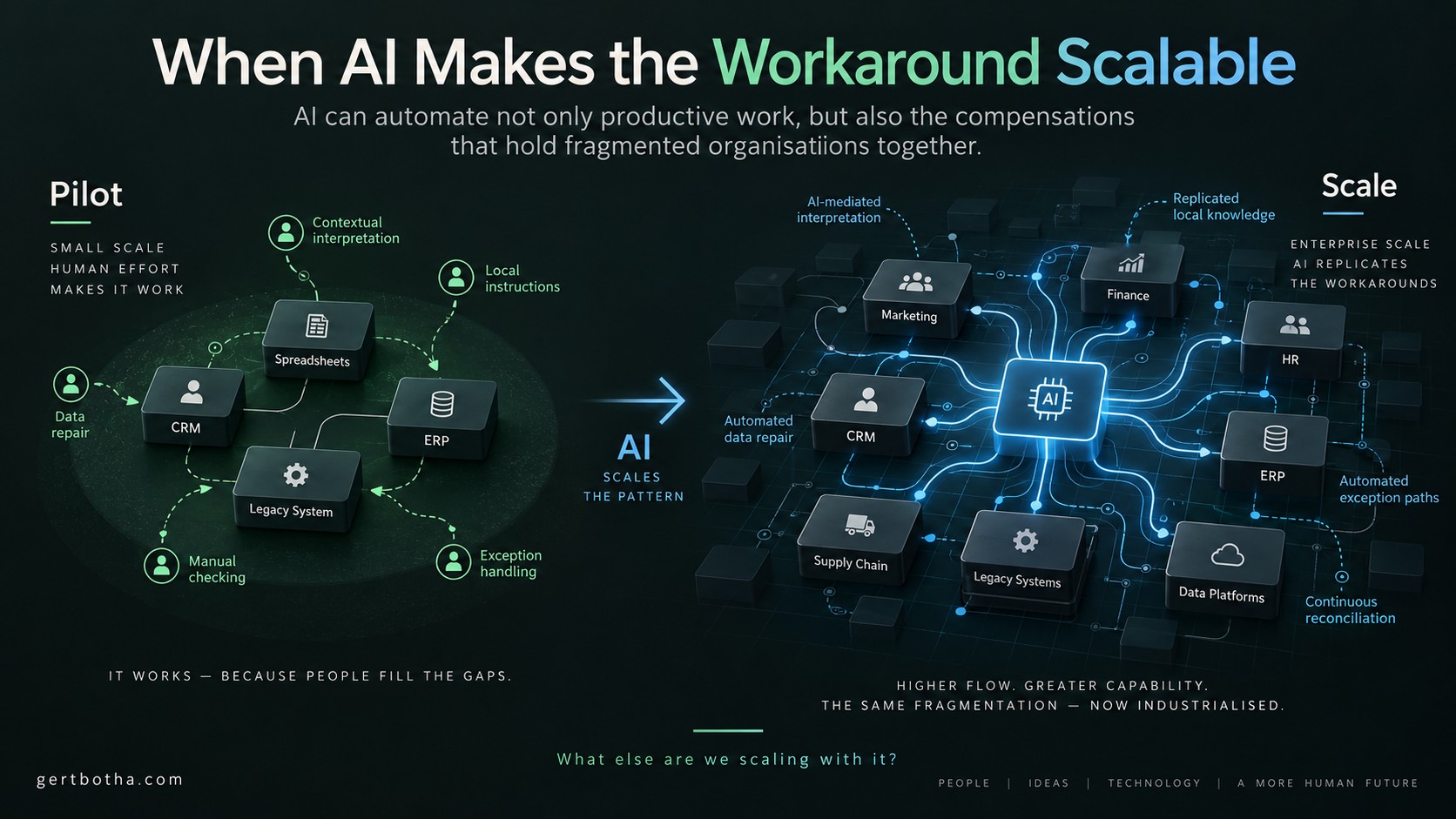 When AI Makes the Workaround Scalable
 The Age of Continuous Shocks: Why the coming downturn will be decided in your supply chain
 Friday’s Leader Reflection Quote – Saeculum Leadership Leaders Accept Decisions Create Responsibilities
 The Corix Partners Friday Reading List - October 9, 2026
 Consumer vs. enterprise AI agents