Feb23
Sponsored Post
Imagine your fitness tracker catches an irregular heartbeat and immediately pings your doctor, while you're out hiking, miles away from any cell tower. Sounds like science fiction? It's not. It's already here. Today's devices don't just respond to commands; they analyze, learn, and stay connected no matter where you are. AI in smart devices is fundamentally changing how we live and work.
But here's the thing: all that processing power is useless without dependable embedded connectivity holding it together. In this piece, we're diving into how smart device technology, AI and IoT integration, and persistent network access are building truly independent systems, the kind that will define the future of connected devices.
Sure, understanding why embedded connectivity makes AI reliable matters. But the harder question? Actually building a system where sensors, processing, power management, and connectivity all work together smoothly at scale. That's where the real engineering happens.
Simple automation is ancient history at this point. Early smart gadgets operated on basic if-this-then-that logic. Now? Edge inference lets your devices crunch data right there on the hardware, and agentic workflows mean your gadget makes decisions and takes action without checking in with the cloud first. The on-device AI market hit US$ 10.1 billion in 2024, jumping about 22 percent from 2023. That tells you this shift isn't just buzz, it's real, it's massive, and it's already scaling.
Here's what nobody talks about enough: raw computational horsepower means absolutely nothing if your device can't grab fresh data or send critical alerts when needed. Embedded connectivity keeps your models current, routes around network hiccups, and maintains uptime through multi-path resilience. You end up with faster response times, stronger privacy, and way less reliance on cloud infrastructure. Real-time decisions still happen locally, but connectivity keeps every device synchronized and up-to-date.
Edge AI executes models directly on your device. TinyML compresses those models for ultra-low-power microchips. eSIM and iSIM remove the need for physical SIM cards. LPWAN extends battery life for years at a time. MQTT manages lightweight messaging. Matter brings smart home protocols under one roof. Digital twins let you simulate device behavior before actual deployment.
Once you've mapped your tech stack, the next big choice determines whether your AI responds in milliseconds or chokes exactly when you need it most: picking the right connectivity architecture for your latency needs, privacy goals, and budget constraints.
Think of sensors as your device's sensory organs, IMUs measure movement, cameras capture visual information, microphones detect audio anomalies. Selecting the right mix means finding the sweet spot between signal clarity and power consumption. For processing, you're choosing MCUs for lighter workloads, MPUs when things get heavier, or NPUs when you need specialized AI acceleration. Memory limitations? They matter more than most people realize. Model compression keeps everything running without choking your hardware.
Travel a lot for work? Using an eSIM from Holafly simplifies international connectivity, letting your AI-powered productivity tools sync seamlessly across borders without scrambling for local SIM cards or gambling on sketchy hotel Wi-Fi. Industrial sensors often use NB-IoT or LTE-M to stretch battery life across years while maintaining solid uplinks. Indoor gadgets typically rely on BLE or Wi-Fi, mobile apps need 5G or LTE, and remote infrastructure increasingly uses satellite IoT when traditional networks can't reach.
Smart devices transmit insights, not massive raw data dumps. Feature extraction happens on-chip first, then compressed data gets sent upstream. Models follow a clear lifecycle: you train in the cloud, validate on actual hardware, deploy through OTA updates, monitor real-world performance, and rollback if something breaks. Edge caching stores frequently accessed data locally, slashing both response time and bandwidth expenses.
Connectivity decisions shape AI performance dramatically, but one technology quietly enables worldwide deployment at scale, eliminating the logistical nightmares and regional headaches that have hampered IoT growth for years.
Collision avoidance needs sub-100ms reactions; wellness reminders can tolerate a few seconds. Map each task to its latency requirement, then architect accordingly. The market should reach US$ 30.6 billion by 2029, representing a compound annual growth rate (CAGR) of 25 percent, powered by use cases where every single millisecond matters. Execute time-critical inference locally; use connectivity for synchronizing context, not making instant decisions.
Keep sensitive information on-device. Transmit embeddings or statistical aggregates, mathematical representations that preserve usefulness while protecting raw data. Differential privacy adds formal mathematical protections, secure enclaves safeguard model weights, and on-device redaction strips identifying details from audio or video before transmission.
Compression methods, event-triggered transmissions, and adaptive sampling slash your data costs significantly. Delta updates send only the changes to models, not complete re-downloads. Connectivity-aware AI switches between resource-intensive and lightweight models depending on network conditions or data plan restrictions, basically, your device learns when to communicate with the cloud and when to stay quiet.
Technical foundations sound great on paper, but proof matters more than theory. Here are actual real-world deployments where AI and embedded connectivity are solving problems that competitors wrote off as impossible.
eSIMs enable remote carrier switching and improved durability by eliminating fiddly card slots. iSIMs take it further, they're integrated directly into the primary chip, reducing hardware costs and power consumption while strengthening security. Consumer electronics typically adopt eSIM; industrial sensors and medical wearables often prefer iSIM for longevity and dependability.
Forget managing different SKUs for each country. Remote provisioning means one hardware design ships worldwide, then activates the appropriate carrier profile upon arrival. You provision during manufacturing, activate on first boot, switch carriers remotely when coverage changes, and handle clean decommissioning at end-of-life. It's quicker, cheaper, and dramatically less prone to mistakes.
Seeing what's achievable inspires, sure, but actually shipping it demands navigating tough trade-offs around model selection, deployment infrastructure, and reliability engineering that separate prototypes from production-ready systems.
Arrhythmia detection runs locally; only genuine anomalies trigger cellular notifications to medical staff. On-device audio processing identifies cough patterns or breathing difficulties without streaming private health information anywhere. Emergency communication activates automatically, and monitoring dashboards stay current without constant check-ins.
Shelf-monitoring cameras use local AI to spot empty inventory. When store Wi-Fi fails, and trust me, it does, cellular backup keeps loss-prevention and cold-chain monitoring operational. Uptime becomes non-negotiable when spoilage costs you thousands every hour.
Vibration sensors mounted on motors run compact neural networks that spot failure patterns early. They transmit feature vectors and warning flags through NB-IoT, not enormous raw waveforms. Bandwidth stays manageable, security improves, and maintenance teams receive advance warnings that prevent expensive downtime.
What is embedded connectivity, and how is it different from Wi-Fi-only devices?
Embedded connectivity incorporates cellular (eSIM/iSIM) or LPWAN technology directly into the device, guaranteeing reliable connection anywhere, even where Wi-Fi doesn't exist or suddenly fails.
How does on-device AI improve privacy compared to cloud AI?
Processing occurs locally, meaning sensitive data stays on your device. Only anonymized insights or statistical summaries get transmitted, massively reducing vulnerability to data breaches.
Which is better for IoT devices: eSIM or iSIM?
eSIM provides flexibility and simpler adoption; iSIM delivers reduced cost, superior power efficiency, and enhanced security, perfect for industrial or medical applications requiring extended lifespans.
AI in smart devices combined with embedded connectivity isn't just making gadgets incrementally smarter, it's building autonomous systems that perceive, reason, and perform reliably anywhere. From health monitors that literally save lives to industrial sensors that prevent catastrophic equipment failures, smart device technology founded on robust AI and IoT integration creates tangible value today. The future of connected devices promises to be more personalized, more private, and exponentially more capable. If you're developing products right now, the convergence of edge intelligence and persistent connectivity isn't optional, it's your competitive foundation.
Keywords: AI, IoT
 “I didn’t write an award acceptance speech because I didn’t expect to win.”
 AI Is Exposing the Data Problems Humans Used to Hide
 "The AI may in fact be conscious." Really?
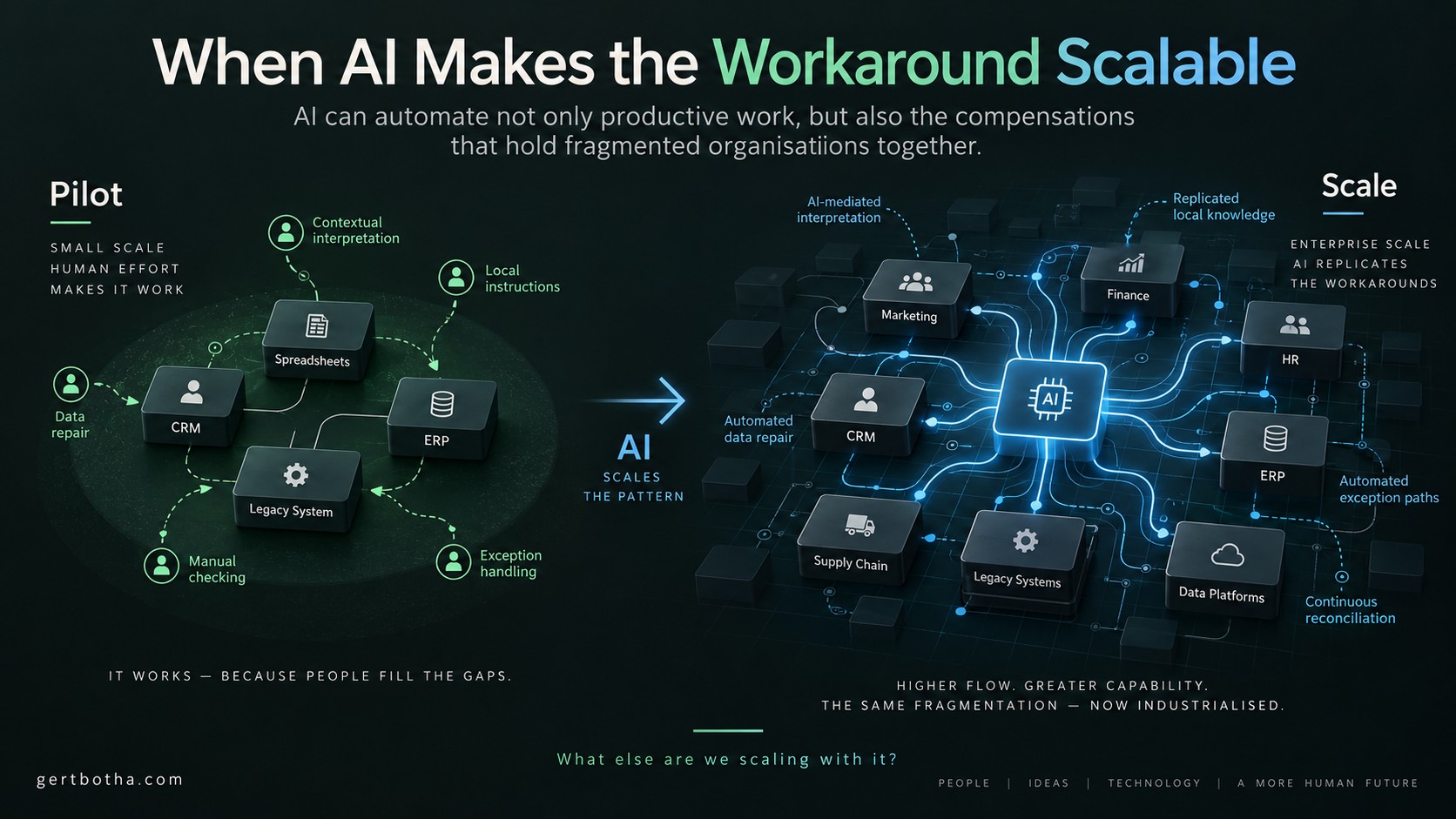 When AI Makes the Workaround Scalable
 The Age of Continuous Shocks: Why the coming downturn will be decided in your supply chain