
Jul12
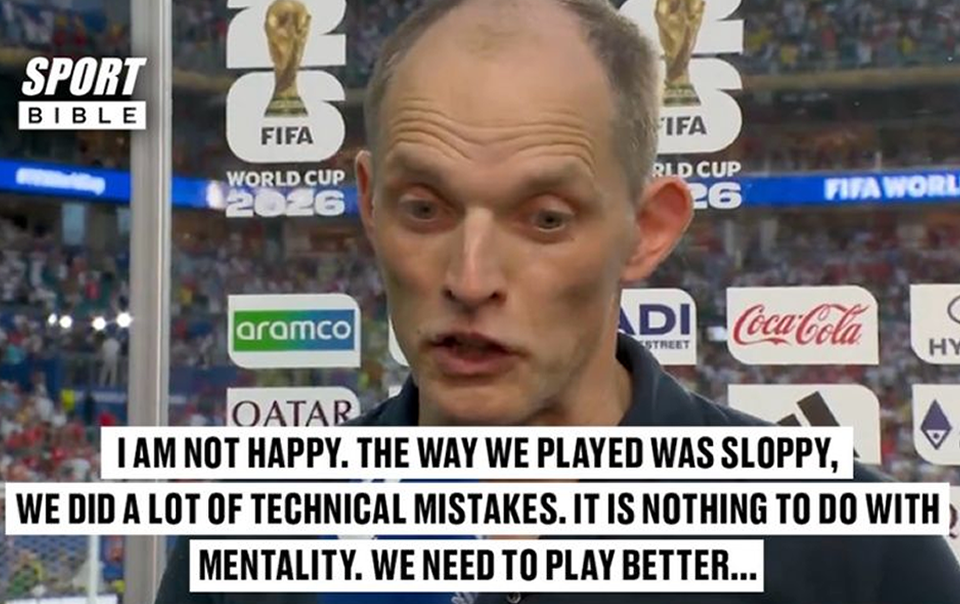
There was an interesting contrast in the television interviews after England's victory.
Thomas Tuchel spoke first. Despite the result, he appeared measured rather than triumphant, suggesting that England had fallen short of the standards he expected. Winning, it seemed, was not the same as performing well.
A few minutes later, one of England's players was invited to respond. Rather than explore the team's achievement or the challenge of the match itself, the interviewer reached immediately for potential conflict. The conversation became less about the football and more about whether the player agreed with his manager's assessment.
It made for engaging television (such is the clickbait/”gotcha” approach of many media outlets today), but it also revealed something rather familiar about the way we evaluate performance.
We are naturally drawn towards what is most visible.
Goals capture our attention. Saves become defining moments. A misplaced pass can dominate social media for hours, while dozens of intelligent decisions made without the ball disappear almost unnoticed.
By the time the final whistle blows, many of us have already assembled a story about who played well and who disappointed, often from a surprisingly small collection of memorable moments.
Psychologists have a name for this tendency. It is known as salience bias: the inclination to give disproportionate weight to information that is vivid, noticeable or emotionally striking while overlooking information that is quieter, less obvious or simply harder to observe.
Our attention is naturally drawn towards what stands out, and our judgement often follows.
From an evolutionary perspective, paying attention to what stands out is usually helpful. Sudden movement, loud noises and emotionally significant events deserved our attention because they often demanded an immediate response. The difficulty is that the same mental shortcut can cause us to overlook quieter, but equally important, information.
In football, salience bias can be remarkably persuasive.
For example, we expect a striker to score goals, so goals become the primary lens through which we assess their contribution. When they fail to score, it becomes tempting to conclude that they have had an ineffective afternoon, even though the ninety minutes contained hundreds of interactions that most spectators neither noticed nor remembered.
Whether Harry Kane had an outstanding game is not really the point. Some supporters will believe he did, others will disagree. What interests me far more is the assumption many of us make before the discussion has even begun. We already know what we intend to measure, and anything outside that expectation struggles to find its way into our assessment.
Perhaps he spent much of the match drawing defenders away from dangerous areas, creating space for teammates, linking play between midfield and attack or offering constant communication to younger players. Perhaps he did not. Unless we deliberately look for those contributions, we are unlikely to notice them at all.
Our judgement is shaped less by everything that happened than by the handful of moments that captured our attention.
The same pattern appears in organisations every day.
When annual performance reviews take place, who receives the greatest recognition? The salesperson who closes the largest deal is easy to identify. The project manager who delivers an important programme on time is similarly visible. Senior leaders naturally receive attention because their decisions are public and their successes are often presented as organisational successes.
Meanwhile, countless other contributions remain almost invisible.
The colleague who quietly prevented a disagreement from escalating between two departments. The experienced employee who spent six months helping a new starter build confidence without ever being asked. The individual who noticed a small operational risk before it became a costly problem. The team member whose calm presence consistently helps others make better decisions under pressure.
These behaviours rarely appear on dashboards. They are difficult to measure, almost impossible to celebrate publicly and frequently absent from formal performance metrics.
Yet remove enough of them and the organisation begins to feel noticeably different. Collaboration becomes harder, trust weakens and decisions slow because people no longer feel confident navigating uncertainty together.
Ironically, the behaviours that sustain high-performing teams are often the very behaviours our attention overlooks.
This is where another psychological tendency quietly joins the conversation.
Once we have formed an initial impression, confirmation bias encourages us to seek evidence that reinforces it. If we decide early in the match that a player is having a poor game, every misplaced pass confirms our opinion while intelligent movement away from the ball barely registers. We become remarkably efficient at collecting evidence that supports the conclusion we have already reached.
Salience bias determines what catches our attention. Confirmation bias determines what we continue to believe. Together, they create a remarkably persuasive picture of performance that often feels complete, despite being anything but.
Again, exactly the same process influences our workplaces.
We quickly decide who our high performers are, who demonstrates leadership and who simply does their job. After that, our observations are rarely neutral. We notice the behaviours that fit our existing picture while overlooking those that challenge it.
Over time, this creates a dangerous organisational myth: that success belongs primarily to those who are most visible.
Leadership suffers particularly from this way of thinking, as much of our language still reflects the image of the heroic leader standing at the centre of events, directing activity through vision, authority and decisive action. When an organisation succeeds, we instinctively ask which individual deserves the credit. When it struggles, we search for the person responsible.
It is an appealingly simple narrative. But, unfortunately, most complex systems do not work that way.
A football manager cannot dictate every movement once the whistle blows. A captain cannot issue instructions quickly enough to coordinate every run, every defensive adjustment or every passing sequence. Elite sport depends upon players making hundreds of independent decisions while sharing a common understanding of purpose, principles and expectations.
The quality of those decisions depends less on constant direction than on the environment created long before kick-off: shared expectations, repeated practice, mutual trust and a common understanding of what success looks like.
Once more, organisations are no different.
The most resilient teams rarely wait for permission before solving problems because they already understand the boundaries within which they can act. They share an understanding of what matters, how decisions should be made and what good judgement looks like. They trust one another sufficiently to adapt as circumstances change rather than pausing whenever uncertainty appears.
This is one of the central ideas behind Constellation Leadership.
Traditional leadership asks how one individual can influence many people. Constellation Leadership begins with a different question altogether. How do we create the conditions in which leadership can emerge from the group wherever the situation requires it?
The distinction matters because it shifts our attention away from personalities and towards systems.
A constellation is not defined by its brightest star. Its meaning emerges from the relationship between many stars connected into something larger than the individual points themselves. Remove the relationships between them and the constellation disappears, regardless of how brightly any single star continues to shine.
High-performing teams operate in much the same way. Shared purpose provides direction. Culture establishes expectations. Trust allows people to act without constant supervision. Psychological safety encourages challenge when challenge is needed. Clear decision boundaries reduce hesitation without removing accountability.
These elements rarely appear in highlight reels, yet they shape almost every meaningful outcome.
Perhaps that explains why Thomas Tuchel’s interview was so interesting.
He understood that victory and performance are not always the same thing. A favourable outcome can conceal weaknesses just as an unfavourable result can mask an excellent collective display. His attention appeared focused not on the moments that would dominate newspaper headlines, but on the hundreds of interactions that determine whether a team continues to improve.
That perspective is considerably harder to maintain inside organisations, where quarterly results, sales figures and individual achievements naturally command attention. Visible outcomes matter, of course, but they are often the product of countless invisible behaviours that began long before success became measurable.
The challenge for leaders is therefore not simply to recognise great performance when it is obvious. It is to become curious about the contributions that rarely announce themselves.
These questions are rarely asked because salience bias encourages us to look elsewhere. We naturally celebrate the goal rather than the movement that made the goal possible.
Perhaps that is understandable. Human beings have always been storytellers, and stories are easier to tell when they have obvious heroes.
The difficulty is that organisations, like football teams, are rarely transformed by heroes alone. They are transformed by cultures in which dozens of people make good decisions, support one another and contribute in ways that are neither glamorous nor immediately visible.
The next time your team succeeds, it may be worth looking beyond the obvious names.
Not because the visible contributors deserve less recognition, but because the invisible ones may have shaped the outcome far more than we realised.
We often ask who led the team. A better question might be who created the conditions that meant leadership no longer had to come from one person.
Perhaps the greatest compliment we can pay a leader is not that everyone followed them. It is that, when the moment demanded it, nobody needed to.
Edmondson, A. (1999). Psychological safety and learning behavior in work teams.
Kahneman, D. (2011). Thinking, fast and slow. Allen Lane.
Mohammed, S., Ferzandi, L., & Hamilton, K. (2010). Metaphor no more: A 15-year review of the team mental model construct.
Nickerson, R. S. (1998). Confirmation bias: A ubiquitous phenomenon in many guises. Review of General Psychology, 2(2), 175–220.
Schein, E. H., & Schein, P. (2021). Organizational culture and leadership (5th ed.).
Taylor, S. E., & Fiske, S. T. (1978). Salience, attention, and attribution: Top of the head phenomena. Advances in Experimental Social Psychology, 11, 249–288.
Tversky, A., & Kahneman, D. (1974). Judgment under uncertainty: Heuristics and biases. Science, 185(4157), 1124–1131.
Keywords: Culture, Leadership
 Consumer vs. enterprise AI agents
 Best Supply Chain AI Tools in 2026: SCM SENSEI AI and Ask Lora Compared
 Making Silos Permeable
 The Corix Partners Friday Reading List - October 2, 2026
 The most dangerous debt in a smart factory isn’t financial.