Jul10
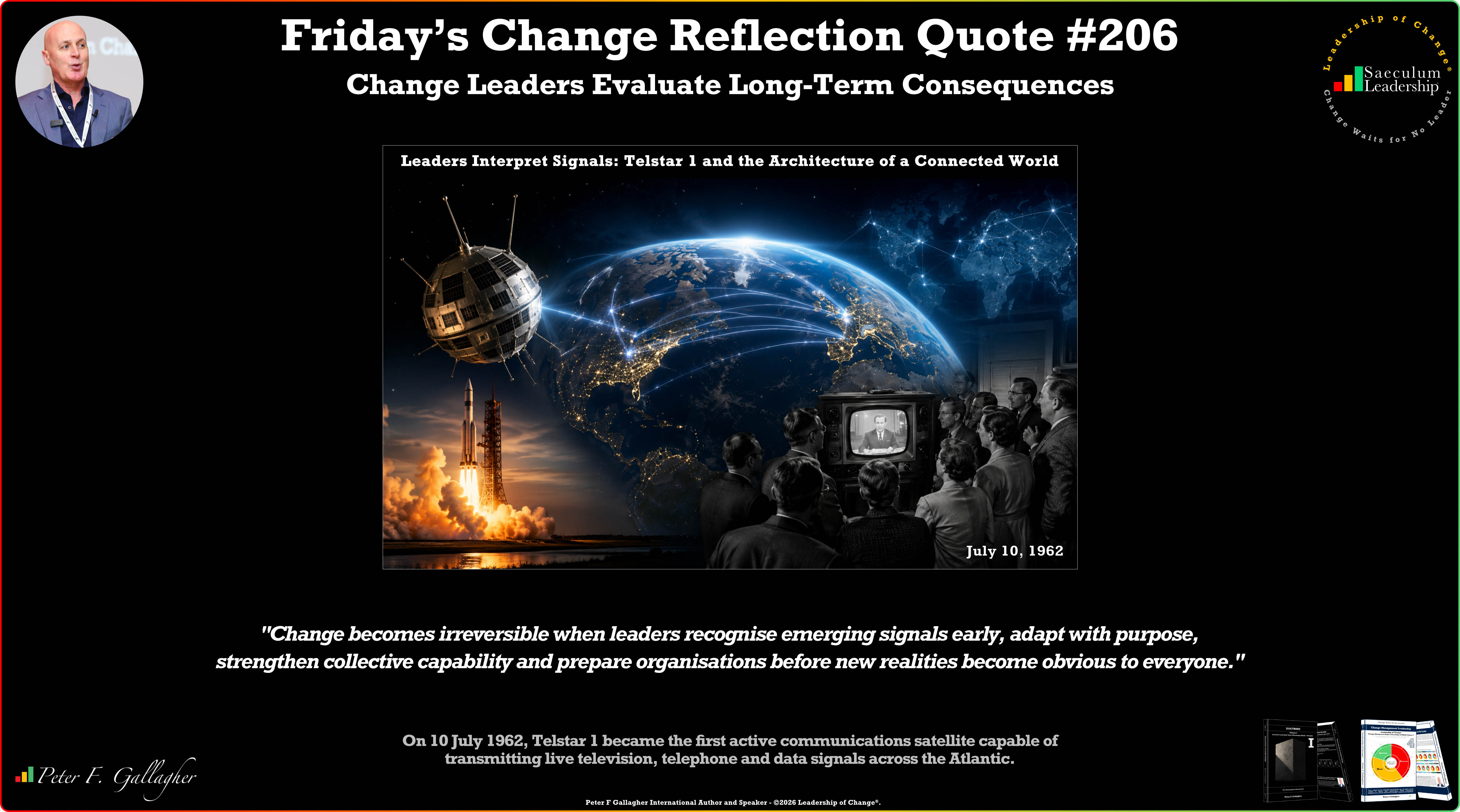
On 10 July 1962, Telstar 1 became the first active communications satellite capable of transmitting live television, telephone and data signals across the Atlantic. The achievement demonstrated that global communications could move beyond geographical limitations and established the technical foundation for the permanently connected world that organisations now depend upon.
One of the most enduring leadership lessons is that transformational change usually begins long before organisations acknowledge its significance. The first signal transmitted by Telstar did not immediately transform every institution, yet it permanently altered what was technically possible. Effective leaders recognise that capability often changes before behaviour, governance and organisational structures respond.
Another lesson is that transformational breakthroughs rarely emerge from isolated effort. Telstar succeeded because governments, scientists, engineers and commercial organisations aligned their capability around a shared strategic objective. Structural change accelerates when leadership across institutions recognises the same Signal and mobilises coordinated action rather than pursuing disconnected initiatives. Sustainable transformation therefore depends on collective readiness and disciplined alignment across organisational boundaries, not independent activity undertaken in isolation.
The event also demonstrates that leaders should avoid judging significance solely by immediate operational outcomes. Telstar operated for a relatively short period before radiation affected its electronics, yet its influence reshaped communications for generations. Leadership should therefore evaluate enduring strategic consequences rather than judging success solely through immediate operational performance.
The history of Telstar further illustrates that technological innovation creates new responsibilities rather than simply new opportunities. Once information could travel across continents almost instantly, expectations around decision making, collaboration, responsiveness and competitive advantage inevitably evolved. leaders therefore become responsible for adapting governance, capability and organisational thinking to match changing external realities.
Perhaps the most significant lesson concerns anticipation. Organisations often respond after disruption becomes visible, while stronger leadership recognises emerging patterns before they become operational crises. The ability to interpret weak signals enables institutions to prepare earlier, reduce unnecessary resistance and position themselves ahead of structural change rather than reacting after competitors have already adapted.
Telstar reminds leaders that history is often shaped by moments appearing technically impressive but strategically underestimated. Civilisation changed not because technology became fashionable, but because a new capability permanently altered how knowledge moved throughout society. The most effective leaders continually examine emerging developments, challenge existing assumptionsand prepare their organisations for realities that others have not yet recognised. This was far more than a satellite launch. It marked the beginning of a Saeculum Leadership Signal and a new Knowledge Architecture in which information became a strategic asset. Leadership had entered a permanently connected world.
Change Leadership Lessons: These historical lessons remain directly relevant because every generation of leaders must decide whether they will recognise emerging strategic capability before its consequences reshape their organisations. Leaders of change recognise emerging capability before others understand its strategic significance. They build collaboration because enduring transformation depends upon aligned institutions. Change leaders evaluate long-term consequences instead of focusing solely on immediate operational results. They continually adapt governance as technology reshapes organisational responsibility. Leaders of change interpret weak signals early to prepare organisations before disruption becomes visible. Change Leaders Evaluate Long-Term Consequences.
“Change becomes irreversible when leaders recognise emerging signals early, adapt with purpose, strengthen collective capability and prepare organisations before new realities become obvious to everyone.”
Application - Change Leadership Responsibility 1: Articulate the Change Vision. Enduring organisational transformation rarely begins when everyone agrees that change is necessary. It begins when leaders recognise an emerging reality and its consequences before either becomes widely accepted and clearly explain why existing assumptions can no longer sustain future success. The responsibility is not simply to communicate ambition, but to interpret significant signals and translate them into a compelling direction that others can understand, trust and ultimately support. Telstar 1 demonstrated that the world had entered a fundamentally different era, where information could move across continents almost instantaneously. Although many institutions viewed the achievement as a remarkable technical milestone, its deeper significance lay in the permanent shift it created in how knowledge, commerce, communication and leadership would evolve. Effective leaders recognise these moments before their consequences become obvious. They connect emerging evidence with long-term organisational purpose, explaining not only what is changing, but why adaptation cannot be postponed. A credible change vision therefore links observable external developments with the strategic capability required to thrive in the future. When leaders articulate this relationship with clarity and discipline, uncertainty becomes an opportunity for disciplined adaptationfor informed action rather than a justification for hesitation. People commit more confidently when they understand both the forces reshaping their environment and the practical pathway that enables the organisation to respond with purpose, resilience and long-term confidence.
Final Thoughts: Telstar 1 reminds us that every Saeculum is shaped by defining Signals that quietly reshape the architecture of civilisation, where a single breakthrough changes how knowledge moves, institutions evolve and leadership responsibilities expand long before most organisations recognise that a structural turning point has already begun. Artificial Intelligence is accelerating the same pattern on an unprecedented scale, compressing the time between technological breakthrough and organisational consequence, making it increasingly essential for leaders to distinguish enduring strategic Signals from temporary innovation if they are to prepare rather than simply react. The responsibility of change leaders is to interpret emerging Signals before they become obvious, articulate a compelling vision that explains why adaptation is necessary, and mobilise disciplined action that positions their organisations to succeed within the new reality instead of defending one that is steadily disappearing.
Peter F. Gallagher, a 20‑book author, consults, speaks, and writes on Saeculum Leadership® and Leadership of Change®. He works exclusively with boards, CEOs, and senior leadership teams to prepare and align them to effectively and proactively lead their organisations through transformation in a rapidly evolving epoch.
For insights on navigating organisational change, feel free to reach out at Peter.gallagher@a2B.consulting.
Further Reading: Change Management Leadership® - Leadership of Change® Volume 4 and Saeculum Leadership®: Doctrine – Volume I.
Peter F. Gallagher, a 20‑book author, consults, speaks, and writes on Saeculum Leadership® and Leadership of Change®. He works exclusively with boards, CEOs, and senior leadership teams to prepare and align them to effectively and proactively lead their organisations through transformation in a rapidly evolving epoch.
For further insights please visit our websites: https://www.a2b.consulting https://www.peterfgallagher.com Amazon.com: Peter F Gallagher: Books, Biography, Blog, Audiobooks, Kindle
Saeculum Leadership® Body of Knowledge (SLBoK): Volumes 1-10.A-E & I-V
~ Leadership of Change® Volume 1 - Change Management Fables
~ Leadership of Change® Volume 2 - Change Management Pocket Guide
~ Leadership of Change® Volume 3 - Change Management Handbook
~ Leadership of Change® Volume 4 - Change Management Leadership
~ Leadership of Change® Volume 5 - Change Management Adoption
~ Leadership of Change® Volume 6 - Change Management Behaviour
~ Leadership of Change® Volume 7 - Change Management Sponsorship
~ Leadership of Change® Volume 8 - Change Management Charade
~ Leadership of Change® Volume 9 - Change Management Insanity
~ Leadership of Change® Volume 10 - Change Management Dilenttante
~ Leadership of Change® Volume A - Change Management Gamification - Leadership
~ Leadership of Change® Volume B - Change Management Gamification - Adoption
Keywords: Business Strategy, Change Management, Leadership
 Two Clocks, One Truck: The Army's Need for Speed Meets New Defense Sourcing Rules
 Sustainable Transformation: The Elephant and The Mouse In The Room
 The Price of Standing Alone: Strategic Autonomy in a World Where Nobody Can Do It Alone
 The Potter’s Hands: Why Great Leaders Shape Environments, Not People
 The Corix Partners Friday Reading List - October 16, 2026