Jul30

Why agentic AI is the final exam for every process you never bothered to fix
Organisations everywhere are racing to deploy AI. The pitch decks are beautiful. The business cases look solid. The enthusiasm is real. The strategy houses make slide decks like crazy. Yet… Somewhere between the boardroom presentation and actual production, something breaks.
Spoiler: it was already broken before AI arrived.
The fundamental problem is not AI. The fundamental problem is that people assume AI is a cure. It is not. AI is an amplifier. When you amplify broken, you get broken faster. You get broken at scale. You get broken automatically, around the clock, without anyone pressing a button. And it will cost you a crazy amount of money.
REPEAT: AI does not fix broken processes. AI executes them at speed.
There is a persistent myth in enterprise transformation. The myth says: once we automate this, things will get better. Efficiency will rise. Errors will drop. People will be freed up for higher value work. Well, dream on.
This myth survived mainframes, ERP rollouts, and RPA deployments. Now it survives AI. Each wave makes the same promise. Each wave exposes the same underlying problem. The process was never clean. The data was never structured. The definitions were never agreed upon. And internal politics are a killer on top of that.
AI is the latest in a long story of technological promises. It is also the hardest test so far, because agentic AI does not just execute a defined task. It reasons, it decides, it acts. Give it a broken starting point and it reasons its way into a very confident wrong answer. Give it ambiguous inputs and it makes a choice, any choice, and presents it as fact.
That is not an AI problem. That is your problem dressed up in a language model.
And here is the uncomfortable truth: most organisations are not ready. Not because the technology is immature. Because the organisation is immature. The processes, the governance, the shared understanding of what things actually mean inside the enterprise. That is where the gap sits. Process minded organizing is more then just having a process; it is living it.
Most organisations lose the plot here. They think about systems as technology stacks. A CRM, an ERP, a procurement platform, a contract management system. Those are tools. They are not systems in the meaningful sense.
A system, in the real sense, is a set of interacting elements working toward a purpose. Your organisation is a system. Your supply chain is a system. Your customer relationship is a system. Every one of those systems sits inside a larger ecosystem, with its own rules, pressures, and feedback loops.
Systemic thinking means you start by understanding how things actually connect before you change anything. Not how they are supposed to connect on paper. How they actually connect in practice. Who talks to whom. Where information actually flows. Where it gets stuck. Where decisions actually happen versus where the process map says they happen.
The difference between the map and the territory is where most transformation projects die. Teams design for the map. They deploy into the territory. They discover the gap too late, too expensively, with a consultant standing nearby saying it can be fixed in phase two.
Systemic thinking closes that gap before the project starts. It is not theoretical. It is operational discipline. Without it, you are building on sand.
Your organisation does not operate in isolation. It is part of supplier ecosystems. Regulatory ecosystems. Customer relationship ecosystems. Industry ecosystems. Every one of those external systems imposes requirements, constraints, and expectations on how your internal processes need to work.
When you design your processes, and then your technology stack on top of those processes, you need to design with the ecosystem in mind. Not just your internal needs. The entire connected web of obligations and interactions.
This matters enormously for AI. An agentic AI making procurement decisions without understanding supplier relationship constraints is a liability. An AI managing contracts without knowing the regulatory context is a compliance risk. An AI supporting customer interactions without awareness of the full relationship history is, frankly, an embarrassment.
External systems are not just constraints. They are information sources. They define what good looks like. They define what legal looks like. They define what the customer actually expects. Your AI needs to be designed with those definitions in mind from day one, not as an afterthought in the final sprint.
The ecosystem is not background noise. The ecosystem is the context in which your AI either adds value or causes damage.
Here is the part that kills more AI projects than any technology failure ever does. Organisations do not speak a common language.
The word "value" means seventeen different things across seventeen different departments. Finance calculates value. Procurement negotiates value. Sales promises value. Operations delivers value. Legal protects value. None of them is wrong. None of them is the same.
Risk is even worse. Risk is a container word. People throw everything into it. Financial risk, reputational risk, delivery risk, compliance risk, relationship risk. When someone says "we need to manage risk", what do they actually mean? Reduce probability of loss? Protect contractual position? Ensure regulatory compliance? All of the above?
Now imagine feeding that ambiguity into an AI model. The model processes the word "risk" based on patterns in its training data. But your "risk" is enterprise-specific. Your "risk" sits inside your specific industry context, your specific contractual framework, your specific organisational culture.
Without a uniform language model, meaning a shared, agreed, documented definition of every key term in your enterprise context, AI does not know what it is actually talking about. And neither do you, although you have been pretending otherwise for years.
This is not a technology problem. This is a governance problem. It requires humans to sit in a room and agree on what things mean. It requires that agreement to be written down, maintained, updated, and used. Every team. Every process. Every AI deployment.
That work is unglamorous. That work is absolutely essential.
Every process has implicit rules. Someone decides. Someone approves. Someone escalates. Someone is accountable when things go wrong. These rules of engagement exist in every organisation. The question is whether they are explicit or whether they live only in the heads of experienced people.
When those rules live only in heads, they die when people leave. They vary when different people apply them. They create inconsistency, dispute, and friction. That is a serious problem in any process. It is a catastrophic problem in an AI-driven process.
Agentic AI needs clear rules of engagement. Not vague guidelines. Not general principles. Clear, documented, tested rules that define what the AI does, what the AI does not do, when it escalates, who it escalates to, and what happens when an edge case appears.
If your rules of engagement are unclear for humans, they are unworkable for AI. Full stop.
Writing those rules forces a conversation that most organisations have never had. It forces agreement on authority. On accountability. On what good looks like. That conversation is uncomfortable. It is also the conversation that separates AI that works from AI that causes expensive problems at impressive speed.
This is the part that frustrates every vendor in the room. It is still the truth.
Technology is a tool. Tools serve purposes. Purposes exist inside processes. Processes exist inside systems. Systems exist inside ecosystems. That is the sequence. The only logical sequence.
What happens in practice? A vendor demonstrates an impressive platform. The demo looks clean. The use case looks familiar. Leadership gets excited. The purchase happens. Then the implementation team arrives and discovers that the process the tool was designed for does not resemble the process the organisation actually runs.
Now a choice appears. Change the process to fit the tool. Or configure the tool to match the process. Most organisations choose the first because it is faster. They call it standardisation. It is not standardisation. It is cutting corners while calling them corners.
The right sequence: understand your systems first. Document your processes. Define your language. Specify your rules. Then select and configure technology that fits that foundation. This takes longer upfront. It saves enormous time and money downstream. It is the only foundation on which agentic AI actually delivers what the business case promised.
Here is the punchline. It is not funny, even with a smile.
Your business case for agentic AI looks fantastic. The ROI calculation is impressive. The efficiency gains are real on paper. The competitive argument is sound. The board approves. The budget is allocated. The project starts.
Then the rubber meets the road.
The AI encounters a process that nobody documented properly. It hits a term nobody defined consistently. It faces a decision nobody specified. It acts on data that means three different things in three different systems. It escalates to a workflow that exists in a diagram but not in reality.
The output is wrong. Or inconsistent. Or legally exposed. Or embarrassingly poor quality at a speed that is genuinely impressive.
The problem is not the AI. The problem was always the foundation.
No systemic thinking means no coherent process. No coherent process means no clean inputs. No clean inputs means no reliable AI. No reliable AI means your business case is worthless the moment it is tested in real conditions. That is not a future risk. That is the current reality of most enterprise AI projects today.
The projects that succeed share one characteristic: someone did the hard foundational work first. Someone mapped the systems. Someone agreed on the language. Someone documented the rules. Someone ensured the technology served the process, not the other way around.
The organisations that skip that work are not deploying AI. They are deploying expensive confusion at scale.
Fix the foundation. Define the language. Document the rules. Deploy the AI.
In that order. Every time.
Arjen van Berkum
Keywords: Agentic AI, Digital Transformation, Economics
 Best Supply Chain AI Tools in 2026: SCM SENSEI AI and Ask Lora Compared
 Making Silos Permeable
 The Corix Partners Friday Reading List - October 2, 2026
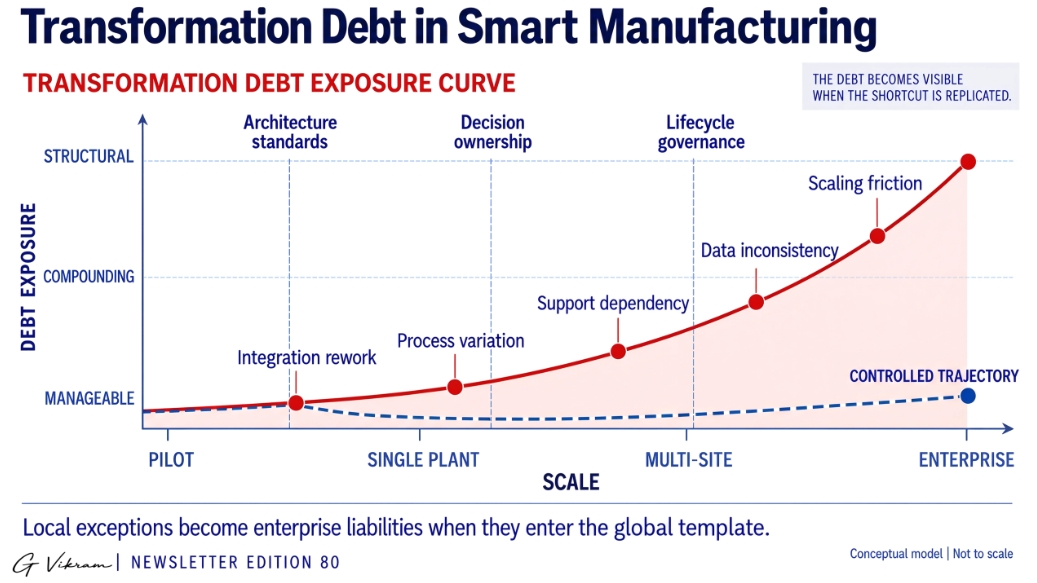 The most dangerous debt in a smart factory isn’t financial.
 Why mission changes everything, leadership lessons from two boardrooms