Jul29

One of the most common mistakes organizations make in leadership development is trying to protect their future leaders from failure.
It is understandable. High-potential employees are valuable. They are dependable, deliver results, and are often viewed as the organization's future. Naturally, leaders want to set them up for success.
But there is a difference between supporting someone and thwarting their growth.
A recent McKinsey & Company report recommends that organizations place high-potential managers into tough situations, intentionally stretching them beyond their comfort zones while providing strong mentorship and ongoing coaching. That advice aligns with what many organizations discover the hard way: leadership readiness cannot be developed in a classroom alone.
Future leaders need experience.
Too often, companies do the opposite.
They carefully select development assignments that almost guarantee success. They assign projects with familiar teams, manageable risks, and “support” that steps in when problems arise.
The result?
Competent managers who have never truly been tested.
Leading during stable conditions is relatively easy. Leading through uncertainty is something entirely different. Executive leaders routinely face incomplete information, competing priorities, difficult personalities, customer crises, financial pressure, and decisions where every option carries risk.
Those muscles are not built by watching someone else make decisions.
They are built by making decisions yourself.
This does not mean throwing emerging leaders into impossible situations without support. That is not development—it is poor leadership on your part.
Instead, think of leadership development the same way elite athletic coaches think about training. Great coaches increase the level of difficulty over time. They introduce stronger competition, more complex situations, and higher expectations. They allow mistakes because mistakes reveal what still needs to be learned.
At the same time, they coach continuously.
Business leaders should take the same approach.
Assign your future leaders to cross-functional projects where they must influence people who do not report to them. Put them in charge of recovering an unhappy customer relationship. Ask them to lead an initiative with limited resources or an aggressive deadline. Have them present difficult recommendations to the executive team. Rotate them into unfamiliar parts of the business where they must quickly learn new operations and build credibility.
Then resist the temptation to rescue them at the first sign of discomfort or going off track.
Those are the conditions where the greatest learning occurs.
Your role as a senior leader is not to solve every problem for them. It is to ask questions that sharpen their thinking. Help them evaluate options. Share your own experiences. Provide context they cannot yet see. Be available when they need guidance.
But let them own the outcome.
Ask yourself this: If you were to be absent for 2 weeks – which of your future executives would confidently hold down the fort ( even though they might make mistakes) and which would be calling you daily for you to make decisions or to give them permission?
That answer reveals far more about your succession planning than any competency assessment ever will.
Future executives are not developed by observing leadership from the sidelines. They become ready by wrestling with ambiguity, making difficult decisions, recovering from mistakes, and growing through challenges that initially feel bigger than they are.
If your rising leaders are always comfortable, they probably are not growing.
And if they are not growing, your succession plan may look much stronger on paper than it does in reality.
Keywords: Entrepreneurship, HR, Leadership
 Best Supply Chain AI Tools in 2026: SCM SENSEI AI and Ask Lora Compared
 Making Silos Permeable
 The Corix Partners Friday Reading List - October 2, 2026
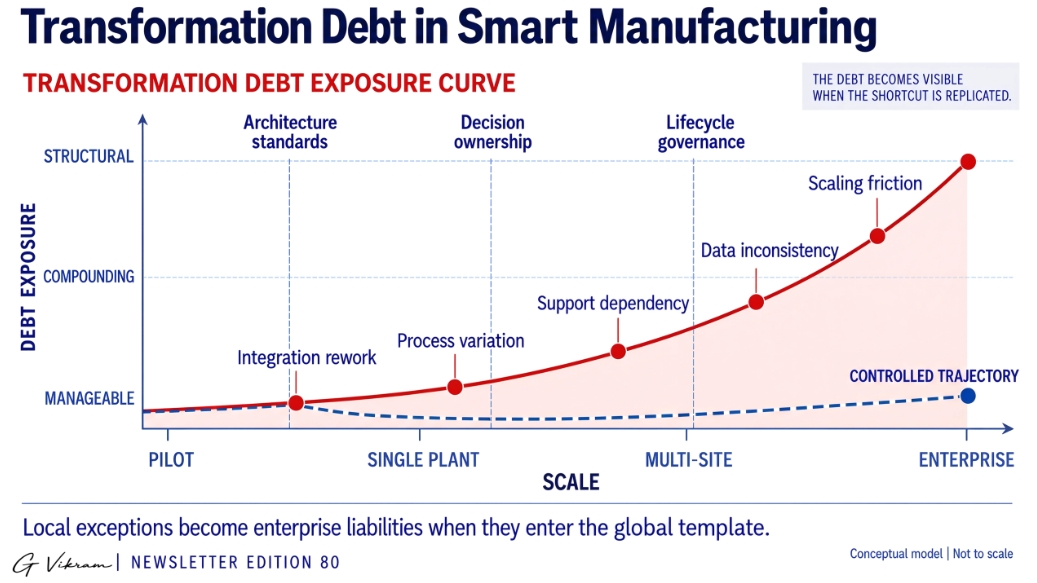 The most dangerous debt in a smart factory isn’t financial.
 Why mission changes everything, leadership lessons from two boardrooms