Dec11

The rapid ascension of Artificial Intelligence, from nascent deep learning models to today's gargantuan generative AI systems, has been wholly dependent on a parallel revolution in hardware. General-purpose Central Processing Units (CPUs), designed for sequential tasks, quickly became bottlenecks for the massive, highly parallel computations inherent in neural networks. This necessity has forged a new silicon frontier, resulting in a diverse and highly specialized landscape of AI accelerators—chips purpose-built to execute AI workloads with unprecedented speed, efficiency, and scale.
The competitive landscape is best understood through the architectural core and primary role of each chip type:
|
Chip Category |
Specific Chip Example |
Primary AI Role(s) |
Architectural Core |
Key Optimization/Feature |
| GPU |
NVIDIA H100, AMD Instinct |
Model Training & High-Performance Inference |
Thousands of Parallel Streaming Multiprocessors (SMs) / Compute Units |
High Memory Bandwidth (HBM), General Purpose Parallelism (CUDA/ROCm) |
|
ASIC (Cloud - Training) |
AWS Trainium |
Model Training |
Proprietary NeuronCores with massive on-chip SRAM |
Cost-effective Training at Scale, Distributed Architecture (NeuronLink) |
|
ASIC (Cloud - General) |
Google TPU |
Model Training & Inference |
Systolic Array of Matrix Multipliers (MAC units) |
Unmatched Performance-per-Watt for Tensor-based operations (TensorFlow/JAX) |
|
ASIC (Cloud - Inference) |
AWS Inferentia |
Model Inference |
Proprietary NeuronCores optimized for low latency |
Lowest cost per inference, high throughput, minimized data movement. |
|
ASIC (Edge/Mobile NPU) |
Apple Neural Engine |
Model Inference |
Specialized Inference Accelerators (Varies by generation) |
Extreme Power Efficiency, On-device processing for privacy and low latency. |
|
FPGA |
Intel Stratix, AMD Versal |
Real-time Inference & Signal Processing |
Reconfigurable Logic Blocks (LUTs) and Dedicated Multipliers |
Hardware Reconfigurability, Deterministic Latency, Customizable Data Paths. |
The fundamental differences in AI hardware stem from their core architectural designs, which determine their suitability for either the energy-intensive training phase or the low-latency inference phase.
GPUs, exemplified by the NVIDIA H100, dominate large-scale AI training due to their fundamental design philosophy: massive parallelism. Unlike CPUs, which have a few powerful cores optimized for sequential instruction processing, GPUs have thousands of smaller, more efficient Streaming Multiprocessors (SMs).
ASICs represent the ultimate commitment to performance and efficiency for a fixed task, often achieving better performance per watt than GPUs.
The Systolic Array architecturally defines the TPU. This is a grid of interconnected Multiply-Accumulate (MAC) units where data (tensors) flows rhythmically, allowing hundreds of thousands of operations to co-occur while minimizing data movement and power consumption.
The ANE is a prime example of an NPU (Neural Processing Unit) for the edge. It is highly optimized for executing inference with minimal power draw, keeping AI processing on-device to enhance privacy and provide ultra-low latency.
FPGAs offer the unique ability to reconfigure their hardware logic after manufacturing via an array of Configurable Logic Blocks (CLBs). This allows FPGAs to achieve deterministic, ultra-low latency for real-time applications and provides a balance between the efficiency of an ASIC and the flexibility of a GPU.
While specialized chips drive efficiency gains per calculation, the overall environmental footprint of the hardware ecosystem is rapidly expanding. This ecological cost spans the entire lifecycle of the chip.
The most significant impact is the embodied carbon and pollution generated before use. Fabrication is extremely resource-intensive, requiring massive amounts of rare earth elements and water, and is energy-intensive, releasing highly potent greenhouse gases.
The immense performance of AI accelerators places massive operational demands on data centers.
The speed of the AI hardware arms race creates a severe e-waste problem. The competitive landscape pushes companies to replace high-performance components every few years, generating enormous volumes of electronic waste containing toxic substances like lead and mercury.
The key negative feedback loop in the AI industry: the relentless pursuit of performance directly drives a massive environmental problem.
To mitigate this environmental crisis, the industry is actively investing in next-generation thermal management and circularity models.
The adoption of sustainable solutions offers significant financial advantages, making green initiatives a strategic business imperative.
The circular economy model provides financial security:
The evolution of the AI chip is more than a story of technical progress; it is a critical narrative of specialization driven by immense computational demand. The future of intelligence is being sculpted in silicon, dictated by the efficiency of the Systolic Array, the throughput of the NeuronCore, and the high bandwidth of HBM memory.
Yet, this power comes with a profound price: the exponential ecological impact of embodied carbon, water consumption, and the rising tide of e-waste. This realization has forced the industry into a necessary, rapid convergence in which peak performance and sustainability are no longer mutually exclusive but mutually dependent.
The transition to efficient Direct-to-Chip and Immersion Cooling systems, coupled with ambitious Circular Economy programs for component reuse, is not merely an act of environmental stewardship. It is a strategic economic imperative. These initiatives yield direct financial benefits, secure supply chains, reduce operational costs, and meet the mandatory ESG requirements of global investors.
Ultimately, the choice of AI hardware has transcended engineering specifications. It is now a defining ethical and economic decision that determines not only the speed of the next generative model but the resilience of the planet's resources. The final frontier of AI is not conquering complexity, but mastering sustainability, ensuring that the relentless pursuit of intelligent machines does not come at the expense of a viable future.
Keywords: Generative AI, Agentic AI, AGI
 “I didn’t write an award acceptance speech because I didn’t expect to win.”
 AI Is Exposing the Data Problems Humans Used to Hide
 "The AI may in fact be conscious." Really?
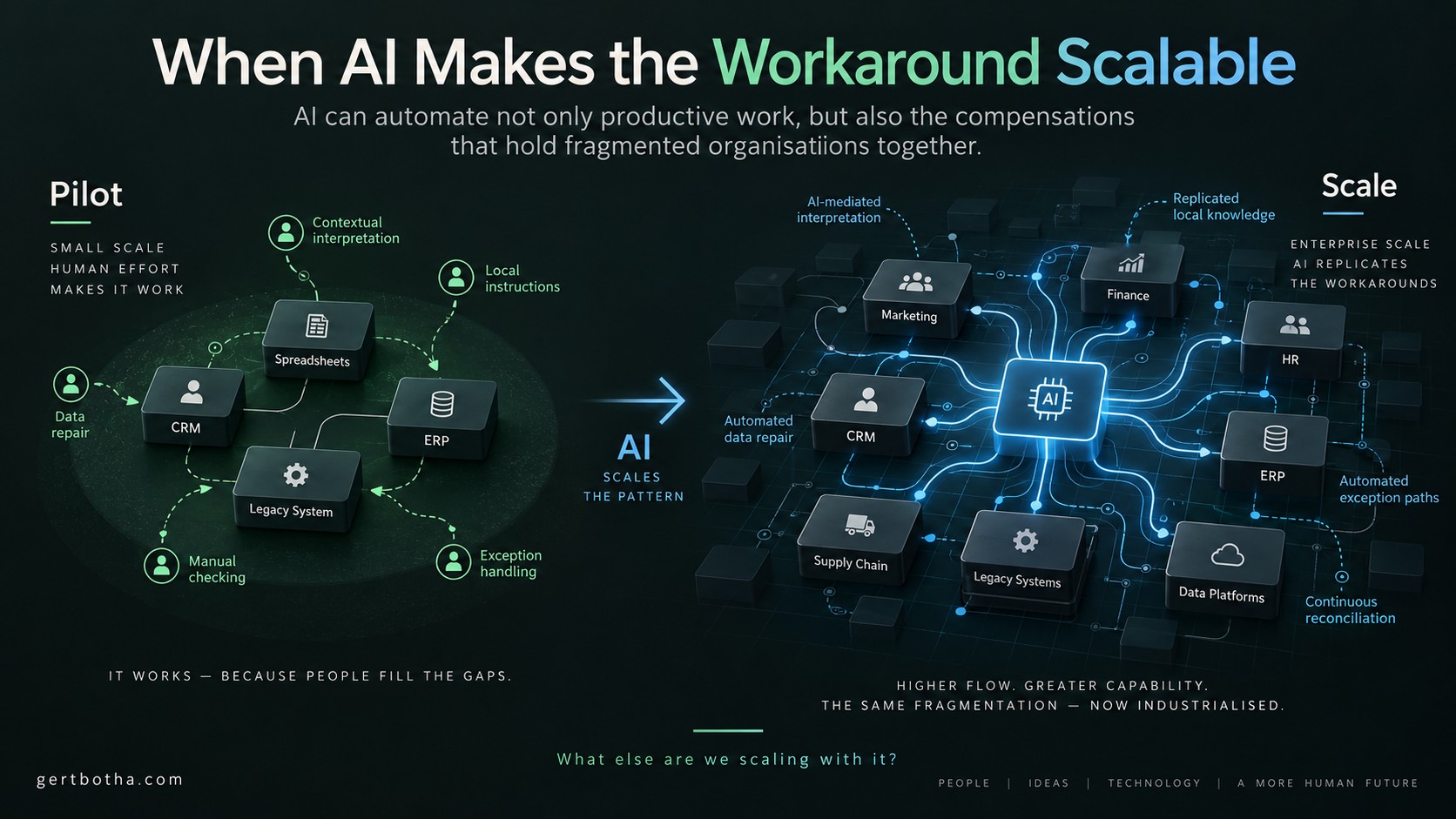 When AI Makes the Workaround Scalable
 The Age of Continuous Shocks: Why the coming downturn will be decided in your supply chain