Nov18

The Dawn of Causal AGI: From Symbolic Dreams to Provable Stability
The quest for truly intelligent machines has been the central, enduring challenge of Artificial Intelligence since the field's inception. While early attempts were rooted in symbolic logic, they ultimately gave way to the immense pattern-matching capabilities of modern deep learning. Yet, the fundamental goal—creating agents with a stable, coherent internal world model capable of explaining why things happen, not just what happens—has remained elusive, severely limiting deployment in safety-critical domains such as autonomous flight and clinical medicine.
Today, we stand at a critical juncture. The focus has decisively shifted from mere predictive capability toward building controlled, verifiable autonomy. The challenge is historical: how to reliably transition from interpreting noisy, real-world data to executing ethical, cost-aware action sequences. This is the era of Integrative AGI. By moving beyond monolithic black-box prediction, a new architectural blueprint emerges, anchored by the foundational breakthrough of the LeJEPA framework. LeJEPA transforms the problem of building robust world models from a reliance on unreliable "engineering hacks" and heuristics to principled, mathematically proven optimization.
The Foundational Breakthrough: LeJEPA and Guaranteed Stability
The Lean Joint-Embedding Predictive Architecture (LeJEPA) is the theoretical core that injects mathematical certainty into the perception and world modelling phases of both the Clinical AGI and Causal Flight Planning systems. Its creation was motivated by the need to solve the instability inherent in prior self-supervised learning (SSL) methods.
The LeJEPA framework is the brainchild of renowned AI scientists Yann LeCun (Turing Award winner) and Randall Balestriero. Their work is formalized in the paper, "LeJEPA: Provable and Scalable Self-Supervised Learning Without the Heuristics." Their primary motivation was to solve the inherent instability and empirical reliance of prior Joint-Embedding Predictive Architectures (JEPAs).
Traditional JEPAs struggled with representational collapse—the failure mode where the model encodes all inputs to the same trivial vector. To prevent this, prior systems relied on a delicate "cocktail of heuristics," such as stop gradients or negative sampling. LeJEPA replaces this brittle empirical reliance with a rigorous theoretical foundation, mathematically proving that the unique, optimal distribution for learned latent embeddings to minimize downstream prediction risk is the Isotropic Gaussian distribution (N(0, I)).
This insight led to the creation of SIGReg (Sketched Isotropic Gaussian Regularization). By integrating SIGReg as a loss term, the model is explicitly penalized if its latent codes deviate from the optimal zero-mean, unit-variance distribution. This guarantees the stability and quality of the feature representations, whether they are:
By starting the reasoning chain with facts and latent states derived from such a theoretically sound feature extractor, the system dramatically reduces the possibility of a perceptual error contaminating the entire diagnostic or planning workflow.
The Integrative Architecture: Decoupling and Delegation
The general architectural blueprint features a modular pipeline that intentionally decouples perception, high-level reasoning, and safety enforcement.
|
Module |
Flight Planning Application (DeepSeek) |
Clinical AGI Application (Qwen3-VL) |
|
Perception/Grounding |
V-JEPA/CLIP and the Latent Dynamics Predictor stabilize the Causal World Model using LeJEPA on ADS-B telemetry data. |
ImageAnalysisAgent uses a LeJEPA-based function to convert raw CT images into objective, verifiable Grounded Perception Facts. |
|
High-Level Reasoning |
DeepSeek LLM interprets classified visual input (e.g., 'airplane landing') and provides a symbolic, operational assessment. |
Qwen3-VL serves as the core reasoning engine, generating an initial radiological analysis and complex therapeutic plans. |
|
World Model/Prediction |
Predictive Latent Dynamics Model (PLDM), stabilized by LeJEPA, simulates future flight states ($\mathbf{\hat{z}}_{t+1}$) based on current state and candidate actions. |
Relies on the inherent stability of the LeJEPA features to minimize the risk of hallucination during LLM-based diagnosis. |
The Role of Open-Source LLMs: DeepSeek and Qwen3-VL
The architectures demonstrate a strategic deployment of open-source Large Language Models (LLMs) to handle the complex symbolic reasoning required for AGI. The integration of DeepSeek and Qwen3-VL is crucial for transforming stable perceptual data into human-interpretable knowledge and actionable plans.
In the Flight Planning scenario, DeepSeek acts as the high-level Reasoning Module. It receives the classification result from the perception layer (e.g., 'airplane landing') and translates it into a concise, contextual operational assessment ("Active landing confirms runway occupancy..."). This mirrors the human cognitive process of instantly contextualizing visual data into actionable symbolic knowledge.
In the Clinical AGI scenario, the multimodal model Qwen3-VL serves as the core Reasoning Engine. It is responsible for generating comprehensive analyses and proposed therapeutic plans based on the LeJEPA-derived Grounded Perception Facts. Because Qwen3-VL operates within an iterative, multi-agent framework, its outputs are immediately subjected to rigorous, rule-based clinical validation. This design highlights a new model for deploying powerful LLMs: not as monolithic black boxes, but as competent reasoning components whose output is actively constrained and corrected by specialized agents to ensure clinical safety and completeness. The reliance on these open-source models underscores a commitment to accessible and verifiable research on AGI.
Controlled Autonomy: The Role of Constraint
The true essence of AGI-level robustness lies not just in power, but in controlled autonomy. Both systems utilize an explicit constraint mechanism to enforce safety and reliability, transforming opaque reasoning into traceable, self-correcting workflows.
1. Causal Flight Planning: Multi-Objective Cost
The aviation agent uses the LeJEPA-stabilized PLDM as a simulation engine for Model Predictive Path Planning (MPPI). The stability of the PLDM's 16D latent space—guaranteed by the LeJEPA training objective—is essential, as it ensures that the forward simulations used for planning are reliable and non-divergent.
The MPPI loop operates by:
2. Clinical AGI: Iterative Safety Enforcement
The medical system employs a multi-agent structure to enforce strict clinical criteria through a continuous feedback loop, which is anchored by LeJEPA's stable output at the outset:
This iterative refinement loop serves as a vital safety mechanism, ensuring that omissions that could lead to patient harm are rapidly converted into actionable, targeted instructions, thereby achieving rapid convergence on a clinically sound, complete, and safe diagnosis.
Conclusion: The New Paradigm
The successful convergence of these two architectures represents a profound shift in the pursuit of AGI. It confirms that the path to reliable AI in critical fields is not merely through training larger, more powerful foundation models, but through architectural constraint and theoretical grounding.
By decoupling perception, reasoning, and validation, and by anchoring stability in the mathematical certainty of LeJEPA, the integrative architecture offers a compelling solution to the perennial problems of hallucination and incomplete output. This framework establishes a new paradigm for controlled AGI. As these systems are deployed, they will not replace the human expert; instead, they will serve as indispensable, safety-grounded co-pilots. This paradigm shift ensures that the complexity of AGI is harnessed not for pure speed or spectacle, but for unwavering reliability and ethical compliance, ushering in an era where artificial intelligence can finally meet the high-stakes demands of autonomous decision-making and fundamentally enhance human capabilities across the global economy. The future of AGI is therefore defined by this fusion: mathematical stability empowering profound, constrained intelligence.
Reference:
The Hybrid AGI Blueprint: A Modular Pathway to General Intelligence in Safety-Critical Domains: https://www.thinkers360.com/tl/blog/members/the-hybrid-agi-blueprint-a-modular-pathway-to-general-intelligence-in-safety-critical-domains
Keywords: Predictive Analytics, Generative AI, Agentic AI
 AI Is Exposing the Data Problems Humans Used to Hide
 "The AI may in fact be conscious." Really?
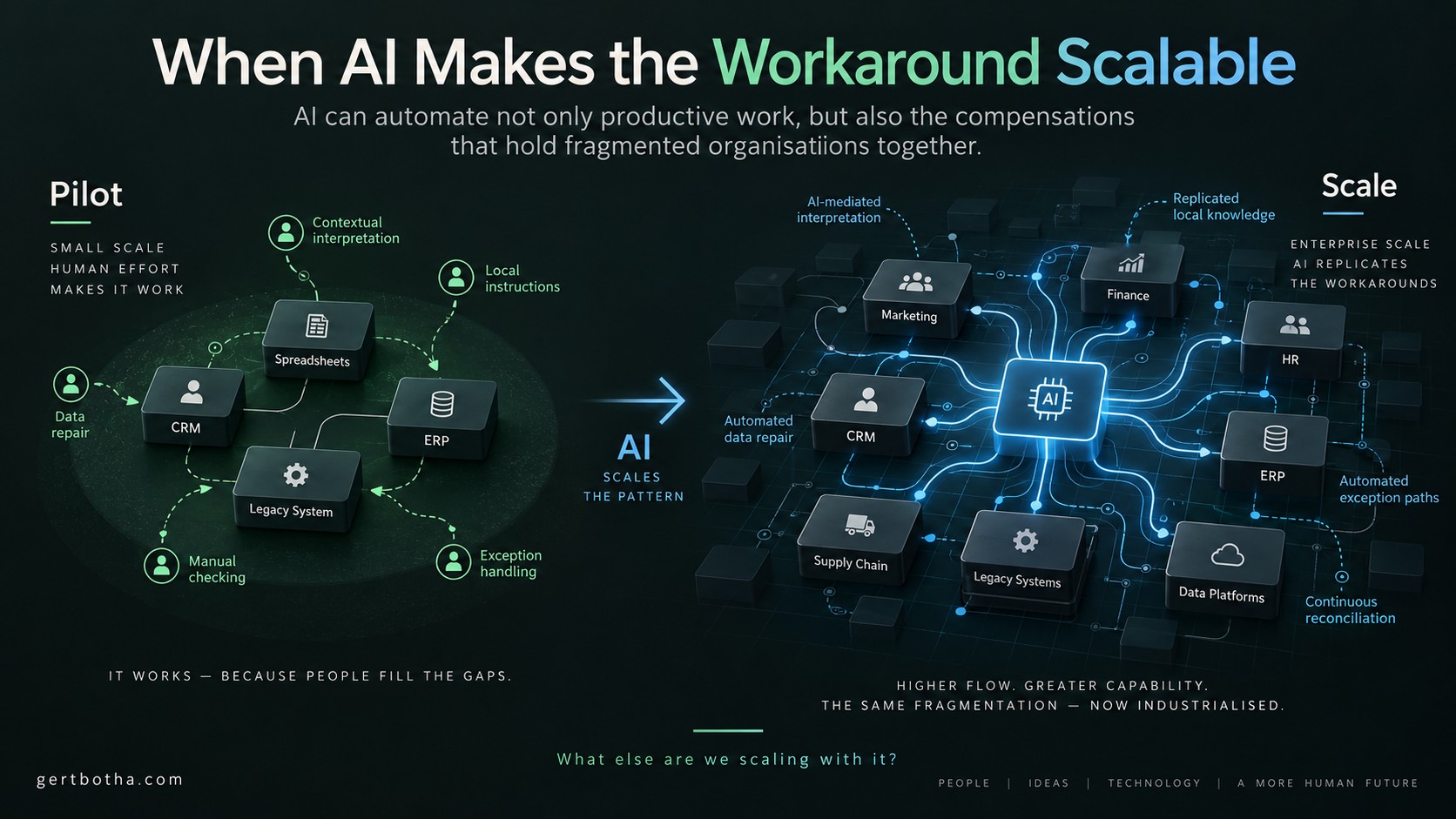 When AI Makes the Workaround Scalable
 The Age of Continuous Shocks: Why the coming downturn will be decided in your supply chain
 Friday’s Leader Reflection Quote – Saeculum Leadership Leaders Accept Decisions Create Responsibilities