Jun02
Every year since 2006, the McKinsey Leadership Forum has brought together high-performing C-suite executives to help prepare them for what many consider the ultimate leadership role: CEO.
And yet, after nearly two decades and hundreds of participants, only about one-third of those executives ultimately became CEOs.
That statistic alone says something important.
Being a strong executive is not the same thing as being prepared to lead an entire enterprise.
In succession planning work, I see this misunderstanding constantly. Organizations often assume that someone who successfully leads a division, function, or region is naturally ready for the CEO role. But the leap to CEO requires a completely different level of thinking, visibility, judgment, and leadership maturity.
One of the clearest lessons from McKinsey’s Forum participants is that nearly every eventual CEO believed they were well-prepared for the role — until they stepped into it and discovered entire leadership “muscles” they had never developed.
That observation should get every organization’s attention.
Most executives grow up inside functional silos. Finance leaders become experts in finance. Operations leaders master execution. Sales leaders learn growth and customer relationships. But CEOs must integrate all of it simultaneously while managing investors, boards, employees, regulators, customers, and public perception.
The role demands enterprise-wide thinking.
Future CEOs must intentionally broaden their perspective long before they assume the top position. That means understanding the business from the ground up — not just from the executive conference room.
Executives preparing for CEO roles should spend time with customers, suppliers, frontline employees, regulators, external stakeholders, and experts outside their industry. Exposure to a wide range of perspectives sharpens judgment and helps future CEOs better understand the complexity of the environments they will eventually lead.
Another lesson from Forum participants is particularly revealing:
To be viewed as a credible CEO candidate, you need an investment thesis.
In other words, you need a clear point of view about where the organization should go and how you would transform it.
That is very different from simply managing what already exists.
Potential CEOs must demonstrate strategic vision, not operational maintenance. Boards and ownership groups want to know:
What would this leader do with the organization?
Strong CEO candidates also learn to think like a CHRO.
That surprises many people.
But the best CEOs understand that organizational performance is ultimately driven by talent deployment. They know where the highest-value roles sit inside the business, which leaders are thriving, which are struggling, and where succession risk exists several levels deep in the organization.
This is one reason succession planning becomes such an important proving ground for future CEOs. Leaders who can accurately assess talent, develop future capability, and build strong leadership benches demonstrate enterprise-level thinking.
The Forum participants also emphasized something many aspiring executives misunderstand:
The CEO is not the chief problem solver.
The CEO is the chief enabler.
The role requires identifying where you can have the greatest impact while empowering others to execute. CEOs must spend their time on the few things nobody else in the organization can do — shaping vision, allocating resources, building culture, managing external relationships, and preparing the company for the future.
And increasingly, CEOs must recognize that they are public figures.
Employees, customers, investors, media, unions, analysts, regulators, and community stakeholders all form opinions about the organization through the CEO’s visibility and behavior. Connection matters. Trust matters. Presence matters.
Interestingly, many Forum participants compared the CEO role to being a professional athlete.
Energy management becomes critical.
The pace, pressure, visibility, and decision load of the role can quickly exhaust leaders who fail to protect their physical and mental capacity over time.
And perhaps the most important lesson of all:
Approach the role with humility.
The closer leaders get to the CEO role, the more dangerous overconfidence becomes. The strongest CEOs remain curious, adaptable, teachable, and willing to surround themselves with people who challenge their thinking.
Because ultimately, becoming a CEO is not about reaching the top of the organizational chart.
It is about becoming capable of carrying the full weight of the enterprise.
Keywords: Entrepreneurship, HR, Leadership
 Consumer vs. enterprise AI agents
 Best Supply Chain AI Tools in 2026: SCM SENSEI AI and Ask Lora Compared
 Making Silos Permeable
 The Corix Partners Friday Reading List - October 2, 2026
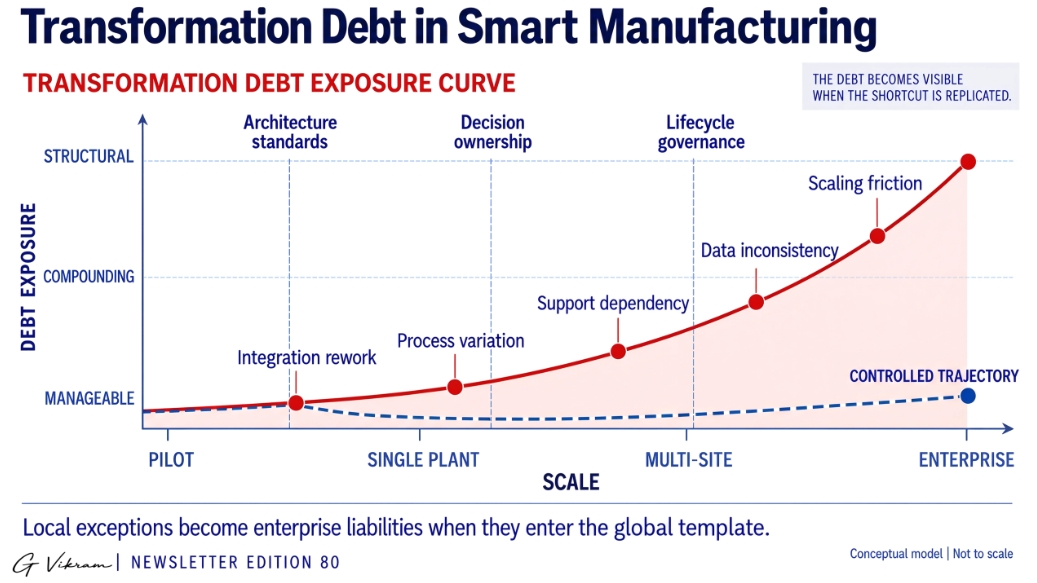 The most dangerous debt in a smart factory isn’t financial.