Jun05
FCRQ201 Leadership Learning!
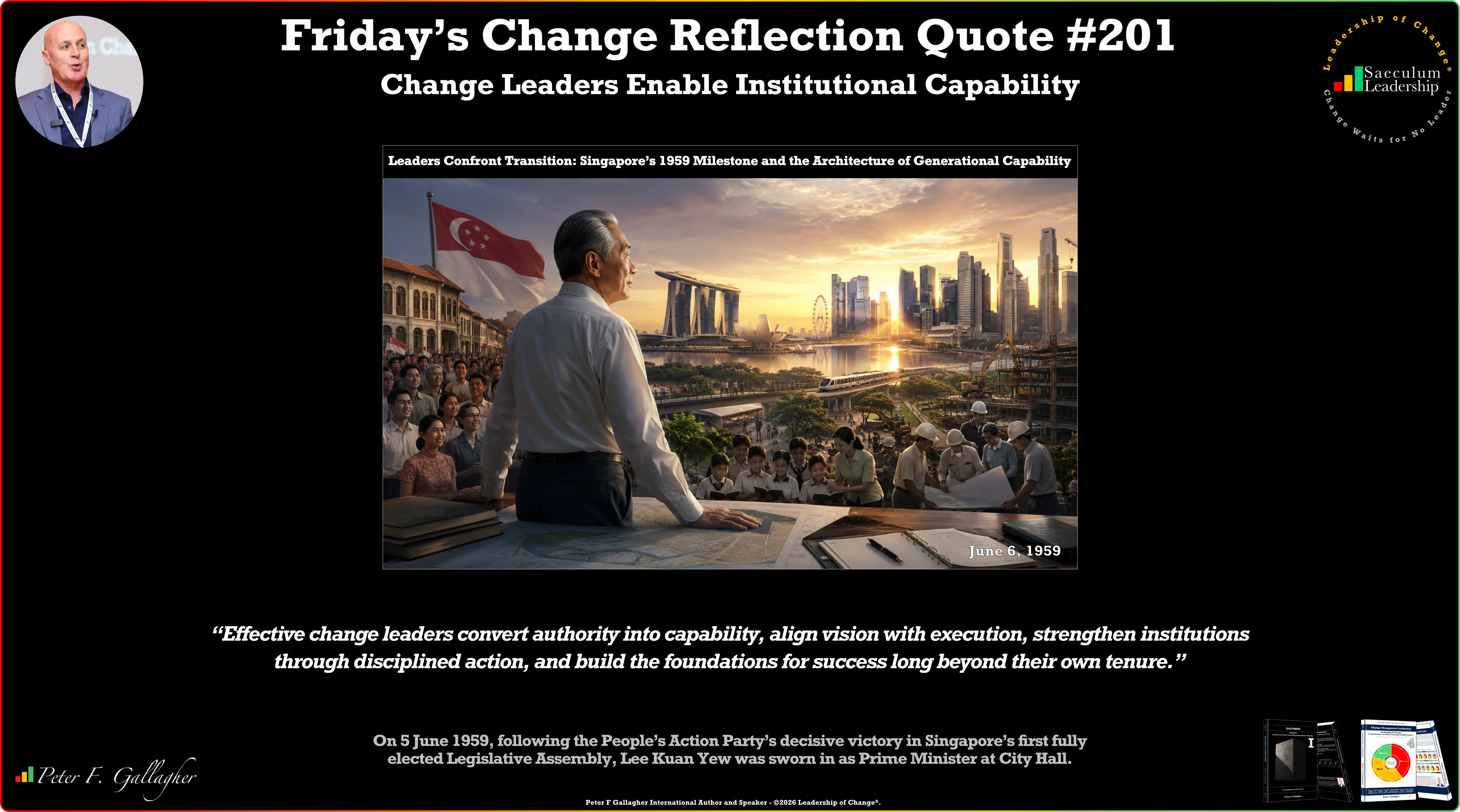
On 5 June 1959, following the People’s Action Party’s decisive victory in Singapore’s first fully elected Legislative Assembly, Lee Kuan Yew was sworn in as Prime Minister at City Hall. The moment marked the beginning of full internal self-government for Singapore and a decisive shift away from direct British colonial administration over domestic affairs. While defence and foreign affairs remained under British authority for a period, the transfer of internal responsibility represented a profound constitutional turning point and established the foundations of modern Singapore. Self‑government under the 1958 Constitution granted Singapore authority over all domestic matters, while Britain retained control of defence and external affairs until later constitutional transitions in 1963 and 1965.
The significance of the day extended far beyond a ceremonial transfer of office. Singapore in 1959 faced a deeply uncertain future. The island had strategic importance but limited natural resources, persistent unemployment, housing shortages, labour unrest and considerable political tension. Social cohesion remained fragile, and the pressures of decolonisation were reshaping political expectations across Asia. Many nations emerging from colonial rule were confronting difficult questions around governance capability, national identity and economic resilience. Singapore entered this period with significant vulnerabilities and no guarantee of long-term stability.
The People’s Action Party secured a commanding mandate in the election held on 30 May 1959. The result gave the incoming government clear authority, but authority alone did not create capability. The transition demanded disciplined leadership, administrative capability and the ability to establish trust across institutions and communities. Immediate priorities included strengthening public confidence, building credible government departments, addressing unemployment, improving housing conditions and establishing confidence in Singapore’s ability to govern itself responsibly.
The swearing-in at City Hall therefore represented more than political succession. It marked the beginning of a sustained national effort to convert uncertainty into capability. Over the years that followed, Singapore underwent a remarkable transformation in governance, infrastructure, economic performance and international standing. The institutional foundations laid during this early period proved highly consequential. Institutions were strengthened, long-term planning became central to public administration, and the expectations placed on government increasingly centred on discipline, delivery and strategic execution.
The importance of 5 June 1959 remains substantial because it marked the beginning of a long and demanding national transition. Singapore’s future was not predetermined. The path ahead required difficult decisions, sustained discipline and institutional maturity. The significance of this moment lies in how a constitutional milestone became the starting point for disciplined institution-building. It remains one of the most consequential political and governance transitions in modern Asian history and continues to offer valuable insight into how nations respond when responsibility and uncertainty arrive at precisely the same time. This moment also illustrates a core principle of Saeculum Leadership®: structural transitions reveal the signals that determine the next generational arc. Leaders who recognise these signals early are able to convert uncertainty into capability long before the outcomes become visible.
Change Leadership Lessons: Singapore's transformation was not achieved through political victory alone. It emerged because authority was converted into institutional capability through disciplined leadership and sustained execution. Leaders of change build confidence through clear direction when responsibility expands and uncertainty begins influencing the wider environment. They strengthen trust when disciplined action consistently aligns with stated priorities and visible progress becomes increasingly important. Change leaders build lasting capability by strengthening institutions that remain dependable under pressure across extended periods. They improve outcomes when urgent priorities are carefully balanced with long-term development and disciplined sequencing. Leaders of change create stable progress when credibility, capability and consistent delivery strengthen confidence across changing conditions. Change Leaders Enable Institutional Capability.
“Effective change leaders convert authority into capability, align vision with execution, strengthen institutions through disciplined action, and build the foundations for success long beyond their own tenure.”
Application - Change Leadership Responsibility 1 – Articulate the Change Vision: The establishment of self-governance in Singapore demonstrates that transformative change begins long before results become visible. When leaders inherit uncertainty, limited resources and competing pressures, their first responsibility is not to promise immediate success but to articulate a credible vision of the future that people can understand, support and help build. The vision must also describe the capability that must be built if that future state is to become achievable and sustainable, explaining why existing conditions are insufficient, and establishing a clear direction capable of guiding decisions through periods of ambiguity and challenge. A compelling vision does not depend upon favourable circumstances; it creates alignment by providing purpose, clarity and confidence when the path forward remains uncertain.
Leaders must communicate why change is necessary, what future capability must be developed, and how disciplined effort can convert aspiration into sustainable progress. This responsibility demands more than setting objectives. It requires translating complexity into a practical and believable future state that aligns people, resources and priorities around a common purpose. When leaders articulate the vision with conviction, consistency and strategic clarity, they create the conditions for trust, commitment and coordinated action. In doing so, they establish the foundation upon which long-term transformation can be achieved and sustained.
Final Thoughts: Singapore's achievement of full internal self-governance marked the beginning of a nation-building Saeculum, demonstrating that civilisational progress emerges when leadership transforms political authority into enduring institutional capability. AI now enables leaders to identify emerging signals, test strategic assumptions and model future scenarios, whilst also increasing the speed at which weak decisions, poor governance and misaligned priorities can compound across complex systems. Leaders of change must therefore articulate a compelling vision early, build resilient institutions that can sustain execution over time, and intervene decisively before emerging challenges become structural constraints.
Further Reading: Change Management Leadership® - Leadership of Change® Volume 4 and Saeculum Leadership®: Doctrine – Volume I.
Peter F. Gallagher, a 20‑book author, consults, speaks, and writes on Saeculum Leadership® and Leadership of Change®. He works exclusively with boards, CEOs, and senior leadership teams to prepare and align them to effectively and proactively lead their organisations through transformation in a rapidly evolving epoch.
For further insights please visit our websites: https://www.a2b.consulting https://www.peterfgallagher.com Amazon.com: Peter F Gallagher: Books, Biography, Blog, Audiobooks, Kindle
Saeculum Leadership® Body of Knowledge (SLBoK): Volumes 1-10.A-E & I-V
~ Leadership of Change® Volume 1 - Change Management Fables
~ Leadership of Change® Volume 2 - Change Management Pocket Guide
~ Leadership of Change® Volume 3 - Change Management Handbook
~ Leadership of Change® Volume 4 - Change Management Leadership
~ Leadership of Change® Volume 5 - Change Management Adoption
~ Leadership of Change® Volume 6 - Change Management Behaviour
~ Leadership of Change® Volume 7 - Change Management Sponsorship
~ Leadership of Change® Volume 8 - Change Management Charade
~ Leadership of Change® Volume 9 - Change Management Insanity
~ Leadership of Change® Volume 10 - Change Management Dilenttante
~ Leadership of Change® Volume A - Change Management Gamification - Leadership
~ Leadership of Change® Volume B - Change Management Gamification - Adoption
Keywords: Business Strategy, Change Management, Leadership
 Consumer vs. enterprise AI agents
 Best Supply Chain AI Tools in 2026: SCM SENSEI AI and Ask Lora Compared
 Making Silos Permeable
 The Corix Partners Friday Reading List - October 2, 2026
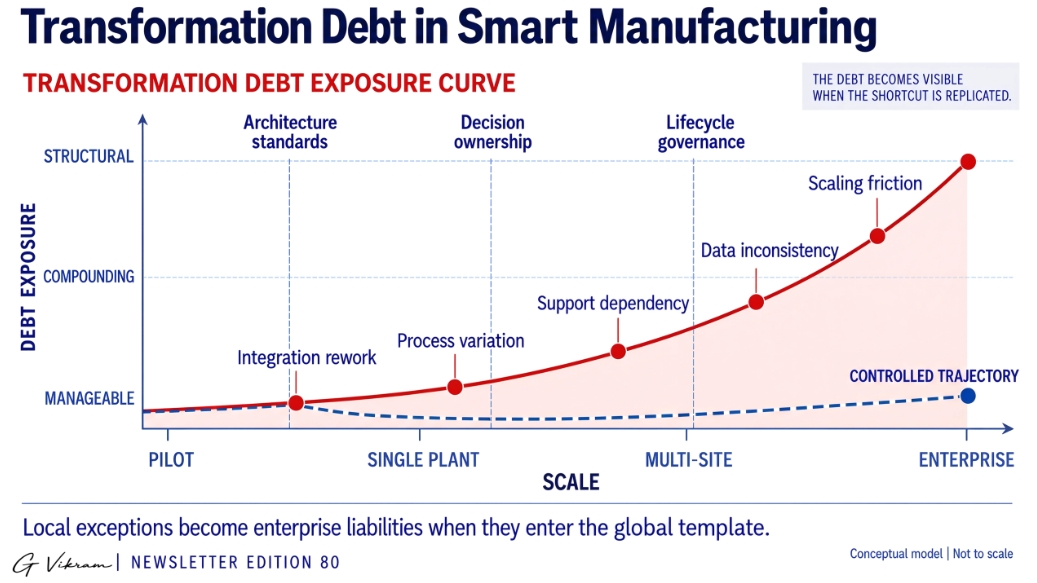 The most dangerous debt in a smart factory isn’t financial.