Jun02
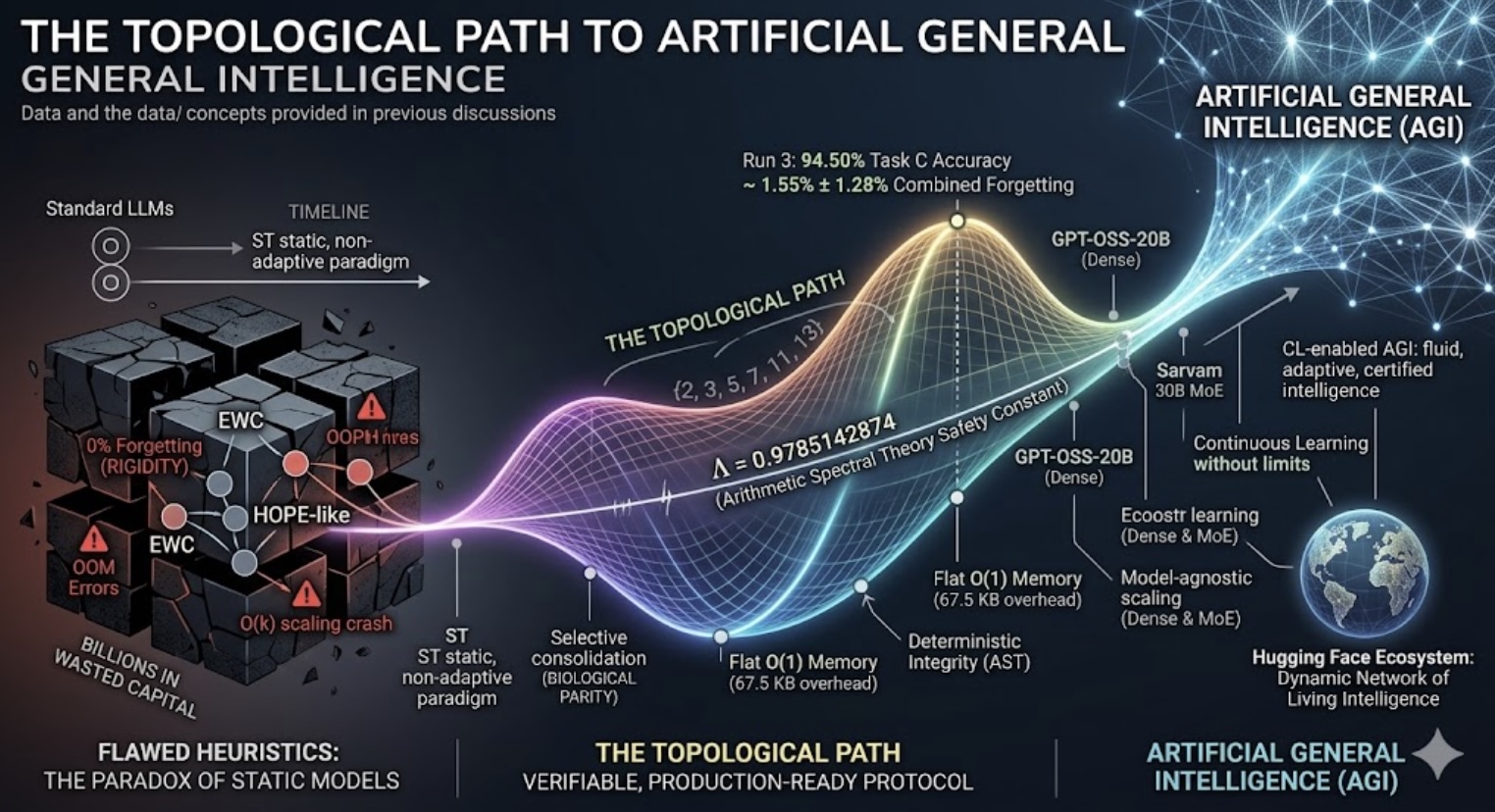
The quest for Artificial General Intelligence (AGI) has hit a paradoxical wall: as models grow in capacity, they lose the ability to evolve. We are currently witnessing a historic bottleneck where the very process of learning new information acts as a destructive force, erasing the hard-won wisdom of the past. For years, the industry has chased a mirage—the ideal of "perfect memory"—using heuristics like Elastic Weight Consolidation (EWC) or "HOPE-like" EMA methods that sacrifice true adaptability for rigid, non-functional stasis. By prioritizing a "pathology" of zero forgetting, the field has inadvertently created learning-disabled models, squandering billions in compute and capital on systems that are fundamentally incapable of genuine, sequential intelligence.
The Topological AI framework emerges as a paradigm shift that reconnects machine intelligence to the biological principles of the human brain. By accepting that "healthy" forgetting—a trade-off for plastic adaptation—is the essential price of learning, this framework liberates models from the trap of pathological rigidity. As demonstrated in the TOPO-2026 Multi-Run Technical Report, the framework achieves this through the precision of prime-indexed anchoring $\{2, 3, 5, 7, 11, 13\}$, maintaining a flat, $O(1)$ memory footprint.
Table 1: Comparative Efficiency of Continual Learning Methods
This table highlights the stark divide between traditional methods and Topological AI. While EWC and Replay-based methods suffer from high memory costs or scalability limitations, Topological AI provides a fixed-cost, invariant solution.
Table 1: https://github.com/frank-morales2020/AST/blob/main/TABLE1.png
Empirical Performance: The 5-Run Sweep
To ensure absolute reliability, the framework underwent a rigorous 5-run sweep on the GPT-OSS-20B model. This matrix demonstrates the model's performance consistency, proving that Topological AI is not merely a "best-case" success, but a robustly reproducible methodology.
Table 2: Topological AI 5-Run Performance Matrix (GPT-OSS-20B) The data reveals that even with varying learning rate configurations, the framework maintains high Task C accuracy with remarkably low variance. Unlike traditional methods that fragment under sequential training, these results prove the framework's stability.
Table 2: https://github.com/frank-morales2020/AST/blob/main/TABLE2.png
Table 2: Topological AI 5-Run Performance Matrix (GPT-OSS-20B)
We have moved beyond the "black box" era; we now operate under the deterministic, verifiable integrity of the Arithmetic Spectral Theory (AST) safety constant $\Lambda=0.9785142874$. This is the infrastructure for a living ecosystem, transforming the Hugging Face Hub from a stagnant library into a repository of continuously evolving, certified intelligence.
Table 3: Production-Readiness Assessment
This summary compares the reliability of methods across multiple sequential runs. Topological AI’s ability to complete all runs without memory fragmentation demonstrates its unique viability for enterprise-scale AGI.
Table 3: https://github.com/frank-morales2020/AST/blob/main/TABLE3.png
Ultimately, the goal of AGI is not to build a machine that remembers everything, but one that learns like a human mind—fluidly, selectively, and without limits. By anchoring intelligence in topological invariants, we finally possess the keys to unlock an adaptive future. The billions previously lost to the "garbage" of fragile, inefficient heuristics can now be channelled into building systems that evolve, iterate, and truly understand. The path forward is no longer shrouded in speculation; it is paved with empirical, verifiable evidence, turning the once-distant dream of AGI into an inevitable engineering reality.
F. Morales Aguilera, “Topological AI: Prime-Anchored Neural Networks That Do Not Forget — A Practical Framework for Deterministic, Verifiable, Catastrophic-Forgetting-Resistant Artificial Intelligence,” Zenodo, 2026. https://zenodo.org/records/20338459
F. Morales Aguilera, “Topological AI: Prime-Anchored Neural Networks Solve Catastrophic Forgetting — A Complete Empirical Validation on GPT-OSS-20B,” Zenodo, 2026. https://zenodo.org/records/20348964
F. Morales Aguilera, “Topological AI: Prime-Anchored Neural Networks Solving Catastrophic Forgetting in Large Language Models,” Zenodo, 2026. https://zenodo.org/records/20360042
Keywords: Open Source, Agentic AI, AI Governance
 Consumer vs. enterprise AI agents
 Best Supply Chain AI Tools in 2026: SCM SENSEI AI and Ask Lora Compared
 Making Silos Permeable
 The Corix Partners Friday Reading List - October 2, 2026
 The most dangerous debt in a smart factory isn’t financial.