Mar27
On the surface, many organisations appear to be doing everything right. They invest in strategy development, convene leadership off-sites, produce polished slide decks, and align senior teams around a clear direction. Yet, months later, little has changed. Priorities drift, teams fall back into familiar routines, and the strategy quietly recedes into irrelevance.
This pattern is not the result of flawed thinking. It is the consequence of flawed systems.
If a strategy does not manifest in how people prioritise, make decisions, and act on a daily basis, it is not being executed—it is being ignored. Execution rarely fails at the point of articulation; it fails within the organisation's operating system.
High-performing organisations recognise a fundamental truth: strategy is not an event. It is a system.

In many organisations, strategy is treated as a periodic exercise—something developed annually and revisited quarterly. But without the structural mechanisms to sustain it, even the most compelling strategy dissolves under the weight of day-to-day operations.
Execution requires more than intent. It requires design.
This is where many organisations fall short. They focus on defining what to do but neglect building the systems that determine how work actually gets done.
For a deeper perspective on how organisations can bridge the gap between intent and execution, resources such as https://visualisesolutions.co.uk/ offer practical frameworks to align strategy with operational systems.
The first critical shift is protecting time for strategy.
In most organisations, strategic thinking is crowded out by operational noise—urgent emails, short-term pressures, and constant firefighting. The result is a reactive environment where strategy becomes secondary to immediacy.
High-performing teams take a different approach. They deliberately carve out time to revisit, test, and refine their strategy. This is not a quarterly ritual; it is an ongoing discipline embedded into how the organisation operates.
Without protected time, strategy becomes something teams intend to follow rather than something they actively manage.
Leadership teams often assume that communicating a strategy once is sufficient. In reality, a single presentation rarely changes behaviour.
Strategy only becomes meaningful when it is consistently reinforced.
This requires over-communication—not in volume, but in clarity and repetition. Teams must understand not only what the strategy is, but what it means for their specific roles, decisions, and priorities.
Repetition is not redundancy. It is reinforcement.
Communication alone, however, is insufficient. The real transformation occurs when strategy is translated into systems.
A strategy without clear goals, meaningful metrics, and defined ownership remains aspirational. Systems provide the infrastructure that converts intent into action.
This includes:
Without these elements, execution becomes inconsistent—dependent on individual effort rather than organisational design.
Even well-designed systems can fail if they are not aligned with the broader organisational environment.
Many strategies falter because the organisation rewards behaviours that contradict its strategic intent. For example, if incentives prioritise short-term outcomes over long-term value creation, teams will naturally optimise for the former.
Similarly, if employees lack the capabilities required to deliver on strategic priorities, execution will stall regardless of intent.
Culture reinforces all of this. What gets recognised, rewarded, and repeated ultimately shapes behaviour far more than what is written in a strategy document.
Perhaps the most challenging—and most critical—discipline is focus.
High-performing teams are not defined by how much they do, but by what they choose not to do. They apply rigorous scrutiny to every initiative, ensuring alignment with strategic priorities.
If something does not support the strategy, it does not get done.
This level of discipline prevents dilution of effort and preserves clarity across the organisation.
When execution breaks down, leaders often default to familiar explanations: lack of motivation, insufficient capability, or poor communication.
In reality, the issue is usually structural.
People are operating within systems that have not been designed to deliver the strategy. Asking them to work harder within a misaligned system rarely produces different results.
The solution is not to push people harder—it is to redesign the environment in which they operate.
The organisations that succeed in execution understand a simple but powerful principle:
When the system is designed effectively—when time is protected, priorities are clear, metrics are meaningful, incentives are aligned, and focus is maintained—strategy ceases to be a document.
It becomes reality.
And in most cases, that is all the organisation needed in the first place—not a new strategy, but a system capable of delivering the one it already has.
Want to ensure your strategy aligns with real-world needs and long-term value? Visualise Solutions helps organisations navigate uncertainty, uncover hidden opportunities, and align execution with purpose. Let’s make sure you’re building the right thing—before you build it right.
By Andrew Constable MBA, XPP, BSMP
Keywords: Innovation, Leadership, Business Strategy
 FROM THE AISLE Field Notes on AI Implementation
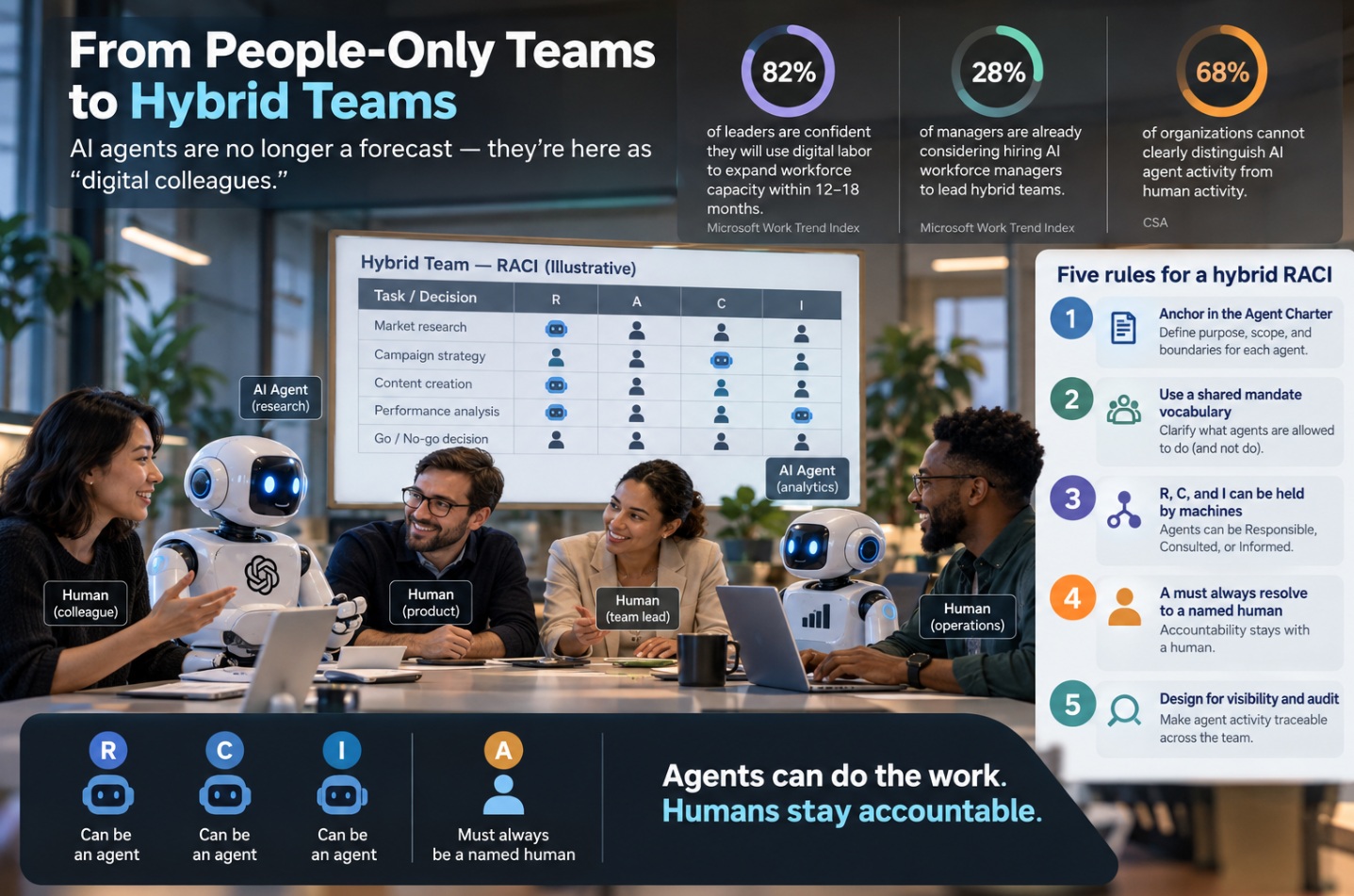 The Hybrid Team: Rethinking RACI When Some of Your Team Members Are Machines
 Two Clocks, One Truck: The Army's Need for Speed Meets New Defense Sourcing Rules
 Sustainable Transformation: The Elephant and The Mouse In The Room
 The Price of Standing Alone: Strategic Autonomy in a World Where Nobody Can Do It Alone