May29
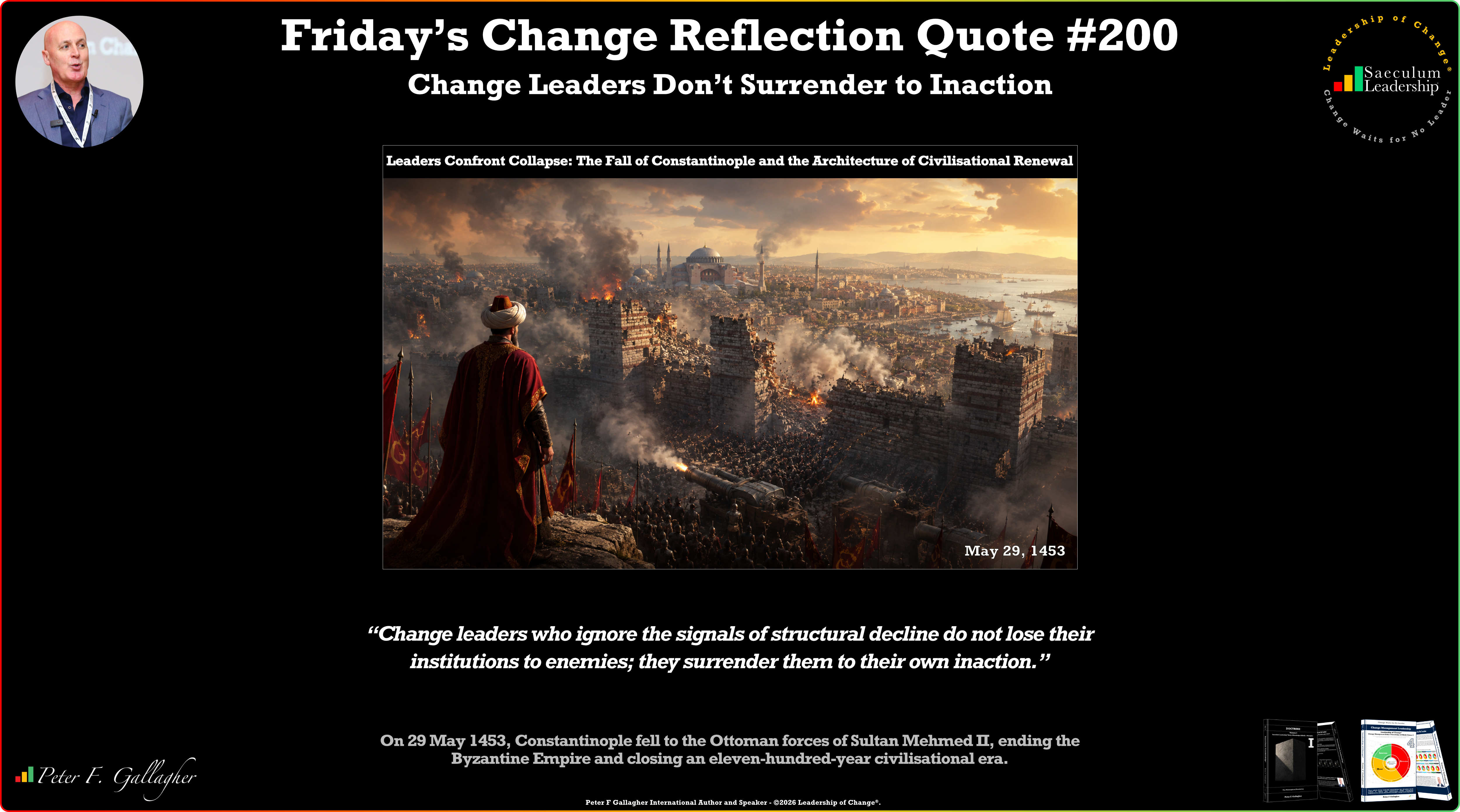
On 29 May 1453, Constantinople fell to the Ottoman forces of Sultan Mehmed II, ending the Byzantine Empire and closing an eleven‑hundred‑year civilisational era. The 21‑year‑old ruler had ordered the final assault after a fifty‑five‑day siege in which his forces, numbering between 80,000 and 100,000, brought overwhelming pressure against a defending army of roughly 7,000 men. By midday, the Theodosian Walls had been breached, Emperor Constantine XI Palaiologos had died in battle, and the city that had long stood as the centre of Christian civilisation was lost. An era had ended.
The siege had begun on 6 April 1453. The Ottomans brought overwhelming force against a defending army of roughly 7,000 men, including a small contingent of Italian mercenaries. What made the assault decisive was not simply numerical superiority. Mehmed had commissioned the construction of enormous cannon capable of breaching the ancient Theodosian Walls, fortifications that had resisted invasion for centuries. When those walls finally gave way in the pre-dawn hours of 29 May, the Janissary elite forces poured through and the city fell within hours.
The significance of the event resonated across continents and centuries. Constantinople had served as the eastern bulwark of Christian Europe, a hub of trade connecting East and West, and the custodian of Greek and Roman intellectual heritage. Its fall opened the Balkans and eastern Europe to unimpeded Ottoman expansion. It disrupted centuries-old trade routes between Europe and Asia, accelerating the search for alternative sea passages that would ultimately lead to the Age of Exploration. Byzantine scholars fleeing to Italy carried with them manuscripts and a living tradition of Greek learning that directly fuelled the Italian Renaissance, reshaping European intellectual life for generations.
Mehmed II, who became known as “the Conqueror,” transferred the Ottoman capital from Edirne to Constantinople, renamed it Istanbul, and transformed the Hagia Sophia from a cathedral into a mosque. He did not merely defeat an empire — he built a new one on its foundations and governed it with a calculated blend of military authority, architectural ambition, and administrative pragmatism.
The fall of Constantinople is best understood not simply as a military defeat but as a Saeculum Signal, the irreversible moment when decades of institutional exhaustion became impossible to conceal. It is a story of institutional exhaustion, strategic miscalculation, failed alliances, and the consequences of prolonged imperial contraction long before the walls were breached.
This event remains one of history’s clearest leadership inflection points. A city that had survived centuries of assault finally fell not because its walls were impenetrable but because the empire behind them had already hollowed out. Political fragmentation, economic decline, and the failure of European powers to provide meaningful support created the conditions for defeat long before the first cannon was fired. The event did not merely end an empire — it redirected the trajectory of European civilisation, global trade, and the architecture of knowledge itself.
Change Leadership Lessons: The fall of Constantinople reveals that institutional collapse is rarely sudden; it is usually the final visible stage of decline that leaders failed to confront early enough. The fall was not only a geopolitical rupture; it was a Knowledge Architecture turning point that exposed how civilisations weaken when their learning systems fail to renew. The intellectual migration that followed became a Knowledge Architecture renewal, transferring preserved Greek learning into the Italian states and igniting the analytical, scientific and philosophical foundations that reshaped Europe’s future. Leaders of change must read the early signals of structural decline before institutional collapse becomes strategically unavoidable. They must align leadership teams, resolve competing priorities, and build collective purpose well before any crisis demands it. Change leaders who govern as though former strength still exists cannot build strategies adequate to their changed reality. They must intervene creatively and decisively, choosing unconventional approaches when conventional defences have already proven insufficient. Leaders of change must confront structural decline and build the institutional architecture that ensures new directions endure long beyond the moment of their own leadership. Change Leaders Don’t Surrender to Inaction.
“Change leaders who ignore the signals of structural decline do not lose their institutions to enemies; they surrender them to their own inaction.”
Application - Change Leadership Responsibility 1 – Articulate the Change Vision:
The fall of Constantinople demonstrates with absolute clarity that institutions fail long before their walls collapse. When leaders do not articulate a truthful picture of structural decline, they leave their people defending illusions rather than preparing for reality. Articulating the change vision begins with clearly identifying the forces reshaping the environment, explaining why established assumptions no longer hold, and defining the direction that must be secured before external pressure turns into irreversible loss. A credible vision does not dilute the truth; it interprets complexity in a way that enables coordinated action rather than fragmented reaction.
Leaders must communicate why the current trajectory is unsustainable, what future conditions must be built, and how collective discipline can prevent deterioration from becoming collapse. This responsibility requires more than acknowledging threats — it demands framing a strategic pathway that aligns teams, resources and priorities around a shared understanding of what must change and why. When leaders articulate the vision with honesty and precision, they create the conditions for unity, resilience and purposeful intervention.
Final Thoughts: The fall of Constantinople closed a civilisational Saeculum of eleven hundred years, permanently reordering the geopolitical and knowledge architecture of Europe and the wider world. AI now helps leaders detect institutional fragility and model the consequences of deferred decisions, whilst also accelerating the speed at which weakened institutions can destabilise before leaders fully diagnose the threat. Leaders of change must therefore read structural signals early, align around honest diagnosis, and build governance architectures resilient enough to outlast their own tenure.
Further Reading: Change Management Leadership® - Leadership of Change® Volume 4 and Saeculum Leadership®: Doctrine – Volume I.
Peter F. Gallagher, a 20‑book author, consults, speaks, and writes on Saeculum Leadership® and Leadership of Change®. He works exclusively with boards, CEOs, and senior leadership teams to prepare and align them to effectively and proactively lead their organisations through transformation in a rapidly evolving epoch.
For further insights please visit our websites: https://www.a2b.consulting https://www.peterfgallagher.com Amazon.com: Peter F Gallagher: Books, Biography, Blog, Audiobooks, Kindle
Saeculum Leadership® Body of Knowledge (SLBoK): Volumes 1-10.A-E & I-V
~ Leadership of Change® Volume 1 - Change Management Fables
~ Leadership of Change® Volume 2 - Change Management Pocket Guide
~ Leadership of Change® Volume 3 - Change Management Handbook
~ Leadership of Change® Volume 4 - Change Management Leadership
~ Leadership of Change® Volume 5 - Change Management Adoption
~ Leadership of Change® Volume 6 - Change Management Behaviour
~ Leadership of Change® Volume 7 - Change Management Sponsorship
~ Leadership of Change® Volume 8 - Change Management Charade
~ Leadership of Change® Volume 9 - Change Management Insanity
~ Leadership of Change® Volume 10 - Change Management Dilenttante
~ Leadership of Change® Volume A - Change Management Gamification - Leadership
~ Leadership of Change® Volume B - Change Management Gamification - Adoption
Keywords: Leadership, Change Management, Business Strategy
 Two Clocks, One Truck: The Army's Need for Speed Meets New Defense Sourcing Rules
 Sustainable Transformation: The Elephant and The Mouse In The Room
 The Price of Standing Alone: Strategic Autonomy in a World Where Nobody Can Do It Alone
 The Potter’s Hands: Why Great Leaders Shape Environments, Not People
 The Corix Partners Friday Reading List - October 16, 2026