
Mar29
In the early hours of the morning, figures move quietly along the street. There are no uniforms. No badges. Just people exchanging glances, whispers, and nods. Some stand at crossroads, watching. Others approach neighbours’ homes with urgent instructions, improvised and immediate.
The streets hum with purpose and an attentiveness sharpened by concern for others rather than duty to an institution.
No one is directing them. No central command or orchestrated plan. No recognised leader is coordinating the response.
And yet, something is clearly happening. Something is organising.
This is not a story from the present. Nor is it about protests in modern cities or contemporary crises. It is 1381, and these are the streets of England during what would later be called the Peasants’ Revolt.
But the parallels between this 650-year-old situation and what we might recognise happening in cities across the United States of America today are undeniable.
What does this tell us about how humans coordinate under pressure, and why do our traditional ideas of leadership struggle to explain what we are seeing?
At first glance, the actions of the medieval villagers might appear chaotic: citizens blocking officials, documents being destroyed, groups moving through towns seemingly at random. But a closer look reveals a remarkable coherence.
Local communities were interpreting the immediate situation around them and then responding to threats and opportunities in ways that aligned with a shared understanding of right action.
There were different actions in different places: some confronted collectors, some destroyed records, some raised alarms to warn others. Each contribution was locally judged, adaptive, and situational, yet all pointed in the same direction. Purpose, not authority, created the alignment.
Today, we see parallel approaches on the streets of Minneapolis, Austin, Washington, New York and more. Over 300 protests and demonstrations against the actions of Immigration and Customs Enforcement (ICE) have taken place – all without central governance or leadership.
In each contemporary example, no one appears to be waiting for instructions. People simply act, contributing what they can: time, presence, information, reassurance. Some stand watch. Some document events. Some escort children to school. Others provide food, transport, or temporary shelter. The contributions differ, but the direction does not.
Just as in 14th century England, this is not an absence of leadership. It is a different form of it.
Much of our thinking about leadership is still rooted in relatively stable environments. We imagine leaders setting direction, issuing guidance, allocating roles, and resolving uncertainty from the top down. This model works reasonably well when conditions are predictable and the pace of change is manageable.
But when change and complexity arrive, the same structure and scaffold provided by hierarchy, position and policies starts to stifle and suffocate.
Hierarchical leadership models struggle to cope with rapid change, cross-boundary collaboration, and the need for innovation that cuts across silos. They reward caution over creativity and compliance over curiosity. What was once a strength now constrains us.
What we are seeing is not the failure of leadership, but the failure of leadership models that assume order must be imposed.
As we’ve seen across history, a purposeful North Star can orient strangers to share a goal, contribute together, and do so without the need for an individual leader.
This orientation is not a map. It does not prescribe exact actions. It simply offers direction that individuals can then interpret in ways that suited their context and capacity. The result is self-organising behaviour that produces visible alignment without formal leadership. It is Constellation Leadership.
A constellation is not a single star issuing light to others. It is a pattern that emerges when many stars are oriented in relation to one another. The stars do not move to create the pattern; the pattern becomes visible because of their alignment.
Constellation Leadership works in much the same way.
It does not rely on hierarchy, titles, or formal authority. Instead, it depends on three conditions:
It is tempting to see this kind of organisation as exceptional or something that only appears in moments of crisis. In fact, it may be closer to our default state than we like to admit.
We are wired for coordination in complexity. Across millennia, survival has often depended on small groups acting in fluid, high-risk situations. There were no org charts. No quarterly plans. No approval gates. Coordination emerged through shared intent, trust, and constant adjustment. Formal hierarchies came later, as societies scaled. They are a powerful tool, but it is not our only one.
When these three conditions are met in times of volatility and change, humans revert to older patterns of coordination: looking sideways, sensing the environment, interpreting cues, and acting in ways that align with shared principles.
For most of human history, survival depended on small groups responding quickly to immediate threats.
This shows that 1381 is not an anomaly. Humans have repeatedly demonstrated the capacity to organise around shared purpose without a traditional figurehead:
In each case, a shared sense of purpose, local autonomy, and mutual awareness created alignment. Different people acted differently, yet all actions advanced the same underlying goal. Leadership existed, but in the form of orientation and amplification, rather than command-and-control.
For leaders and institutions, the historical record is instructive. Hierarchy and formal authority are not the only ways to produce alignment.
In complex or fast-moving contexts, people will organise themselves if a purpose is evident, conditions support autonomy, and communication allows mutual awareness. Leadership becomes less about dictating action and more about holding the purpose steady, safeguarding the conditions for distributed action, and resisting the urge to over-specify behaviour.
However, there is a consideration. Decentralised coordination is not inherently safe or virtuous. Misjudgements, misinformation, and friction are inevitable. Yet its recurrence across centuries demonstrates a persistent human capability to create meaningful order from complexity without centralised control.
The streets of 1381, Copenhagen in 1943, and London during the Blitz each reveal the same pattern of humans organising themselves around a shared orientation, contributing what they can, and producing coherence without being commanded. Today, we see the same approaches on new streets. Those of Chicago, Portland and Los Angeles.
This is not chaos. It is not leaderlessness. It is a constellation forming in real time. It is a reminder that beneath formal structures and titles, humans are wired to align around purpose, adapt to circumstance, and act collectively when the stakes are high.
What occurred in each example was not dramatic in the way leadership is often portrayed. There were no speeches. No charismatic figures. No clear victories.
And yet, it may be one of the clearest demonstrations of how humans actually organise when it matters. Not through command or through consensus. But through shared orientation and voluntary contribution.
Constellation Leadership is not a radical invention. It is a rediscovery.
Under pressure, when hierarchy falls away, we do not descend into chaos. We look up, find a north star, and begin to align ourselves accordingly.
Sometimes, that alignment looks like standing quietly outside a neighbour’s house, watching the road, ready to act if needed.
This is what leadership looks like when it stops trying to be seen.
No one in charge. Everyone responsible.
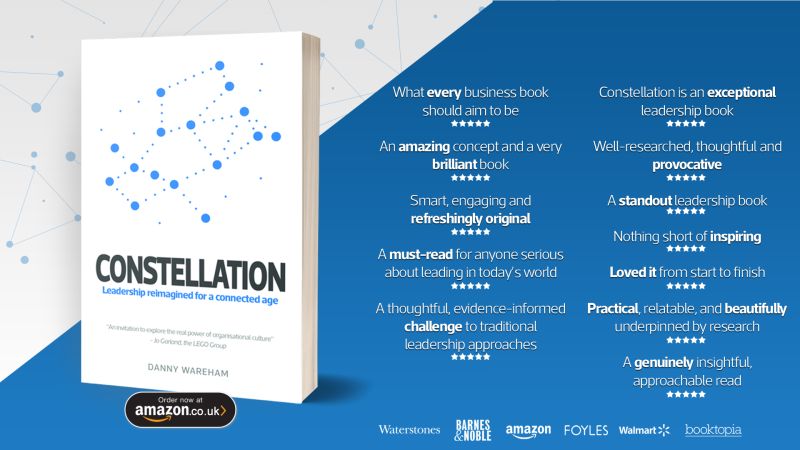
Constellation: Leadership reimagined for a connected age is available in all bookshops across Europe, North America and Asia, and from Amazon.
Danny believes that happy bees make tasty honey. With a purposeful culture, strategy and support systems, high performance becomes a side effect.
He is a psychologist, author of Constellation, an accredited coach, and a psychometrician whose work lies at the intersection of leadership, culture and personality, with a focus on individual differences – especially the “dark triad” traits of narcissism, psychopathy, and Machiavellianism.
An expert in culture and leadership dynamics, Danny has been recognised among the Global Top 10 Thought Leaders on Culture and the Top 25 in Leadership and has spent nearly 30-years in contact centre, retail and fintech industries, designing cultures, leadership systems, and strategies in which energy, clarity, and collaboration multiply success.
He is the founder of Firgun, a consultancy whose Hebrew name captures his core motivation: “the genuine, sincere and pure happiness for another person’s accomplishment or experience”, whose clients include Worldpay, M&G Investment Bank, and LEGO.
More articles are available on his website: dannywareham.co.uk/articles
Keywords: Culture, Leadership
 FROM THE AISLE Field Notes on AI Implementation
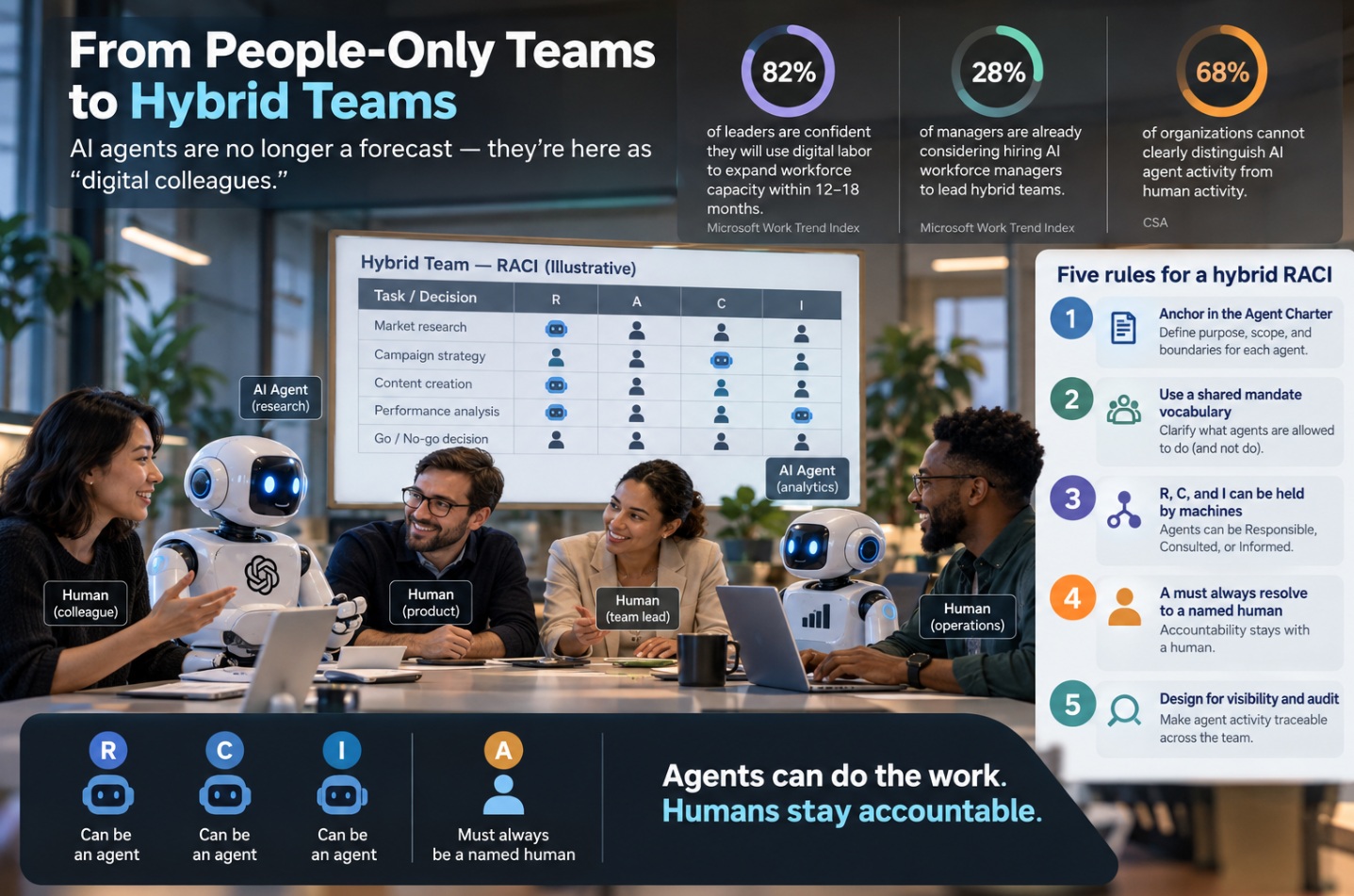 The Hybrid Team: Rethinking RACI When Some of Your Team Members Are Machines
 Two Clocks, One Truck: The Army's Need for Speed Meets New Defense Sourcing Rules
 Sustainable Transformation: The Elephant and The Mouse In The Room
 The Price of Standing Alone: Strategic Autonomy in a World Where Nobody Can Do It Alone