May01
FCRQ196 Leadership Learning!
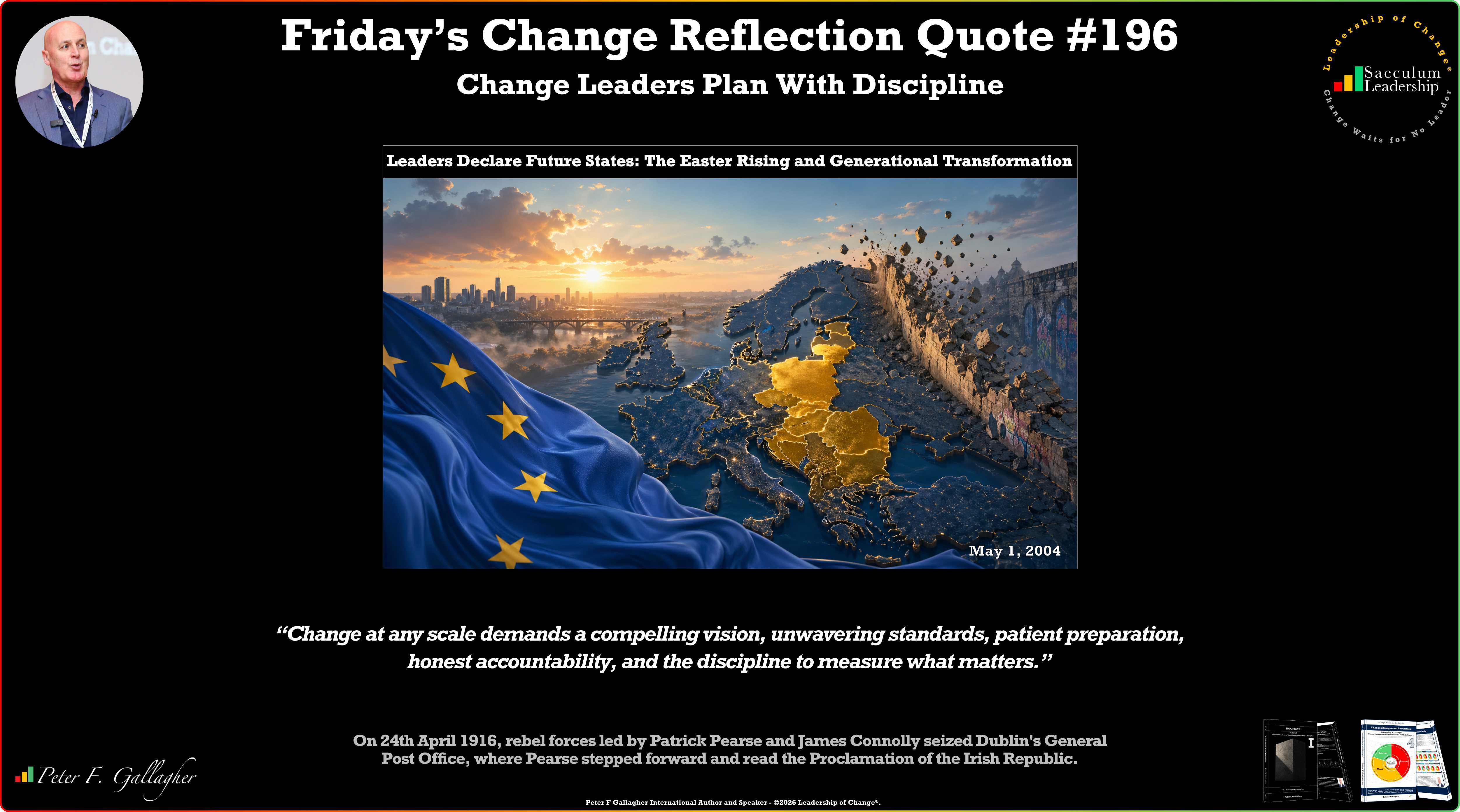
On 1st May 2004, the European Union completed the most ambitious enlargement in its history. Ten new member states, Cyprus, the Czech Republic, Estonia, Hungary, Latvia, Lithuania, Malta, Poland, Slovakia, and Slovenia, acceded simultaneously to the Union, transforming it from 15 to 25 member states overnight. The combined population of the ten new members stood at nearly 75 million people, bringing the total Union to approximately 450 million citizens and materially expanding the scale and reach of the single market.
The roots of this moment stretched back to one of the most defining events of the twentieth century. The fall of the Berlin Wall on 9th November 1989 marked the collapse of the Communist bloc and ignited the long process of European reunification. Seven of the ten acceding nations had lived under Soviet control or influence, including the Baltic states of Estonia, Latvia and Lithuania, and the Central and Eastern European states of Poland, Hungary, the Czech Republic, Slovakia and Slovenia. For these nations, accession represented the institutional completion of their transition from authoritarian systems to democratic governance and from planned economies to functioning market economies.
The accession process was neither swift nor simple. Formal negotiations between the European Union and the first wave of candidate countries began on 31st March 1998. Each candidate was required to satisfy the rigorous Copenhagen Criteria, established at the European Council in Copenhagen in June 1993, which demanded stable democratic institutions, respect for the rule of law, the protection of human rights and minorities, a functioning market economy, and the ability to absorb and implement the full body of EU legislation known as the acquis communautaire. The negotiation process required detailed, structured assessment across all areas of governance and economic policy, supported by continuous evaluation from the European Commission. The Copenhagen European Council of December 2002 formally confirmed that ten countries had met the necessary conditions, and the Accession Treaty was signed in Athens on 16th April 2003.
The institutional scale of the change was extraordinary. Nine new official languages were added to the EU's working framework, and the single market gained tens of millions of additional participants within the single market. Trade between pre-2004 member states and the new members subsequently increased more than fivefold compared to figures from the year 2000.
The economic impact on the acceding nations was transformative. In the two decades following accession, all ten countries recorded significant increases in GDP per capita. Several, including Estonia, Latvia and Lithuania, more than tripled their mean income levels, demonstrating the profound economic dividend that structured integration within a rules-based, single market framework can deliver.
The 2004 enlargement, widely known as the ‘Big Bang,’ was not merely an economic or institutional event. It was a deliberate political act that advanced the long-term reintegration of a divided continent. It demonstrated what becomes possible when nations commit over many years to shared values, uphold rigorous standards, and build the institutional capacity required to sustain lasting change. The enlargement confirmed that ambition, when grounded in discipline and patient preparation, can produce outcomes of historic magnitude. Two decades on, the economic progress and democratic stability of the EU10 nations provide enduring evidence that standards-based transformation at scale is both achievable and measurable. The 2004 enlargement stands as a clear signal: disciplined preparation can realign the long arc of a continent. Saeculum Leadership® recognises such signals as the moments when structural forces converge and a turning point becomes irreversible.
Change Leadership Lessons: Events create the facts. Leadership creates the meaning. What unfolded across Europe was not accidental progress, but disciplined transformation over time. Leaders of change understand that a compelling and clearly articulated vision must precede and continuously anchor every step of the change journey. They build and protect credibility by maintaining unwavering standards throughout the process, never compromising thresholds under political or organisational pressure. Change leaders invest in genuine preparation as a strategic discipline, ensuring that organisations build the institutional capacity to sustain change long after implementation. They apply accountability honestly and consistently, knowing that selective standards erode trust and ultimately undermine the integrity of the entire change effort. Leaders of change commit to measuring what matters, demonstrating that disciplined, evidence-based change consistently delivers durable and superior long-term outcomes. Change Leaders Plan With Discipline.
“Change at any scale demands a compelling vision, unwavering standards, patient preparation, honest accountability, and the discipline to measure what matters.”
Application - Change Leadership Responsibility 1 – Articulate the Change Vision: Sustained organisational transformation rarely begins with consensus. It begins with the clarity to define a future that others have not yet committed to, and the courage to lead towards it before the conditions for doing so are universally understood. Effective change leaders read the forces already in motion, translate that reading into a coherent direction, and ensure that others can follow with both conviction and purpose. This clarity is what converts uncertainty into coordinated action
A credible change vision does more than signal intent. It draws an honest and visible connection between the pressures demanding a response, the capabilities available to act, and the long-term value that structured, disciplined action can unlock. The architects of the 2004 EU enlargement did precisely that, interpreting the collapse of the Soviet bloc, the democratic aspirations of ten nations, and the strategic opportunity of a unified continent as clear and compelling signals that bold, structured action was not only possible but necessary.
That act of interpretation is a core leadership responsibility. Stakeholders sustain commitment when the reasoning behind a change is transparent and when present actions are credibly linked to future outcomes. Leaders must therefore translate complexity into clear, structured explanation, framing uncertainty not as a reason for delay but as a condition of disciplined discovery and long-term progress.
Final Thoughts: The 2004 EU enlargement was a generational act of civilisational repair, demonstrating that when institutions hold firm to shared values across decades of patient, structured preparation, they can permanently close the fault lines that division and conflict leave behind. As artificial intelligence accelerates the pace and complexity of organisational change, the discipline demonstrated in the EU enlargement process offers a critical framework for governing transformation responsibly and at scale. Leaders of change must articulate a vision that sustains commitment across years, hold standards without compromise under pressure, and measure outcomes with the honesty required to confirm that transformation has genuinely taken root.
Further Reading: Change Management Leadership® - Leadership of Change® Volume 4 and Saeculum Leadership®: Doctrine – Volume I.
For further insights please visit our websites: https://www.a2b.consulting https://www.peterfgallagher.com Amazon.com: Peter F Gallagher: Books, Biography, Blog, Audiobooks, Kindle
Leadership of Change® Body of Knowledge Volumes: Change Management Body of Knowledge (CMBoK) Books: Volumes 1-10.A-E & I-5
~ Leadership of Change® Volume 1 - Change Management Fables
~ Leadership of Change® Volume 2 - Change Management Pocket Guide
~ Leadership of Change® Volume 3 - Change Management Handbook
~ Leadership of Change® Volume 4 - Change Management Leadership
~ Leadership of Change® Volume 5 - Change Management Adoption
~ Leadership of Change® Volume 6 - Change Management Behaviour
~ Leadership of Change® Volume 7 - Change Management Sponsorship
~ Leadership of Change® Volume 8 - Change Management Charade
~ Leadership of Change® Volume 9 - Change Management Insanity
~ Leadership of Change® Volume 10 - Change Management Dilenttante
~ Leadership of Change® Volume A - Change Management Gamification - Leadership
~ Leadership of Change® Volume B - Change Management Gamification - Adoption
Keywords: Business Strategy, Change Management, Leadership
 Two Clocks, One Truck: The Army's Need for Speed Meets New Defense Sourcing Rules
 Sustainable Transformation: The Elephant and The Mouse In The Room
 The Price of Standing Alone: Strategic Autonomy in a World Where Nobody Can Do It Alone
 The Potter’s Hands: Why Great Leaders Shape Environments, Not People
 The Corix Partners Friday Reading List - October 16, 2026