Feb06
FCRQ184 Leadership Learning!
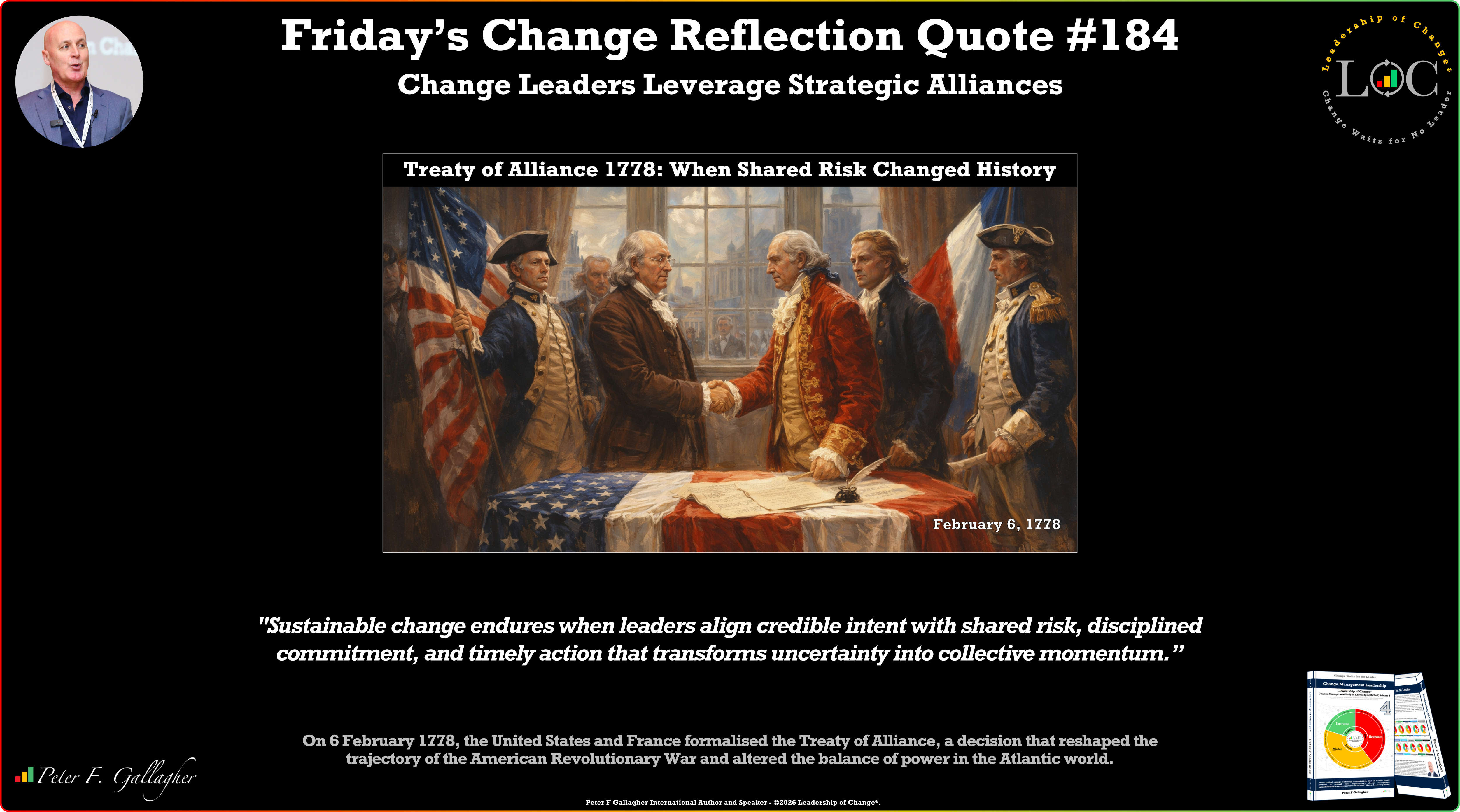
On this day, 6 February 1778, the United States and France formalised the Treaty of Alliance, a decision that reshaped the trajectory of the American Revolutionary War and altered the balance of power in the Atlantic world. What began as a fragile colonial rebellion gained credibility, resources, and strategic depth through this act of diplomatic alignment, transforming a precarious struggle into a viable nation-building effort. The alliance emerged from years of calculated hesitation rather than ideological enthusiasm. France, still recovering from its earlier defeat by Britain, recognised both opportunity and risk. Supporting the American colonies invited retaliation from Britain and threatened renewed continental conflict. For the American leadership, reliance on a foreign monarchy posed reputational dangers, ideological tensions, and the possibility of strategic dependence. Yet the realities of prolonged warfare, depleted finances, and limited naval capability forced a reassessment of what survival required. The decisive shift followed the American victory at Saratoga in 1777, which demonstrated to European observers that the rebellion possessed endurance and military competence. This single event reframed perceptions. France no longer viewed the colonies as an aspirational cause but as a credible partner capable of sustaining resistance. The Treaty of Alliance therefore represented not idealism, but pragmatic recalibration grounded in evidence and context. The agreement committed France to military, naval, and financial support while formally recognising American independence. In return, the United States pledged not to seek peace with Britain without French consent, binding both parties to a shared strategic horizon. This mutual exposure to risk reinforced commitment and reduced the likelihood of abandonment during moments of pressure. Its consequences extended far beyond the battlefield, forcing Britain to defend a dispersed empire and diluting its strategic focus. French naval involvement proved decisive, most notably at Yorktown in 1781, where British surrender effectively ended major hostilities. The Paris signing formalised a partnership that reshaped global perceptions of power and demonstrated how strategic alignment can alter the course of conflict. Beyond military outcomes, the treaty established an early precedent for modern strategic alliances built on shared interests rather than shared governance systems. It demonstrated that legitimacy, credibility, and timing matter profoundly when fragile entities seek external support. Misjudged alignment can destroy autonomy, yet delayed alignment can guarantee failure. This moment illustrates that consequential leadership decisions rarely offer comfort, only clarity of intent. Strategic courage often requires choosing exposure over isolation, uncertainty over stagnation, and partnership over purity. The treaty was signed by Benjamin Franklin, Silas Deane, and Arthur Lee on behalf of the United States, and by Conrad Alexandre Gérard for France, each recognising that the risks they accepted would reshape the future of both nations. This moment also reflects the Saeculum LeadershipTM discipline of recognising the Signal, the point at which capability, context, and strategic necessity converge to make alignment both possible and essential. Leaders who read the Signal accurately understand when the risks of isolation outweigh the risks of partnership, choosing disciplined alignment over reactive independence. It remains a reminder that transformation frequently requires courageous alignment under conditions of profound uncertainty.
Change Leadership Lessons: The Treaty of Alliance demonstrates that meaningful transformation depends not only on capability and timing but on leaders who can articulate a credible direction that encourages others to commit to shared risk and disciplined alignment. Leaders of change establish strategic credibility by demonstrating capability before external stakeholders commit resources, legitimacy, or long-term support under uncertainty. They enable enduring progress when commitments openly expose all parties to shared consequence reducing opportunism and reinforcing disciplined follow through. Change leaders privilege contextual readiness and evidence over ideological alignment or moral comfort when making decisions that shape complex change. They use formal agreements and constraints to stabilise collaboration when pressure fatigue and competing interests surface during extended change efforts. Leaders of change recognise that validation by credible external actors amplifies internal effort and accelerates the scale and sustainability of change outcomes. Change Leaders Leverage Strategic Alliances.
“Sustainable change endures when leaders align credible intent with shared risk, disciplined commitment, and timely action that transforms uncertainty into collective momentum.”
Application. Change Leadership Responsibility 1 - Articulate a Change Vision: A credible change vision provides the anchor point when leaders face uncertainty and must choose between isolation and strategic alignment. Just as the American cause gained legitimacy through demonstrated capability and clear intent, modern organisations secure commitment when leaders articulate a future state that is both ambitious and evidence based. This clarity enables stakeholders to understand what must be achieved, why collaboration is essential, and which trade offs are unavoidable. A well articulated vision does not eliminate uncertainty, it frames it, allowing decisions to be tested against purpose rather than pressure. When leaders communicate vision with conviction and credibility, they reduce drift, discourage opportunism, and create the conditions for shared commitment before challenges intensify. This responsibility ensures that long term transformation remains grounded in legitimacy, disciplined judgement, and purposeful direction.
Final Thoughts: Enduring change is secured when leaders articulate a credible vision that provides clarity of direction before complexity and uncertainty intensify. Although modern leaders have unprecedented access to data analytics, artificial intelligence, and predictive insight, the responsibility remains the same, vision must be timely, transparent, and legitimate to sustain trust and alignment. When leaders define a future state with conviction and disciplined intent, they create the conditions for collective commitment, ensuring transformation progresses through shared purpose rather than pressure or circumstance.
Further Reading: Change Management Leadership - Leadership of Change® Volume 4.
For further reading please visit our websites: https://www.a2b.consulting https://www.peterfgallagher.com Amazon.com: Peter F Gallagher: Books, Biography, Blog, Audiobooks, Kindle
Leadership of Change® Body of Knowledge Volumes: Change Management Body of Knowledge (CMBoK) Books: Volumes 1, 2, 3, 4, 5, 6, 7, 8, 9, 10, A, B, C, D & E available on both Amazon and Google Play:
~ Leadership of Change® Volume 1 - Change Management Fables
~ Leadership of Change® Volume 2 - Change Management Pocket Guide
~ Leadership of Change® Volume 3 - Change Management Handbook
~ Leadership of Change® Volume 4 - Change Management Leadership
~ Leadership of Change® Volume 5 - Change Management Adoption
~ Leadership of Change® Volume 6 - Change Management Behaviour
~ Leadership of Change® Volume 7 - Change Management Sponsorship
~ Leadership of Change® Volume 8 - Change Management Charade
~ Leadership of Change® Volume 9 - Change Management Insanity
~ Leadership of Change® Volume 10 - Change Management Dilenttante
~ Leadership of Change® Volume A - Change Management Gamification - Leadership
~ Leadership of Change® Volume B - Change Management Gamification - Adoption
Keywords: Business Strategy, Change Management, Leadership
 Two Clocks, One Truck: The Army's Need for Speed Meets New Defense Sourcing Rules
 Sustainable Transformation: The Elephant and The Mouse In The Room
 The Price of Standing Alone: Strategic Autonomy in a World Where Nobody Can Do It Alone
 The Potter’s Hands: Why Great Leaders Shape Environments, Not People
 The Corix Partners Friday Reading List - October 16, 2026