
Jan30
FCRQ183 Leadership Learning!
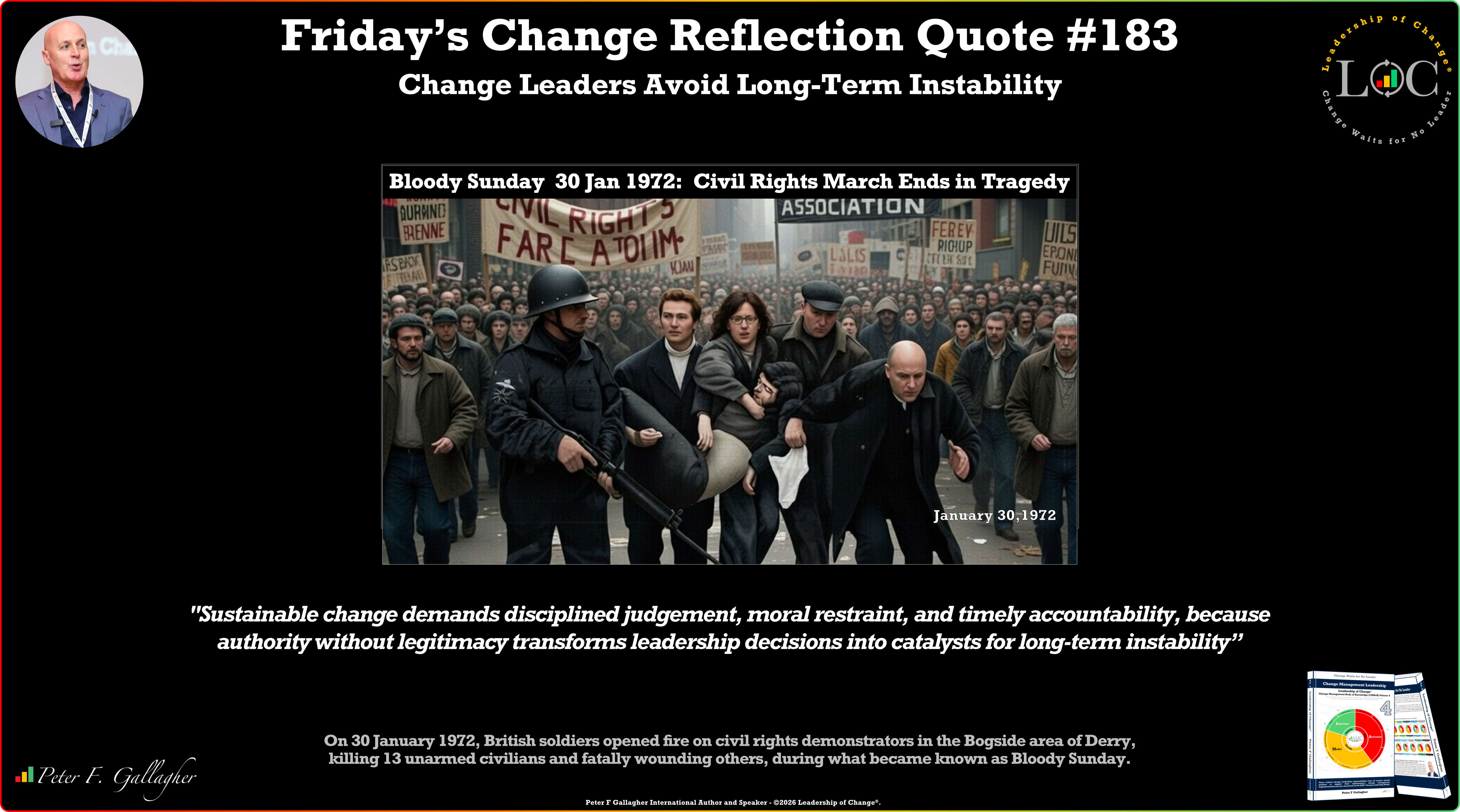
On 30 January 1972, British soldiers opened fire on civil rights demonstrators in the Bogside area of Derry, killing 13 unarmed civilians and fatally wounding others, during what became known as Bloody Sunday. A fourteenth victim died months later from his wounds. The events of that winter afternoon unfolded within a complex and deteriorating social environment in Northern Ireland. Civil rights marches had emerged in response to long-standing grievances concerning housing allocation, employment discrimination, voting rights, and the use of internment without trial. Tensions between communities were already acute, shaped by decades of mistrust, uneven governance, and escalating security responses. The march in Derry/Londonderry was intended as a protest against internment, which had been introduced by the Northern Ireland authorities in 1971. Despite being banned, organisers proceeded, reflecting a widening disconnect between state authority and public legitimacy. British troops from the Parachute Regiment were deployed to police the event, operating under orders framed by concerns about disorder, paramilitary activity, and loss of control. What followed marked a decisive rupture. Soldiers fired live ammunition into a crowd of civilians who were fleeing, assisting the wounded, or observing. No weapons were found on those killed. Immediate official statements suggested soldiers had responded to gunfire and nail bombs, claims that were later systematically discredited. Initial investigations reinforced official narratives, further deepening public anger and eroding trust. The long-term consequences were profound. Public confidence in institutions collapsed across nationalist communities. Recruitment to paramilitary organisations increased sharply in the aftermath. International opinion shifted, placing sustained scrutiny on British governance in Northern Ireland. The event became a defining signal of systemic failure, not only in tactical decision-making, but in judgement, accountability, and moral authority. Decades later, the Saville Inquiry concluded that the killings were unjustified and unjustifiable. On 15 June 2010, Prime Minister David Cameron formally apologised on behalf of the British government, acknowledging the innocence of those who died and the failure of the state to uphold its responsibilities. The delay in reaching this acknowledgement itself became part of the legacy, reinforcing perceptions of institutional defensiveness and resistance to truth. Bloody Sunday remains a reference point in discussions of legitimacy, authority, and the consequences of misjudged force. It illustrates how rapidly trust can be destroyed when power is exercised without proportionality, clarity, or accountability. The event also demonstrates how unresolved grievances, when met with coercive response, can accelerate cycles of instability rather than restore order. This event became a stark Saeculum Leadership™ Signal, marking a generational inflection point where trust in state authority was fundamentally shattered, accelerating a long-cycle societal shift. The inquiry and subsequent apology stand as a Signal, an encoded acknowledgement that misjudged force, without accountability, redefines public legitimacy for decades to come. Its historical significance lies not only in the loss of life, but in how a single day altered the trajectory of a conflict, reshaped public perception, and embedded a cautionary signal about the cost of failing to understand context, consequence, and responsibility.
Change Leadership Lessons: These historical events, when viewed through a change leadership lens, offer critical insights into authority and instability. Leaders of change establish legitimacy by exercising authority with restraint and context awareness to prevent irreversible loss of trust. They recognise that delayed accountability deepens harm and that timely acknowledgement preserves institutional credibility during disruption. Change leaders understand roles matter because deploying unsuitable capabilities under pressure increases risk and accelerates escalation. They prioritise judgement over force knowing short term control decisions often generate long term instability. Leaders of change accept that narrative defence cannot substitute for transparency when rebuilding trust after failure. Change Leaders Avoid Long-Term Instability.
“Sustainable change demands disciplined judgement, moral restraint, and timely accountability, because authority without legitimacy transforms leadership decisions into catalysts for long-term instability.”
Application - Change Leadership Responsibility 3 - Intervene to Ensure Sustainable Change: These lessons move beyond history and point directly to the responsibility leaders carry to intervene when trust and stability are at risk. Change leaders must identify the precise moments when their authority begins to erode legitimacy. Sustainable change requires recognising when existing strategies produce consequences that damage stability rather than strengthen it. Within organisations, this manifests when leaders defend outdated policies despite evidence of organisational harm, delaying necessary intervention. Delayed accountability compounds harm by signalling detachment from lived reality. Effective leadership intervention demands disciplined judgement, careful assessment of context, and a commitment to address systemic failure before it leads to rupture. Leaders are accountable for creating mechanisms that uphold transparency and ensure the ethical execution of power, preventing situations where power is exercised without proportionality.
Final Thoughts: Effective leadership in complex environments demands proactive intervention based on sound judgement, not reaction based on force. The integration of AI-driven data analytics offers new tools to assess risk and ensure decisions uphold legitimacy before instability takes hold. Leadership that intervenes decisively, transparently, and with context awareness is what separates change that endures from change that fractures institutions and communities.
Further Reading: Change Management Leadership - Leadership of Change® Volume 4.
For further reading please visit our websites: https://www.a2b.consulting https://www.peterfgallagher.com Amazon.com: Peter F Gallagher: Books, Biography, Blog, Audiobooks, Kindle
Leadership of Change® Body of Knowledge Volumes: Change Management Body of Knowledge (CMBoK) Books: Volumes 1, 2, 3, 4, 5, 6, 7, 8, 9, 10, A, B, C, D & E available on both Amazon and Google Play:
~ Leadership of Change® Volume 1 - Change Management Fables
~ Leadership of Change® Volume 2 - Change Management Pocket Guide
~ Leadership of Change® Volume 3 - Change Management Handbook
~ Leadership of Change® Volume 4 - Change Management Leadership
~ Leadership of Change® Volume 5 - Change Management Adoption
~ Leadership of Change® Volume 6 - Change Management Behaviour
~ Leadership of Change® Volume 7 - Change Management Sponsorship
~ Leadership of Change® Volume 8 - Change Management Charade
~ Leadership of Change® Volume 9 - Change Management Insanity
~ Leadership of Change® Volume 10 - Change Management Dilenttante
~ Leadership of Change® Volume A - Change Management Gamification - Leadership
~ Leadership of Change® Volume B - Change Management Gamification - Adoption
Keywords: Business Strategy, Change Management, Leadership
 The Corix Partners Friday Reading List - October 16, 2026Friday’s Leadership Reflection Quote – Saeculum Leadership Leaders Separate Known Facts from Fear
 You are not your diagnosis
 Is GenAI good for anything?
 “I didn’t write an award acceptance speech because I didn’t expect to win.”