Apr20

Most corporate sustainability programs are reporting programs wearing a different name. This is not a controversial claim inside the function. It is an open secret among the people doing the work. The disclosure cycle consumes the staff, the software, the consulting spend, and the executive attention. What is left over goes to actual change. In most organizations, what is left over is not much.
The uncomfortable part is that this arrangement works for almost everyone involved. Regulators get filings. Auditors get fees. Rating agencies get inputs. Consultants get renewals. Executives get a defensible story. Sustainability staff get job security tied to a compliance calendar. The only party that does not benefit is the thing the program is ostensibly about, which is the environmental and social system the company operates inside. That system does not read reports.
If you want to know whether a company's sustainability function is doing anything, the report will not tell you. Look instead at three decisions. Look at how capital is allocated, because that is where the future footprint is set. Look at what procurement is willing to reject, because that is where the supply chain is shaped. Look at which projects get killed at gate review, because that is where intent meets authority. In most companies, the sustainability function has no binding role in any of these. It is consulted. It is not decisive. The people who decide are the same people who decided before the function existed, applying the same criteria they applied before.
This is why emissions curves do not bend in proportion to the reporting volume. The reports have scaled. The authority has not. A function without decision rights cannot produce decisions, no matter how well it documents the ones made by others.
The phrase that should make people uncomfortable is the one used to defend the current posture. The claim is usually that reporting drives behavior, that disclosure creates pressure, that transparency is itself a form of governance. There is a narrow version of this that is true and a broad version that is used as cover. The narrow version is that disclosure creates some external accountability for egregious outliers. The broad version is that a well-run reporting program is equivalent to a well-run sustainability program. The broad version is what most organizations operate on, and it is not supported by the evidence of the last fifteen years. Reporting has expanded. Material outcomes have not tracked with the expansion.
The integrity risk here is specific. It is not that companies are lying in their reports. Most are not. The risk is that the reports are technically accurate and substantively irrelevant. A report can be assured, aligned to every applicable framework, reviewed by the board, praised by analysts, and describe an operating model that is not meaningfully different from the one in place ten years ago. Compliance and consequence have decoupled. The function has learned to produce the first without producing the second, and the incentives to keep that arrangement in place are stronger than the incentives to disturb it.
For practitioners, the question is whether the role is structured to change decisions or to describe them. For boards, the question is whether the sustainability governance they oversee has authority or only visibility. For executives, the question is whether they are willing to move decision rights, because nothing else they do will close the gap between what the report says and what the company does.
The report is not the program. The program is whatever survives contact with the capital plan. In most companies, very little does.
By Joel Carboni
Keywords: Sustainability
 FROM THE AISLE Field Notes on AI Implementation
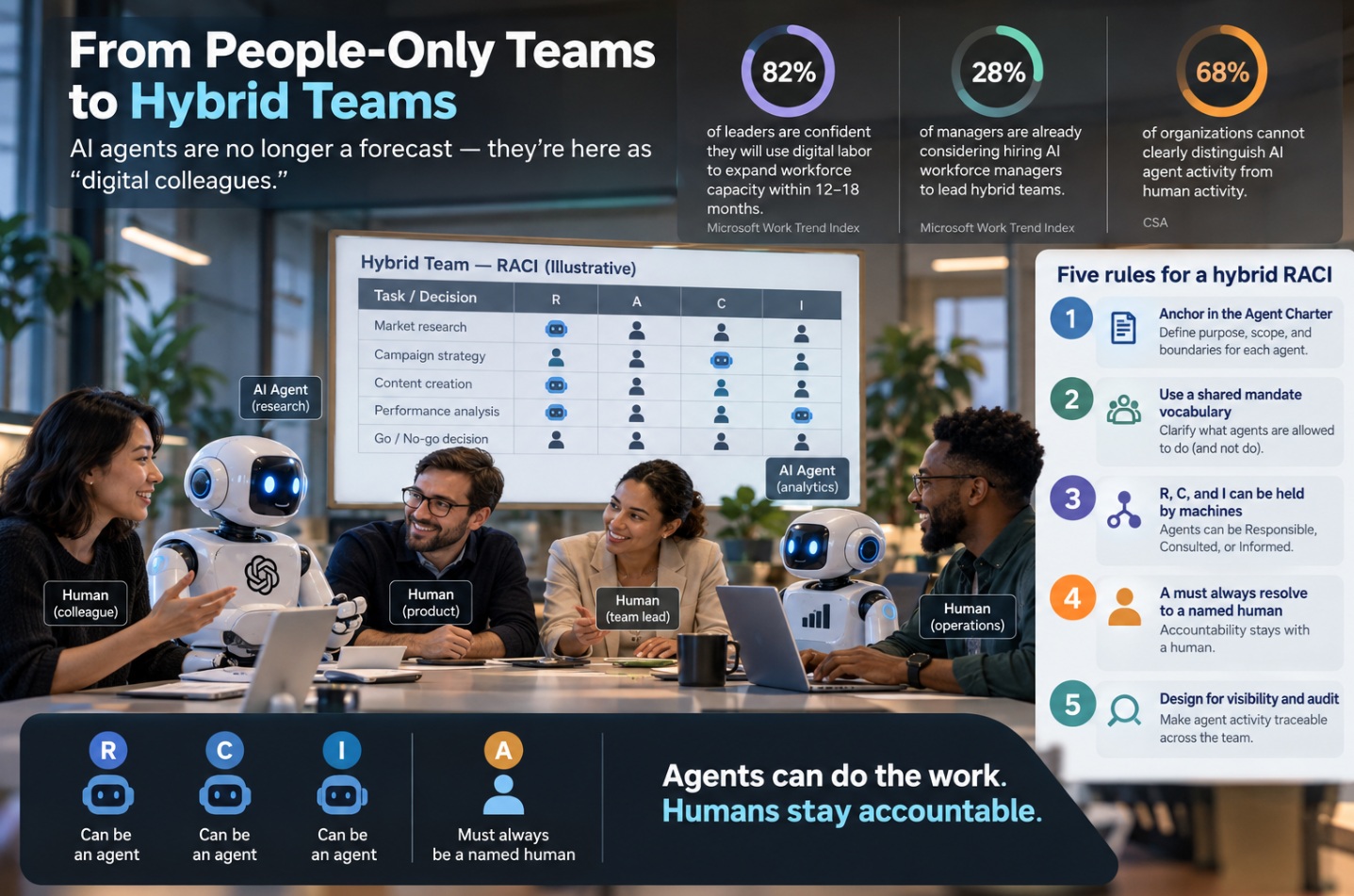 The Hybrid Team: Rethinking RACI When Some of Your Team Members Are Machines
 Two Clocks, One Truck: The Army's Need for Speed Meets New Defense Sourcing Rules
 Sustainable Transformation: The Elephant and The Mouse In The Room
 The Price of Standing Alone: Strategic Autonomy in a World Where Nobody Can Do It Alone