May08
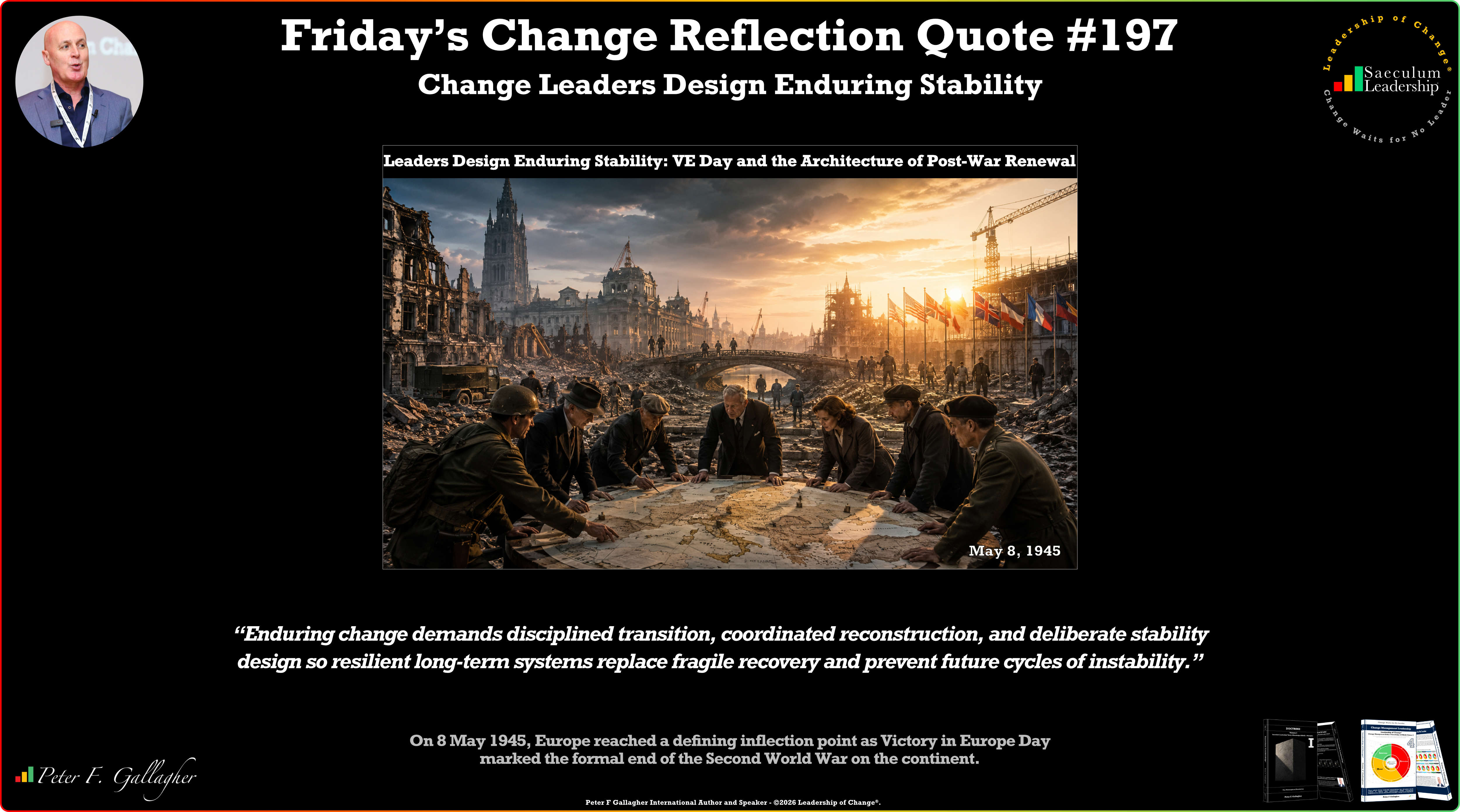
On 8 May 1945, Europe reached a defining inflection point as Victory in Europe Day marked the formal end of the Second World War on the continent. After nearly six years of sustained conflict, destruction, and systemic disruption, Nazi Germany’s unconditional surrender brought hostilities in Europe to a close. Cities lay in ruins, economies were fractured, and millions had been displaced or lost. The event represented not only military victory, but the cessation of one of the most destructive cycles in modern history.
The significance of this moment extended far beyond military victory. Governments, institutions, and populations were confronted with the immediate reality that victory did not equate to stability. The infrastructure of entire nations had been dismantled, political systems were under strain, and trust between states had been fundamentally eroded. While the end of combat created relief, it simultaneously exposed the scale of reconstruction required across economic, social, and governance domains.
Leadership at this moment required more than wartime coordination and military command. It demanded the transition from conflict to recovery, from fragmentation to coordination, and from short term survival to long term renewal. Decisions taken in the days and months following this moment would shape the geopolitical and economic architecture of the second half of the twentieth century. The emergence of new alliances, the formation of international institutions, and the redefinition of national priorities all traced their origins to this turning point.
The challenge was compounded by the psychological and societal toll of prolonged conflict. Populations required reassurance, direction, and clarity about the future. Leaders were required to project confidence while confronting uncertainty, to rebuild confidence while managing scarcity, and to align disparate national interests into coherent frameworks that could prevent recurrence of such destruction.
This moment stands as a powerful illustration of large-scale systemic transition under extreme conditions. It highlights the complexity of moving from one operational paradigm to another, particularly when the existing structures have been fundamentally compromised. The scale of coordination required across nations, sectors, and institutions underscores the importance of deliberate, structured approaches to large scale transformation.
In the aftermath, the foundations for long term peace and economic cooperation began to take shape, influencing the creation of institutions that continue to define global governance today. The event therefore represented not an end point, but the beginning of a prolonged era of reconstruction and reorganisation that required sustained leadership focus over decades.
This moment remains one of history’s clearest demonstrations of how large-scale disruption compels institutional redesign. It reinforces that the conclusion of a crisis is often the starting point of a more complex phase, where the absence of conflict reveals the full extent of transformation required to achieve durable stability. This moment became a defining Saeculum Leadership®Signal, revealing that the real turning point was not the event itself, but the shift in meaning leaders assigned to it. When leaders interpret such signals with clarity, they convert disruption into the first disciplined step of a new era.
Change Leadership Lessons: Victory may end conflict, but leadership determines whether recovery becomes lasting stability. Events create the facts. Leadership creates the meaning. What emerged across Europe was not accidental recovery, but disciplined transformation sustained over decades. Leaders of change establish disciplined transitions that convert instability into structured recovery while maintaining clarity of direction and purpose. They ensure coordinated reconstruction across systems so that fragmented efforts do not undermine the effectiveness of recovery initiatives. Change leaders deliberately design stability through institutions, governance structures, and policies that reinforce long term resilience and operational continuity. They balance immediate recovery demands with long-term system design to prevent recurring cycles of disruption and instability. Leaders of change align stakeholders and resources to ensure reconstruction efforts deliver sustainable outcomes across complex and interconnected environments. Change Leaders Design Enduring Stability.
“Enduring change demands disciplined transition, coordinated reconstruction, and deliberate stability design so resilient long-term systems replace fragile recovery and prevent future cycles of instability.”
Application - Change Leadership Responsibility 1 – Articulate the Change Vision: The end of conflict in Europe during May 1945 did not automatically create stability, recovery, or lasting peace. Those outcomes required leaders capable of articulating a credible vision for reconstruction at a moment when institutions were damaged, populations exhausted, and uncertainty widespread. Effective change leadership begins when leaders interpret emerging conditions with clarity and honesty and transform that understanding into a coherent future direction others can align behind with confidence and discipline.
A meaningful change vision is not aspirational rhetoric separated from operational reality. It is the disciplined explanation of why existing conditions can no longer continue, what structural changes are required, and how coordinated action can create long-term stability. In the aftermath of war, leaders were required to connect immediate recovery efforts to a broader vision of economic cooperation, institutional redesign, and international coordination capable of preventing future systemic collapse.
That responsibility remains central to leadership today. People sustain commitment when they understand both the necessity for change and the pathway through uncertainty toward a more resilient future toward a more resilient future. Leaders therefore carry the obligation to translate complexity into clarity, ensuring disruption becomes a catalyst for disciplined reconstruction rather than prolonged instability or fragmented reaction.
Final Thoughts: Victory in Europe Day marked more than the end of conflict, it initiated a new civilisational era shaped by reconstruction, institutional redesign, and strategic cooperation across generations. AI now accelerates how leaders detect instability, coordinate recovery, and anticipate systemic risk, while simultaneously exposing the fragility of poorly designed systems. Leaders of change must therefore move beyond reactive crisis management and deliberately construct resilient structures capable of sustaining long-term stability across future generations.
Further Reading: Change Management Leadership® - Leadership of Change® Volume 4 and Saeculum Leadership®: Doctrine – Volume I.
For further insights please visit our websites: https://www.a2b.consulting https://www.peterfgallagher.com Amazon.com: Peter F Gallagher: Books, Biography, Blog, Audiobooks, Kindle
Leadership of Change® Body of Knowledge Volumes: Change Management Body of Knowledge (CMBoK) Books: Volumes 1-10.A-E & I-5
~ Leadership of Change® Volume 1 - Change Management Fables
~ Leadership of Change® Volume 2 - Change Management Pocket Guide
~ Leadership of Change® Volume 3 - Change Management Handbook
~ Leadership of Change® Volume 4 - Change Management Leadership
~ Leadership of Change® Volume 5 - Change Management Adoption
~ Leadership of Change® Volume 6 - Change Management Behaviour
~ Leadership of Change® Volume 7 - Change Management Sponsorship
~ Leadership of Change® Volume 8 - Change Management Charade
~ Leadership of Change® Volume 9 - Change Management Insanity
~ Leadership of Change® Volume 10 - Change Management Dilenttante
~ Leadership of Change® Volume A - Change Management Gamification - Leadership
~ Leadership of Change® Volume B - Change Management Gamification - Adoption
Keywords: Business Strategy, Change Management, Leadership
 Two Clocks, One Truck: The Army's Need for Speed Meets New Defense Sourcing Rules
 Sustainable Transformation: The Elephant and The Mouse In The Room
 The Price of Standing Alone: Strategic Autonomy in a World Where Nobody Can Do It Alone
 The Potter’s Hands: Why Great Leaders Shape Environments, Not People
 The Corix Partners Friday Reading List - October 16, 2026