Dec18
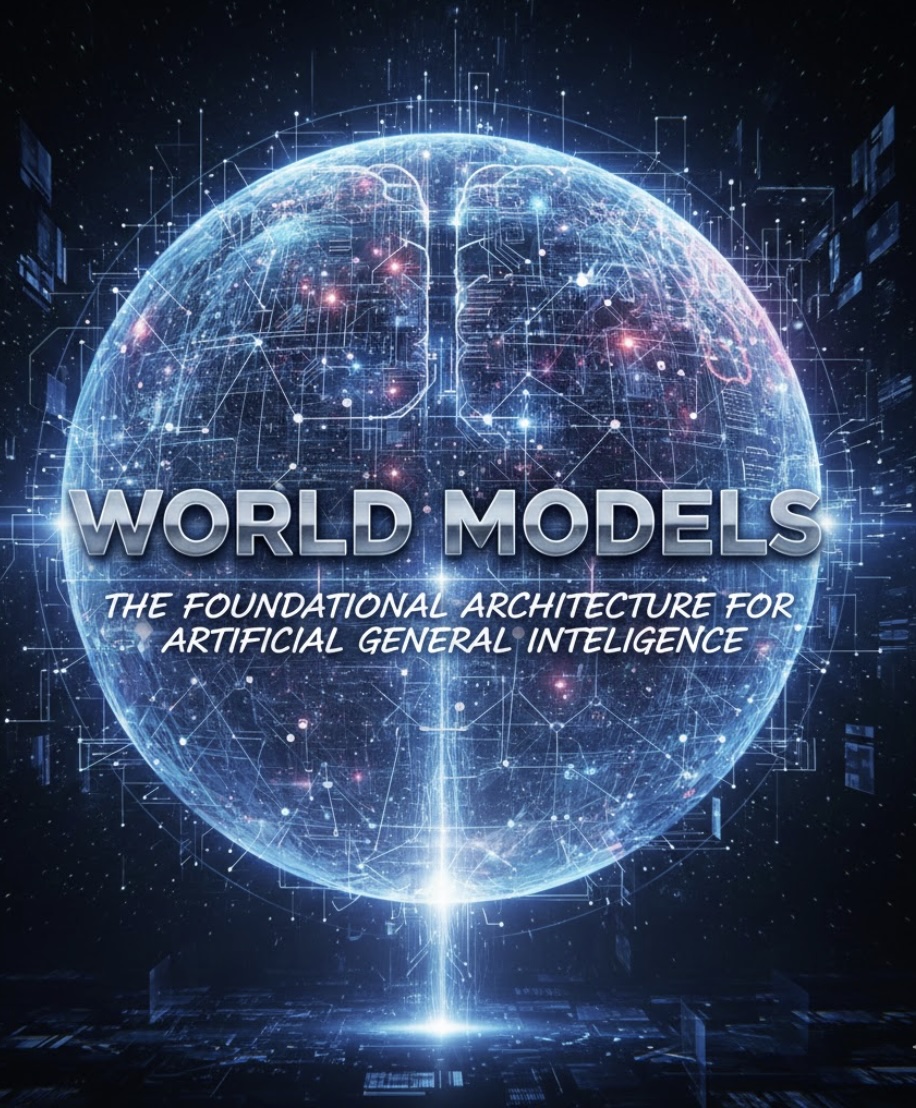
The pursuit of Artificial General Intelligence (AGI)—systems capable of learning, understanding, and applying intelligence across diverse tasks like a human—is hampered by a fundamental flaw in current AI architectures. Contemporary deep learning models, while exhibiting spectacular performance in narrow domains, are overwhelmingly data inefficient, often requiring millions of examples to learn what a child grasps in one or two. Furthermore, they struggle with causality and long-horizon planning, operating primarily as powerful, yet reactive, pattern matchers. The solution lies in a cognitive architecture that mirrors the human brain's most powerful feature: the ability to imagine. This architecture is the World Model. Far from being merely a robotics tool, World Models represent the most promising paradigm shift toward AGI, fundamentally by teaching AI systems the basic, causal, and common-sense principles of the world, whether physical, biological, or digital.
The concept of an internal model for predicting the future is not a new invention but an evolutionary convergence of ideas from psychology, control theory, and machine learning.
The philosophical foundation of World Models lies in theories of human cognition. As early as the 1940s, a prominent psychologist proposed that the human mind builds "small-scale models" of external reality to anticipate events and "try out various alternatives" before taking action. This concept—that the brain acts as an internal simulator—is the psychological ancestor of the computational World Model. Concurrently, in engineering, model-based control became standard. This approach, encapsulated in the Good Regulator Theorem (which states that every good regulator of a system must be a model of that system), relied on explicit mathematical models of a plant's dynamics to calculate control signals, establishing the mathematical necessity of an internal system model for adequate control.
The transition to modern AI began when researchers sought to merge the explicit models of control theory with the learning capabilities of early machine learning. In 1990, the Dyna architecture was proposed, representing one of the earliest explicit integrations of planning and Reinforcement Learning (RL). Dyna agents used real-world experience to train a simple transition model, which was then used to generate simulated experience (planning in imagination) to train the agent's policy further. This was a crucial shift, demonstrating that simulated experience could accelerate real-world learning and directly prefiguring the sample-efficiency argument. Pre-deep learning approaches, however, were limited because their models relied on hand-crafted state features, making them too brittle to handle the complexity of raw sensory data, such as pixels.
The breakthrough arrived when deep neural networks provided the tools to manage high-dimensional inputs. The seminal "World Models" paper formalized the modern concept. The key innovation was using deep learning architectures (such as Variational Autoencoders) to address the perception problem: the Encoder Model compressed raw pixels into a low-dimensional latent space. This allowed the Dynamics Model to efficiently predict the future in this abstract, computationally efficient space. Subsequent advancements in algorithms established latent imagination as the state of the art for continuous control. Today, this concept is scaling to foundation models (such as those used for text-to-video generation), which are widely viewed as powerful, generative World Models that learn physics from video data, cementing the architecture as the core cognitive piece required for general intelligence.
Having established its historical roots, the World Model's first modern contribution is to address the sample-efficiency crisis plaguing Model-Free Reinforcement Learning (RL). Traditional RL agents learn through massive trial-and-error, directly mapping sensory inputs to actions based on accumulated reward. This methodology is impossibly slow and resource-intensive for real-world applications, proving infeasible for tasks that require physical interaction or long training cycles. World Models resolve this by functioning as a generative internal simulator. The system first learns an Encoder Model to compress high-dimensional raw inputs (like video frames) into a concise, low-dimensional latent space. Crucially, the Dynamics Model is then trained to predict the next latent state from the current state and the chosen action. This enables the agent to perform latent-space planning—or "dreaming"—by running forward simulations entirely within the model, generating synthetic experience data at extremely high speed. In applications like Game AI, agents can accrue millions of virtual interactions, accelerating learning and achieving far greater sample efficiency than their real-world counterparts. This ability to learn from imagination rather than constant real-world interaction is a non-negotiable step toward AGI.
A second failure of reactive AI is its inability to perform long-horizon planning—the capacity to sequence dozens of steps to achieve a distant goal—and to ensure safety through foresight. Reactive systems select the best immediate action based on the current state. World Models imbue the agent with accurate temporal foresight and causal understanding. By using its internal Dynamics Model, the agent can perform counterfactual reasoning: it can simulate multiple possible futures resulting from different initial actions and evaluate which sequence maximizes the long-term expected reward. This is essential for safety-critical non-robotics applications. For instance, in Autonomous Vehicles (AVs), the World Model is used not just to classify objects, but to predict the trajectories of all surrounding vehicles and pedestrians over the next five seconds. This allows the system to test a potentially risky maneuver (e.g., a lane change) in simulation and predict a catastrophic outcome (a crash) before executing it in reality, making the system safer and more deliberative.
Modelling Complex, Generalized Digital Dynamics
The significance of World Models extends beyond the domain of physical reality to any system governed by complex, high-dimensional dynamic principles. The goal of AGI is to generalize, and World Models are the architecture for learning generalized dynamics—traditional, equation-based modelling struggles with the non-linear, chaotic nature of systems like climate or financial markets. World Models, however, are trained to find the underlying dynamical principles of any system, regardless of its domain. They are purely statistical models that learn the flow of complex data. This has far-reaching applications in Climate modelling and Forecasting. By training World Models on massive datasets of satellite imagery and atmospheric sensor readings, systems learn the physics of the atmosphere and oceans, providing more accurate, physics-consistent, and high-resolution forecasts than older methods. Similarly, dynamic network systems (traffic, supply chains, economics) can be modelled. By succeeding in these diverse, non-physical domains, World Models demonstrate their fundamental nature as a general-purpose cognitive tool, capable of abstracting and predicting the rules of any complex system.
Finally, World Models provide the crucial link that currently separates powerful Large Language Models (LLMs) from achieving AGI: grounding and common sense. While LLMs are masters of linguistic reasoning, they are essentially "brains floating in linguistic space," lacking an understanding of the physical consequences of the words they use (e.g., gravity, friction, object permanence). A World Model, particularly one trained on massive amounts of video and sensorimotor data (a Vision-Language-Action, or VLA, foundation), learns the intuitive physics of the world purely through observation. This provides the causal framework—the "rules of reality"—that an LLM can reference. A complete AGI will likely use the LLM for high-level, symbolic reasoning and planning, while delegating the physical plausibility checks to the World Model. This integration solves the Reality Gap and transforms symbolic reasoning into physically grounded action, ensuring that abstract plans are causally coherent and robust against unexpected real-world events.
The advancement of AI towards AGI necessitates a cognitive architecture that transcends simple pattern matching. World Models deliver on this necessity by implementing an internal simulator capable of imagination and foresight. They are the mechanism that provides four essential capabilities for general intelligence: radical sample efficiency through dreaming, robust long-horizon planning via counterfactual reasoning, generalized modelling across diverse dynamic systems, and the grounding of language in physical reality. By moving AI from reactive systems to predictive, deliberative agents, World Models are not just improving existing technology—they are realizing the historical convergence of cognitive theory and engineering by constructing the necessary cognitive backbone that will define the next generation of generally intelligent machines.
Keywords: Agentic AI, AGI, Generative AI
 You are not your diagnosis
 Is GenAI good for anything?
 “I didn’t write an award acceptance speech because I didn’t expect to win.”
 AI Is Exposing the Data Problems Humans Used to Hide
 "The AI may in fact be conscious." Really?