Sep15
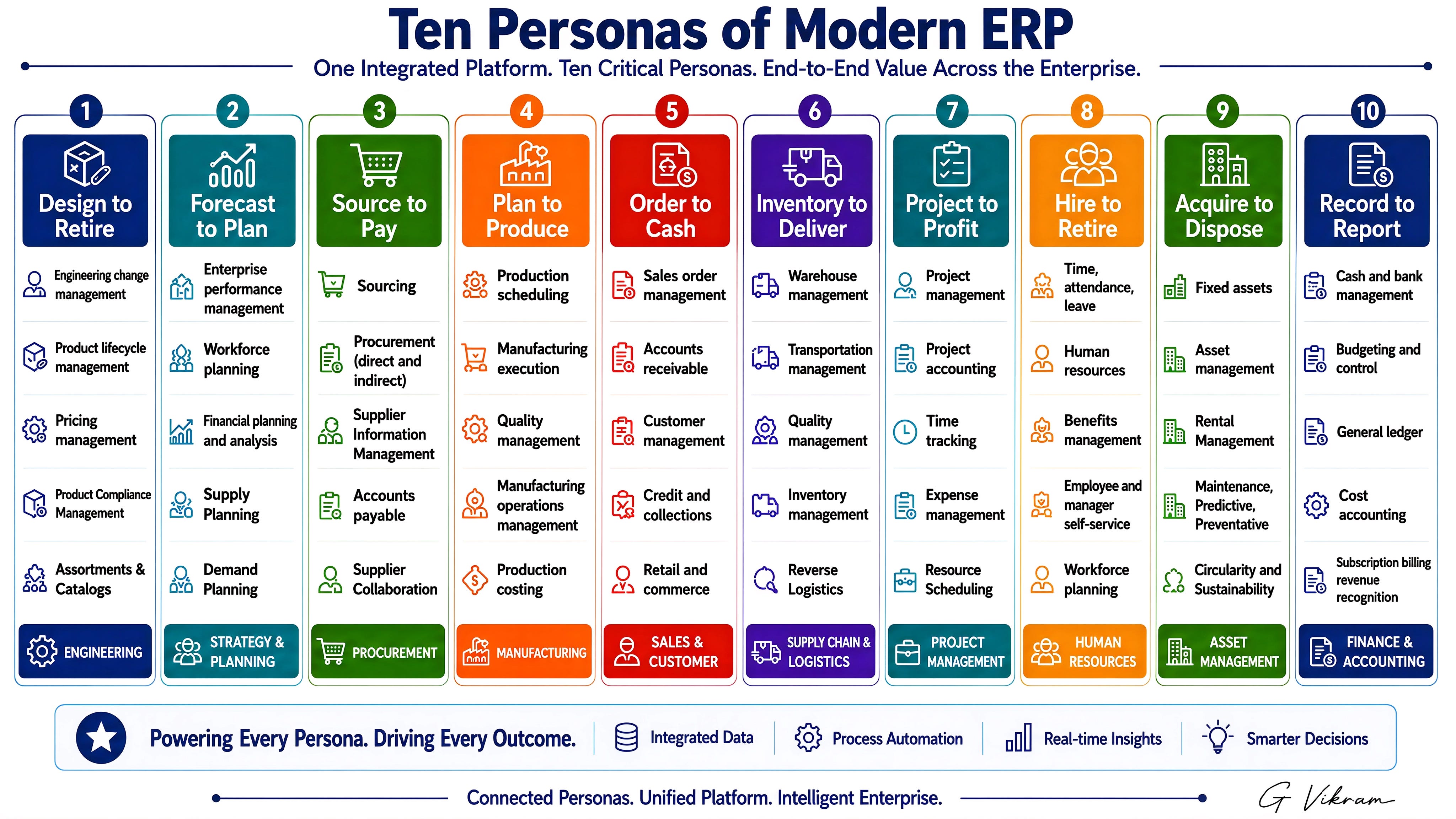
It is becoming the enterprise operating system that connects people, processes, data, and decisions across the full business value chain.
For years, ERP was discussed in terms of modules.
Finance module. Procurement module. Inventory module. HR module. Manufacturing module.
But that language is becoming outdated.
The better question today is not:
“Which ERP modules do we need?”
The better question is:
“Which enterprise personas are we enabling?”
Because ERP value is not created by software alone.
It is created when every critical business persona can make faster, cleaner, and better decisions from one connected platform.
This is the engineering and product lifecycle persona.
It covers engineering change management, product lifecycle management, compliance, pricing, assortments, and catalogs.
The real value is simple:
Build the right product before trying to build it efficiently.
This is the strategy and planning persona.
It connects enterprise performance management, workforce planning, financial planning, supply planning, and demand planning.
This persona helps organizations move from reactive planning to continuous business alignment.
Strategy becomes executable only when planning is connected.
This is the procurement persona.
It includes sourcing, procurement, supplier management, accounts payable, and supplier collaboration.
Modern procurement is no longer only about buying cheaper.
It is about building resilient supplier ecosystems.
Procurement becomes strategic when supplier decisions are connected to cost, quality, risk, and demand.
This is the manufacturing persona.
It connects production scheduling, manufacturing execution, quality management, operations management, and production costing.
This is where ERP meets the shop floor.
The goal is not just production efficiency.
The goal is predictable, quality-driven, demand-aligned manufacturing.
Manufacturing value is created when planning and execution speak the same language.
This is the sales and customer persona.
It covers sales order management, accounts receivable, customer management, credit and collections, retail, and commerce.
Revenue is not created when an order is booked.
Revenue is created when the entire commercial cycle is executed without friction.
Customer demand must flow cleanly into cash realization.
This is the supply chain and logistics persona.
It includes warehouse management, transportation, quality, inventory management, and reverse logistics.
Modern supply chains are not judged only by how much inventory they hold.
They are judged by how well they respond.
The future of supply chain is not inventory visibility alone. It is delivery intelligence.
This is the project management persona.
It includes project management, project accounting, time tracking, expense management, and resource scheduling.
For project-driven organizations, execution and profitability must be visible together.
A project is not successful just because it is completed. It is successful when it delivers margin, discipline, and measurable value.
This is the human resources persona.
It covers attendance, leave, human resources, benefits, employee self-service, manager self-service, and workforce planning.
ERP transformation often talks about process and technology.
But workforce capability is where transformation becomes real.
People are not just users of ERP. They are the enterprise capacity behind it.
This is the asset management persona.
It includes fixed assets, asset management, rental management, maintenance, predictive maintenance, circularity, and sustainability.
Assets are not just accounting entries.
They are performance engines.
The modern enterprise must manage assets for uptime, lifecycle value, sustainability, and return on capital.
This is the finance and accounting persona.
It includes cash and bank management, budgeting, general ledger, cost accounting, subscription billing, and revenue recognition.
Finance remains the enterprise source of truth.
But modern finance is moving beyond reporting history.
Finance must become a real-time performance intelligence function.
The Bigger ERP Shift
The real power of ERP is not in any one persona.
It is in the connection between them.
Design influences procurement.
Procurement impacts production.
Production affects inventory.
Inventory affects delivery.
Delivery affects revenue.
Revenue affects finance.
Finance influences planning.
Planning shapes workforce and asset decisions.
This is why ERP must be treated as an integrated enterprise platform, not a set of disconnected departmental systems.
The Four Foundations
Every modern ERP transformation depends on four foundations.
Integrated data creates one source of truth across the enterprise.
Process automation reduces manual effort and improves consistency.
Real-time insights help leaders act before problems become expensive.
Smarter decisions turn ERP from a recording system into a decision platform.
Without these foundations, ERP becomes another expensive transaction system.
With them, ERP becomes the intelligence layer of the enterprise.
Final Thought
Modern ERP is not about digitizing departments.
It is about connecting enterprise personas.
The strongest organizations will not be the ones with the most ERP modules.
They will be the ones where engineering, planning, procurement, manufacturing, supply chain, projects, HR, assets, and finance operate from one shared platform.
That is when ERP stops being back-office software.
That is when ERP becomes the operating system of the modern enterprise.
Modern ERP is not a system of records anymore.
It is a system of connected decisions.
By G Vikram
Keywords: Digital Transformation, Manufacturing
 Consumer vs. enterprise AI agents
 Best Supply Chain AI Tools in 2026: SCM SENSEI AI and Ask Lora Compared
 Making Silos Permeable
 The Corix Partners Friday Reading List - October 2, 2026
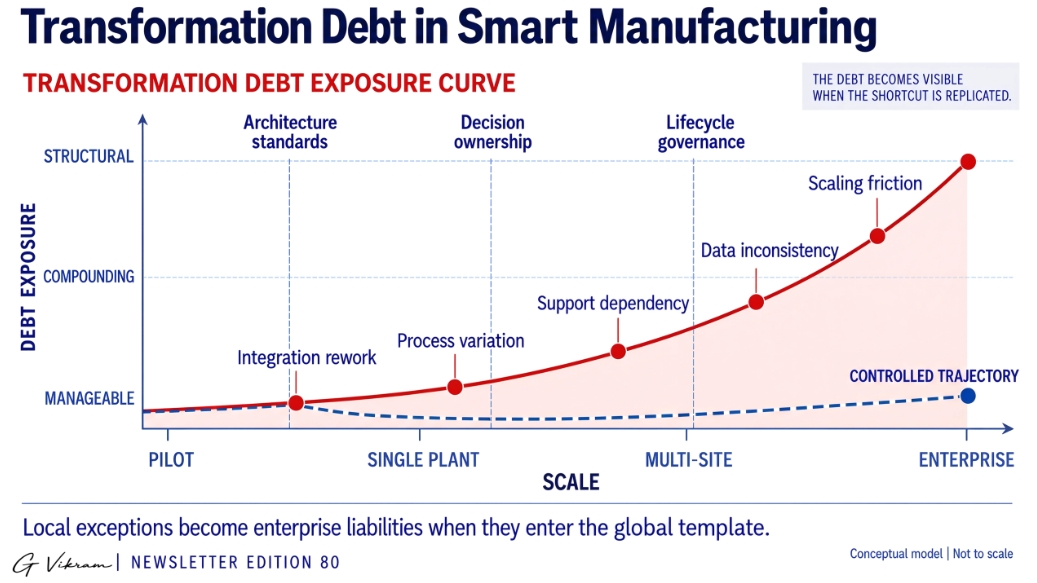 The most dangerous debt in a smart factory isn’t financial.