Dec20
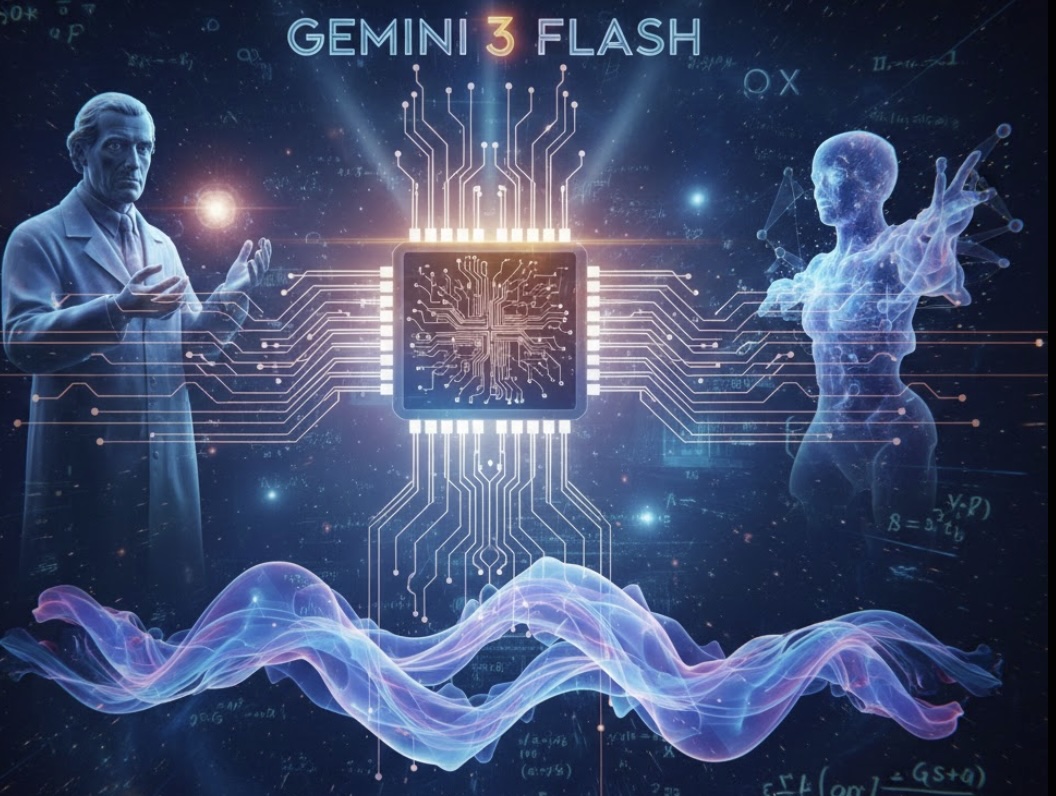
In 1924, Satyendra Nath Bose fundamentally altered the course of physics by describing a world where particles with integer spin—bosons—could overlap to form a single, coherent "super-atom." This state of matter, the Bose–Einstein Condensate (BEC), remained a theoretical prediction for 71 years until experimentalists finally achieved the required nanokelvin temperatures in 1995. Today, we are entering a third era of this legacy: one in which the observer is no longer just a human physicist but an Agentic AI capable of reasoning about the complex visual signatures of quantum matter.
The current implementation of a BEC simulation integrated with Gemini 3 Flash demonstrates a profound shift in scientific discovery. By combining a physics-based simulation with a "High Reasoning" AI agent, we create a closed-loop system where the machine generates data, visualizes it, and applies "Chain of Thought" reasoning to validate physical laws.
1. The Virtual Laboratory: Simulating the "Spike"
The simulation environment mimics the cooling of a boson gas. At high temperatures ($1.0\text{K}$), the system follows classical Maxwell–Boltzmann statistics, producing a broad, unimodal Gaussian distribution in its momentum space. As the simulation "cools" the system toward absolute zero ($0.01\text{K}$), it triggers the phase transition predicted by Bose: a macroscopic fraction of particles suddenly occupies the lowest-energy state. Visually, this is captured in a momentum histogram as a bimodal distribution—a sharp, high-density central spike sitting atop a broad thermal "pedestal."
2. The Architecture of Discovery: A Deep Dive into the Agentic BEC Simulation
The implementation of this demo is not merely a script but a closed-loop agentic ecosystem. It bridges the gap between classical numerical simulation and modern "High Reasoning" AI.
I. Physics Engine: The Stochastic Modelling of Bosons
The core of the simulation lies in the generate_bec_visual(temp) function, which uses the numpy library to model momentum distribution:
II. Multimodal Data Pipeline: In-Memory Visualization
To maintain a high-speed workflow, the system avoids the bottleneck of local file storage:
III. The Reasoning Agent: Gemini 3 Flash "High" Level
The most critical component is the call to the Gemini 3 Flash API using high-level reasoning configurations:
3. Results: Observed Simulation Phases
Based on the integrated simulation and analysis files, the following states were successfully identified:
Core Objective: The project demonstrates an agentic scientific workflow using Gemini 3 Flash to bridge the gap between numerical simulation and high-level physical reasoning
Phase | Temperature | Agent Observation | Scientific Verdict |
Normal Gas | 1.0K | Unimodal, broad Gaussian distribution (Maxwell-Boltzmann). | No BEC formed. |
Critical Region | 0.1K | Emergence of a bimodal distribution; onset of ground-state occupation. | BEC formed. |
Condensate | 0.01K | Distinct, sharp central spike sitting on a broad thermal "pedestal". | BEC formation confirmed. |
Key Agentic Insights:
4. Conclusion: The Impact of Gemini 3 Flash on Scientific Discovery
The integration of Gemini 3 Flash into the analysis of Bose–Einstein condensates (BEC) represents a transformative leap in scientific communication and discovery. This agentic implementation proves that AI has evolved from a passive "helper" into an active "scientific supervisor," capable of bridging the gap between raw numerical data and theoretical grounding.
The project demonstrates that Gemini 3 Flash can deliver PhD-level reasoning while maintaining high-speed throughput. In the context of the BEC simulation, this enables real-time detection of complex quantum phase transitions—identifying the "bimodal signature" of a condensate within seconds—a task that historically required human experts to verify manually.
The true impact lies in the model’s native multimodality. By analyzing visual histograms directly from an in-memory buffer, the agentic AI bypasses the need for manual data stitching and visual artifact correction. It correctly identifies the macroscopic ground-state occupation predicted by Satyendra Nath Bose, not just through temperature readings, but through spatial pattern recognition of the "central spike" atop the thermal cloud.
As we approach the centenary of Bose's groundbreaking work, this demo serves as a modern tribute to his statistical genius. Bose reimagined the universe by discarding the distinct identities of microscopic particles, a philosophical leap that gave rise to quantum statistics. Today, agentic AI like Gemini 3 Flash honours this legacy by automating the verification of his theories, grounding its "Scientific Verdicts" in the very indistinguishability and wave-overlap principles Bose first described.
In the legacy of Satyendra Nath Bose, we are no longer just looking at the universe; we are teaching our machines to understand and explain the deep, underlying beauty of its quantum order.
Satyendra Nath Bose: The Collaborator Who Gave Birth to Bose-Einstein Statistics!
Keywords: Generative AI, Agentic AI, AGI
 "The AI may in fact be conscious." Really?
 When AI Makes the Workaround Scalable
 The Age of Continuous Shocks: Why the coming downturn will be decided in your supply chain
 Friday’s Leader Reflection Quote – Saeculum Leadership Leaders Accept Decisions Create Responsibilities
 The Corix Partners Friday Reading List - October 9, 2026