May11

The post appears on LinkedIn shortly after eight o’clock, with a carefully chosen photograph.
The business owner stands in front of a banner, smiling with the kind of composed confidence that suggests things are moving in the right direction. The caption is upbeat and reassuring. It mentions a busy week, several exciting projects, and gratitude for the support of customers and colleagues.
To the casual observer, the message is clear: Business is strong, opportunities are emerging, and the future looks promising.
What the post does not reveal is that the photograph was uploaded after a night spent worrying about cashflow. It does not mention the client who has still not paid, the contract that failed to materialise, or the tax bill that has been quietly occupying more mental space than its owner would care to admit.
Nor does it capture the subtle tension that has followed them to the breakfast table, where conversation with family is punctuated by glances at an inbox that never seems entirely at rest.
The image is not necessarily dishonest. There may indeed be genuine reasons for optimism. Yet it is incomplete, offering a polished account of entrepreneurial life that obscures the emotional burden carried behind the scenes.
For many small business owners, this burden is not only financial or operational. It is psychological.
Alongside the practical demands of winning work, serving customers, managing accounts, and planning for an uncertain future, there exists a quieter and less visible task: the need to project confidence regardless of how one actually feels.
This is the emotional labour of entrepreneurship.
Sociologist Arlie Russell Hochschild used the term emotional labour to describe the regulation of feeling in order to create an appropriate outward display. It is masking one’s internal emotions from an external audience.
Her original examples included flight attendants, customer service advisers, and hospitality staff, all of whom are expected to present warmth and reassurance even when experiencing frustration, fatigue, or distress.
The same process occurs in entrepreneurship, although with a particularly personal twist.
For an employee, emotional labour is attached to a role. The smile can be removed at the end of a shift, along with the uniform or name badge. For a business owner, the distinction is less clear. The enterprise often emerges from personal ambition, financial sacrifice, and years of accumulated identity. The business is not simply something they do. It becomes an extension of who they are.
This fusion of work and self helps explain why the emotional experience of entrepreneurship can feel so intense. A disappointing quarter is not interpreted merely as a temporary fluctuation in revenue. It can feel like a judgement on one’s competence, worth, and ability to provide for those who depend upon them.
When the business flourishes, the owner experiences a sense of validation. When it struggles, the emotional impact extends far beyond the balance sheet.
Every organisation trades, in part, on confidence.
Customers want reassurance that they are making the right choice. Prospective employees seek evidence of stability. Partners and suppliers look for signals that the enterprise is well managed and likely to endure. Even family members often take comfort from visible signs that the risks associated with self-employment are beginning to pay off.
The entrepreneur quickly learns that confidence has commercial value.
This creates a subtle but persistent pressure to communicate certainty, regardless of the internal reality. Public statements become carefully managed. Challenges are reframed as opportunities. Moments of doubt are edited out of view.
The result is a kind of curious inversion. The more authentically a business seeks to connect with others, the less authentic its owner may feel they are able to be.
One of the enduring myths surrounding entrepreneurship is that autonomy leads naturally to freedom.
This assumption is understandable. Without a manager or organisational hierarchy, the individual appears to have complete control over their schedule and priorities.
The reality is often rather different.
In large organisations, responsibilities are distributed across departments. Finance, marketing, sales, administration, and customer service each have designated specialists. In a small business, these functions converge on a single individual who must move continuously between strategic thinking and operational detail. The same person who develops a long-term vision in the morning may spend the afternoon chasing overdue invoices and the evening drafting social media content.
This continual switching carries a psychological cost. Attention becomes fragmented, recovery is postponed, and the boundaries that normally separate professional and personal life begin to erode. Family meals are interrupted by customer enquiries. Weekends become opportunities to catch up. Holidays are accompanied by a low-level sense that important matters are being neglected.
Over time, the business ceases to be a place of work and becomes a persistent cognitive presence, occupying mental space even when no immediate action is required.
Because the business is so closely tied to identity, its emotional effects rarely remain confined to working hours.
A difficult client interaction may create irritability that surfaces later in conversation with a partner. Concerns about revenue may make it harder to be mentally present with children. Uncertainty about the future can produce a background level of anxiety that colours experiences which would otherwise provide rest and connection.
Those closest to the entrepreneur often experience the secondary effects of pressures they cannot fully see. This is one of the less discussed consequences of self-employment.
The owner may appear physically present while psychologically preoccupied, drawn repeatedly back to a set of unresolved problems that resist tidy closure and, because entrepreneurial culture tends to celebrate optimism, do so whilst remaining outwardly positive.
Meanwhile, social media is filled with stories of perseverance, growth, and resilience. Their setbacks are framed as learning experiences, and relentless activity is presented as evidence of commitment.
There is some truth in this narrative. Building a business does require hope and determination. But difficulties can arise when positivity becomes obligatory.
When expressions of uncertainty are interpreted as weakness, and when exhaustion must be hidden behind carefully curated updates, optimism shifts from a source of strength to a form of emotional concealment.
The business owner continues to smile because confidence is perceived to be part of the product.
The result can be a profound sense of isolation. Surrounded by contacts, customers, and followers, the individual may feel increasingly unable to disclose the realities of running a business that remains both personally meaningful and chronically uncertain.
During Mental Health Awareness Week, conversations rightly focus on stress, burnout, and psychological wellbeing at work.
Organisations are encouraged to support their employees, foster healthy cultures, and create environments in which people feel able to speak openly about their mental health. These conversations are important, but they often overlook those who work outside traditional organisational structures.
Small business owners and self-employed professionals may have no manager to notice changes in behaviour, no occupational health service to access, and no employee assistance programme to call upon. They are frequently the individuals responsible for supporting the wellbeing of others while managing their own uncertainty in relative isolation.
In this sense, entrepreneurship occupies a curious position in discussions about mental health. Business owners are expected to create psychologically healthy workplaces, yet their own emotional needs can remain largely invisible.
Recognising the mental health of entrepreneurs does not diminish the importance of employee wellbeing. Rather, it acknowledges a simple reality: behind every small business is a person whose resilience is often admired, but whose vulnerability is far less frequently discussed.
Every small business presents a carefully constructed image to the outside world. There is a logo, a website, a tone of voice, and a narrative about what the organisation stands for.
Behind that image is a person attempting to reconcile ambition with vulnerability, responsibility with exhaustion, and professional confidence with ordinary human doubt.
They are not failing because they feel overwhelmed. They are responding to the psychological demands of carrying an enterprise that is deeply intertwined with their identity, finances, and hopes for the future.
The smiling photograph posted early in the morning may represent genuine gratitude and optimism. It may also conceal a more complicated emotional reality, one in which confidence and anxiety coexist, and where the outward performance of certainty serves as a way of protecting both the business and the person behind it.
Entrepreneurship is often described as a journey toward independence. Yet for many who work for themselves, the greater challenge lies not in building the business, but in preserving a sense of self that can exist separately from it.
During Mental Health Awareness Week, it is worth remembering that behind every invoice, proposal, and carefully curated social media post is a human being carrying far more than the work itself.
A delayed payment may become a sleepless night. An unanswered proposal can feel like a personal rejection. A sudden change in scope can quietly unravel hours of invisible work that will never be acknowledged.
Sometimes the most meaningful support is also the simplest: paying promptly, communicating honestly, and checking in on the business owners in our lives with the same care and concern we readily extend to employees.
Ashforth, B. E., Kreiner, G. E., & Fugate, M. (2000). All in a day’s work: Boundaries and micro role transitions. Academy of Management Review, 25(3), 472–491. https://doi.org/10.5465/amr.2000.3363315
Hochschild, A. R. (1983). The managed heart: Commercialization of human feeling. University of California Press.
Stephan, U. (2018). Entrepreneurs’ mental health and well-being: A review and research agenda. Academy of Management Perspectives, 32(3), 290–322. https://doi.org/10.5465/amp.2017.0001
Shepherd, D. A., & Haynie, J. M. (2009). Family business and social capital: The case for strategic support. Entrepreneurship Theory and Practice, 33(6), 1323–1350. https://doi.org/10.1111/j.1540-6520.2009.00345.x
World Health Organization. (2022). Mental health at work. https://www.who.int/news-room/fact-sheets/detail/mental-health-at-work
Keywords: Culture, Leadership
 The Most Dangerous Leader in the Room May Be the One Everyone Depends On
 What is that Analytical AI?
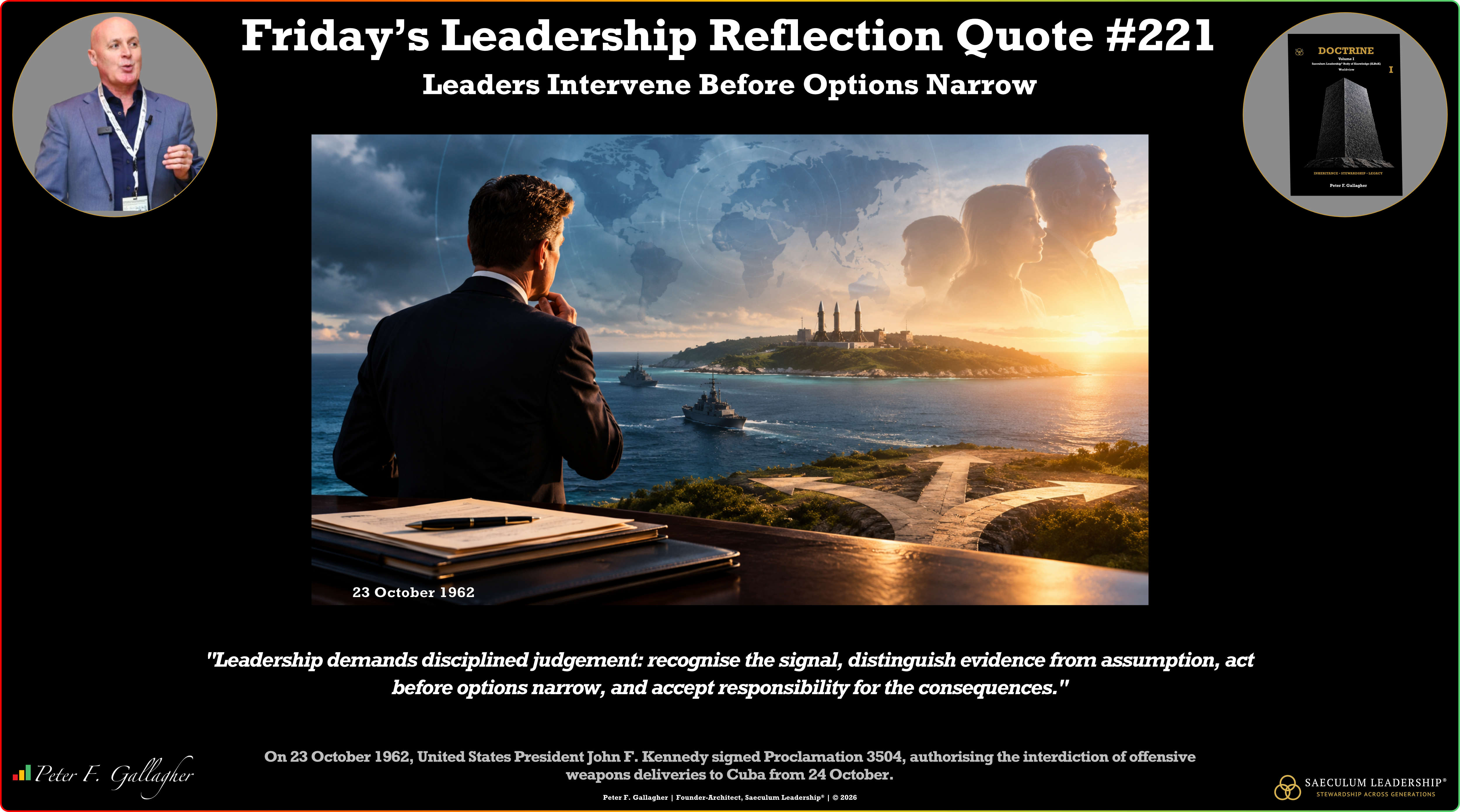 Friday’s Leadership Reflection Quote – Saeculum Leadership Leaders Intervene Before Options Narrow
 The Corix Partners Friday Reading List - October 23, 2026
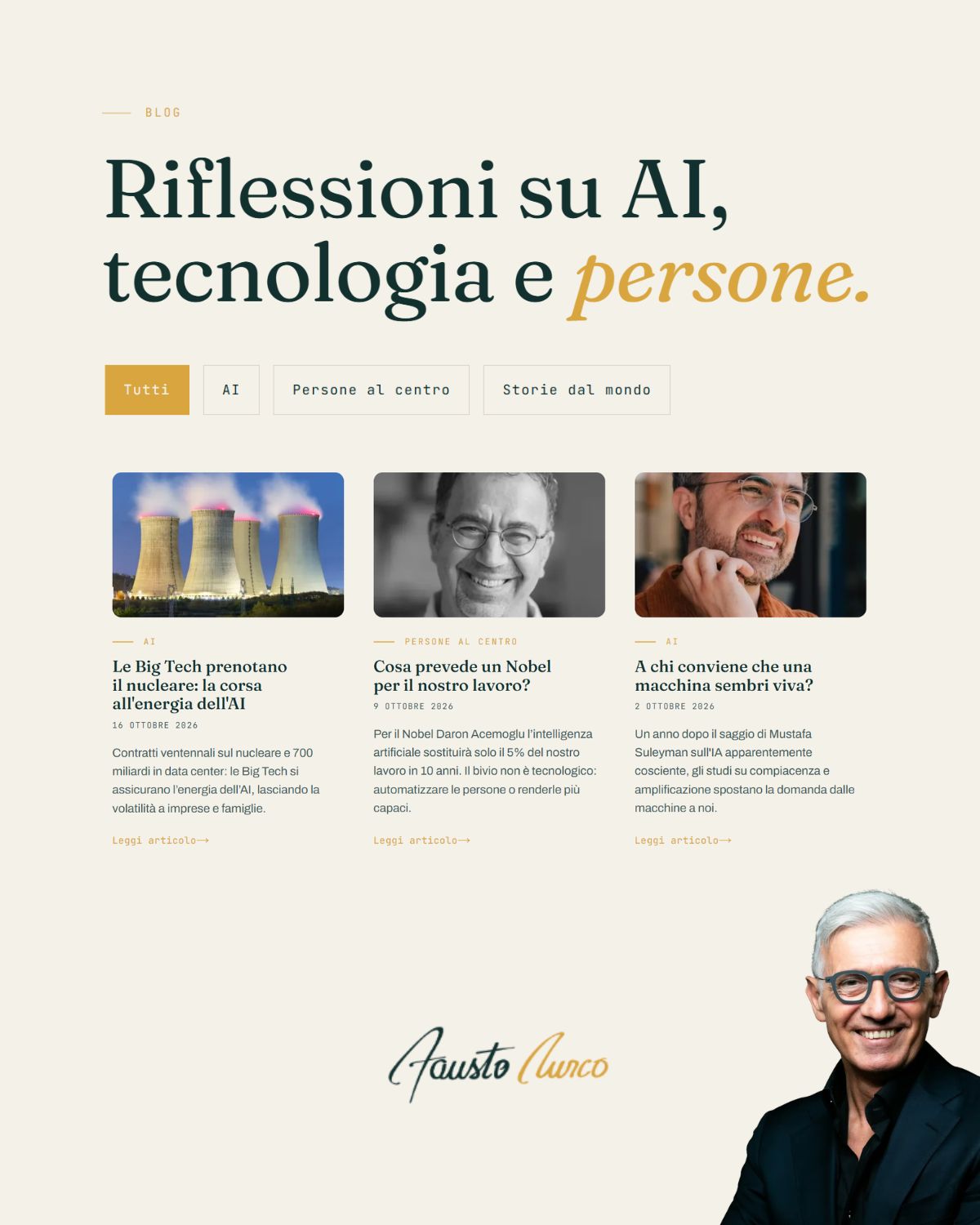 RIFLESSIONE SU AI, TECNOLOGIA E PERSONE