Dec25
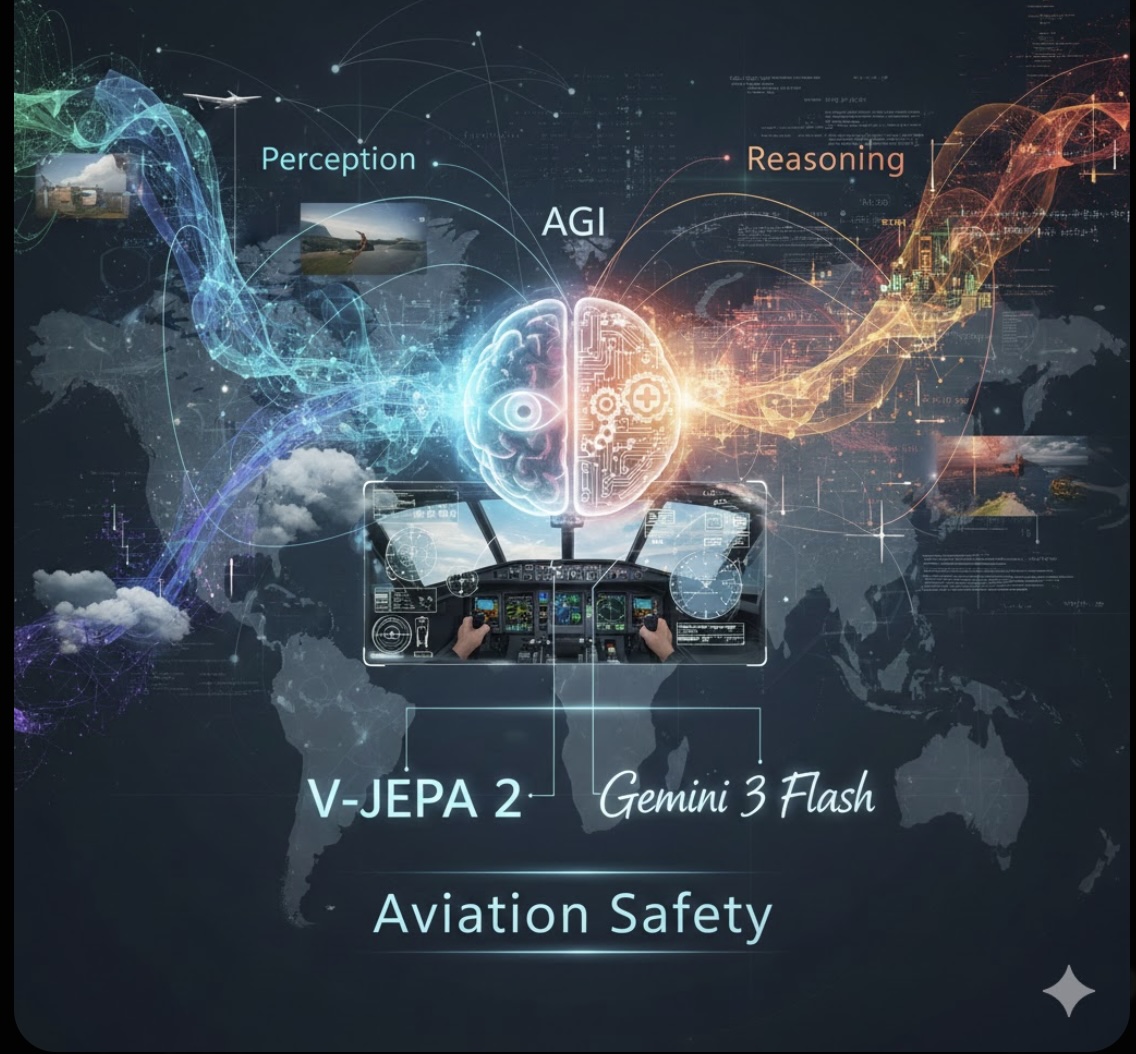
The history of aviation is defined by humanity's relentless pursuit of conquering the skies. This journey began with the daring ambition of the Wright brothers and the mythological warnings of Icarus. For over a century, safety in the air was bought with the hard-earned lessons of the past—often written in the aftermath of tragedy. However, we are entering a new epoch where we no longer need to wait for failure to learn. We are moving from a world of "reactive mechanics" to "proactive intelligence." This transition is fueled by the realization that proper safety lies not just in the strength of the steel but in the depth of the understanding. Today, we harness Artificial General Intelligence (AGI) to act as a digital sentinel, a vigilant mind that never tires and sees the very "DNA" of flight. By marrying the raw physics of motion with the high-level reasoning of human logic, we are fulfilling the ultimate promise of aviation: a sky that is not only accessible but inherently safe.
The foundation of this system is the Video Joint-Embedding Predictive Architecture (V-JEPA 2), which serves as the "sensory cortex" of the AGI. Unlike standard AI, which relies on static labels to identify objects, V-JEPA 2 is a predictive world model. It processes raw video of flight maneuvers—specifically landing sequences—and compresses them into a 1024-dimensional "Global Signature".
This signature represents the "physical DNA" of the flight, capturing the intricate relationship between mass, velocity, and gravity. Instead of looking for pixel patterns, the model understands the aircraft's motion in terms of Newtonian mechanics. The system calculates a Latent Prediction Error (LPE), a "surprisal" metric that quantifies how much the actual flight path deviates from a physically ideal landing. A high LPE score serves as an immediate red flag for potential safety violations.
While V-JEPA 2 provides the sensory data, the Gemini 3 model acts as the "prefrontal cortex," providing high-level reasoning. The integration of these two models allows the system to move beyond simple pattern matching into autonomous deliberation. Gemini receives the numerical "DNA" and LPE scores and interprets them using its vast internal knowledge base.
In a hard-landing scenario, Gemini does not just label the event; it reasons through the physics. It can distinguish between a "firm" but safe landing—where the airframe successfully transitions from aerodynamic lift to ground reaction mechanics—and a catastrophic failure where physical laws are violated. This capability allows the AGI to provide a transparent "verdict" rather than an opaque score.
Integrating Gemini 3 Flash with Meta's V-JEPA 2 creates a powerful "sensory-cognitive" loop, combining specialized physical world modelling with high-speed, frontier-level reasoning.
V-JEPA 2 (Video Joint Embedding Predictive Architecture) serves as the "eyes" of the system, trained on over a million hours of raw video to understand the laws of physics without human labelling.
Gemini 3 Flash serves as the decision-maker, processing abstract physical data from V-JEPA 2 to produce human-understandable logic and planning.
When these models are integrated, the resulting AGI (Artificial General Intelligence) pipeline can perceive, reason, and act within complex environments:
This video provides a deep dive into the original JEPA architecture and how V-JEPA uses latent representation prediction as its core objective to learn visual representations from video.
A critical new dimension of this AGI integration is its potential for Long-Term Structural Health Monitoring. Because the "Physical DNA" captures high-fidelity energy signatures of every landing, the agent can track the cumulative stress placed on an aircraft's airframe and landing gear.
By comparing the "Physical DNA" of multiple flights over time, Gemini can identify subtle shifts in an aircraft's response to impact—essentially detecting structural fatigue before it becomes visible to the naked eye. If the LPE during a landing is within nominal bounds but the "vibration signature" in the 1024-dimensional vector begins to shift from the baseline, the AGI can infer a loss of structural rigidity or dampening efficiency. This transforms the AGI from a real-time monitor into a predictive maintenance engine, ensuring safety is managed throughout the asset's lifecycle.
To understand where exactly a landing becomes "critical," the system generates a Surprise Score Profile. This graph plots the LPE over the duration of the landing sequence.
In a nominal landing, the surprise score remains low and stable as the plane descends, with only a predictable minor rise at touchdown. However, in a hard landing, the graph shows a sudden, sharp spike—like the 3.02 score observed in the demo—at the exact millisecond the landing gear strikes the runway. This visual "heartbeat" of the flight provides immediate, actionable evidence for safety investigators.
The model detects whether the airplane is landing and further categorizes the landing type. The system identifies the flight status through a multi-layered analysis:
The integration of V-JEPA 2 and Gemini 3 marks a paradigm shift in aviation safety, transitioning from reactive telemetry to proactive physical understanding. By moving beyond simple pixel recognition and instead capturing the "Physical DNA" of flight, this AGI framework enables a "digital twin" of Newtonian reality that can detect anomalies with unprecedented precision.
Key Technological Milestones
A New Era of Safety
The ultimate takeaway of this demo is that aviation safety no longer relies solely on human observation or binary sensor data. We are entering an era where Autonomous Safety Agents can "think" through the physics of a flight maneuver in real-time, providing a transparent, auditable, and physically grounded layer of protection for every asset in the sky. This convergence of computer vision and high-level reasoning doesn't just monitor flight—it understands it.
Keywords: Agentic AI, AGI, Generative AI
 You are not your diagnosis
 Is GenAI good for anything?
 “I didn’t write an award acceptance speech because I didn’t expect to win.”
 AI Is Exposing the Data Problems Humans Used to Hide
 "The AI may in fact be conscious." Really?