Dec26
FCRQ179 Leadership Learning!
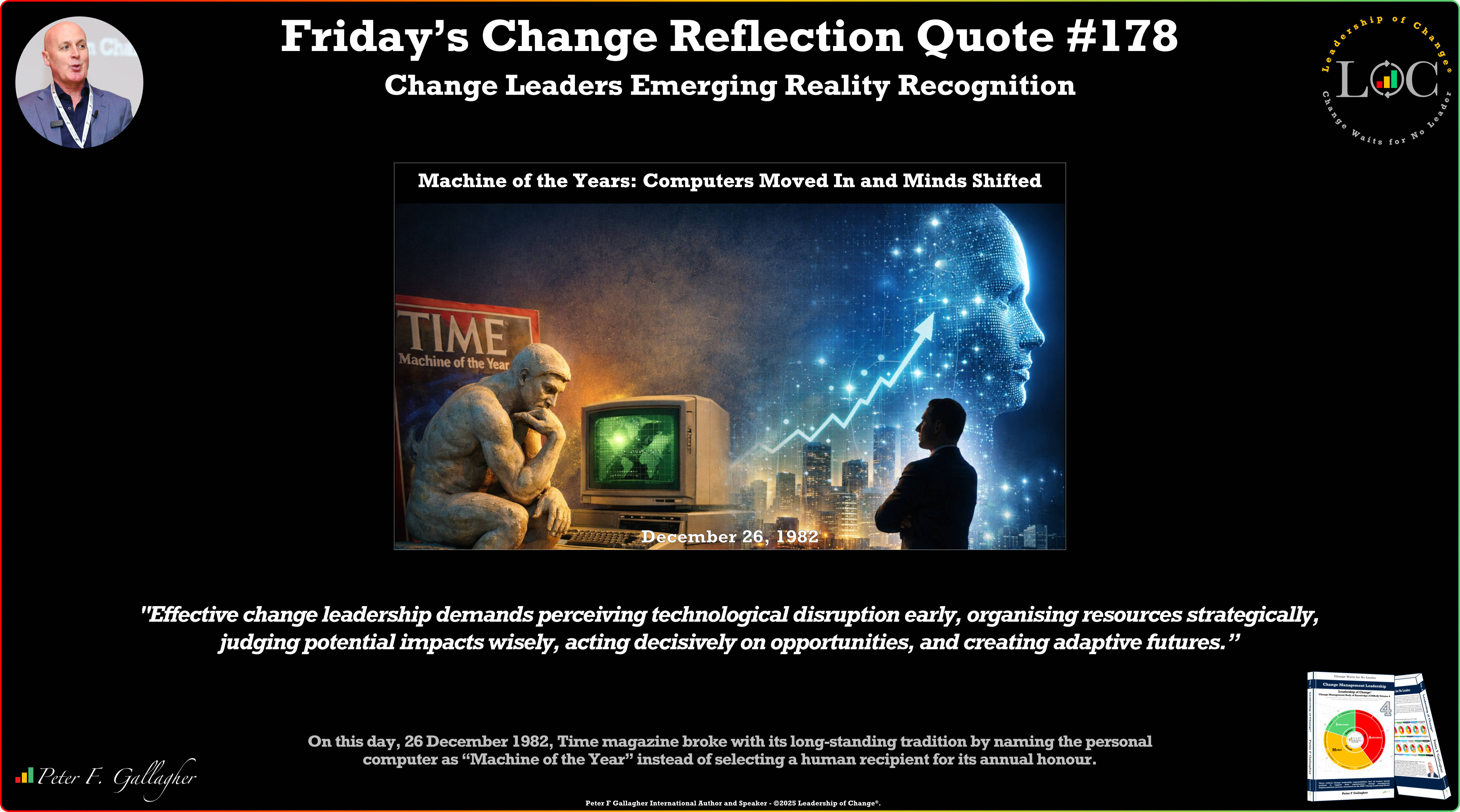
On this day, 26 December 1982, Time magazine broke with its long-standing tradition by naming the personal computer as “Machine of the Year” instead of selecting a human recipient for its annual honour. This marked the first time since the feature began in 1927 that a non=human entity received the accolade, underscoring the profound societal shift underway. The issue, dated 3 January 1983 but released to newsstands on 26 December 1982, featured a striking cover depicting a plaster figure contemplating a conceptual computer screen. Inside, the magazine explored how personal computers were rapidly entering homes and workplaces, transforming daily life. Sales of personal computers surged dramatically in the early 1980s. Time reported that 724,000 units were sold in 1980, with sales doubling in 1981 and doubling again in 1982 to reach nearly 2.8 million units reflecting explosive growth driven by companies like Apple, IBM, and Commodore. Time's editors explained the choice by noting that while individual leaders might have dominated headlines, no single person symbolised the year's most influential force more than this technological process. The personal computer represented a widespread recognition that innovation was reshaping communication, work, and entertainment. Surveys cited in the article revealed that 80 percent of Americans expected home computers to become as commonplace as televisions or dishwashers in the near future. This decision highlighted the machine's potential for both good and evil, as it amplified human capabilities while raising questions about privacy, employment, and societal dependence. The historical significance of this event lies in its role as a cultural milestone, signalling the dawn of the information age. By elevating a machine to such prominence, Time magazine captured the moment when computing transitioned from specialised tools in laboratories and businesses to accessible devices for ordinary people. This recognition accelerated public awareness and acceptance, fuelling further investment and innovation in the sector. The consequences of this recognition proved enduring. Personal computers democratised information access, enabled new forms of creativity, and laid the foundation for the internet era. Industries evolved as computing power became affordable, leading to advancements in software, networking, and digital communication that redefined global economies. Societies adapted to new ways of working remotely, learning interactively, and connecting instantly. The event's importance endures as a reminder of how technological breakthroughs can redefine human potential, fostering productivity while prompting ongoing debates about ethical implications and equitable access. Today, with computing integral to every aspect of life, this 1982 honour stands as a prescient acknowledgement of an unstoppable evolution that continues to shape our world.
Change Leadership Lessons: Historical recognition alone does not create change because leadership response determines whether insight becomes an advantage. Leaders of change must observe technological shifts early to understand their potential impact on society. They structure teams and resources to capitalise on rapid market growth and new opportunities. Change leaders evaluate innovations for broad influence before committing long-term strategies and investments. They respond decisively when public anticipation signals widespread adoption of change. Leaders of change foster environments that embrace tools reshaping work and daily life for sustained advantage. Change Leaders Recognise Emerging Technology.
“Effective change leadership demands perceiving technological disruption early, organising resources strategically, judging potential impacts wisely, acting decisively on opportunities, and creating adaptive futures.”
Application. Change Leadership Responsibility 1 - Articulate a Change Vision: A clear change vision prevents organisations from misreading emerging technological realities and anchoring decisions to assumptions that no longer hold. When leaders define a credible and evidence-based future, they create the conditions for coordinated action long before disruption becomes unavoidable. A well-articulated vision aligns planning, investment, and behaviour around a shared destination rather than inherited practice. Such a vision acknowledges uncertainty, complexity, and risk while remaining unequivocal about the future the organisation is committed to deliver. It becomes the reference point that guides judgement, exposes contradiction, and prevents drift during long-term transformation. Leadership of change requires leaders to use this clarity to maintain direction, discipline decision making, and ensure that organisational choices remain aligned with reality rather than comfort. When this responsibility is fulfilled with integrity, organisations build resilience, confidence, and readiness for sustained change.
Final Thoughts: Enduring transformation is not sustained by momentum alone but by leadership grounded in judgement and clarity. As AI and emerging technology reshape organisational environments at accelerating speed, leaders must anchor change in purpose rather than reaction. Those who remain committed to a defined future despite uncertainty create alignment, confidence, and long-term organisational strength.
Further Reading: Change Management Leadership - Leadership of Change® Volume 4.
For further reading please visit our websites: https://www.a2b.consulting https://www.peterfgallagher.com Amazon.com: Peter F Gallagher: Books, Biography, Blog, Audiobooks, Kindle
Leadership of Change® Body of Knowledge Volumes: Change Management Body of Knowledge (CMBoK) Books: Volumes 1, 2, 3, 4, 5, 6, 7, 8, 9, 10, A, B, C, D & E available on both Amazon and Google Play:
~ Leadership of Change® Volume 1 - Change Management Fables
~ Leadership of Change® Volume 2 - Change Management Pocket Guide
~ Leadership of Change® Volume 3 - Change Management Handbook
~ Leadership of Change® Volume 4 - Change Management Leadership
~ Leadership of Change® Volume 5 - Change Management Adoption
~ Leadership of Change® Volume 6 - Change Management Behaviour
~ Leadership of Change® Volume 7 - Change Management Sponsorship
~ Leadership of Change® Volume 8 - Change Management Charade
~ Leadership of Change® Volume 9 - Change Management Insanity
~ Leadership of Change® Volume 10 - Change Management Dilenttante
~ Leadership of Change® Volume A - Change Management Gamification - Leadership
~ Leadership of Change® Volume B - Change Management Gamification - Adoption
Keywords: Business Strategy, Change Management, Leadership
 You are not your diagnosis
 Is GenAI good for anything?
 “I didn’t write an award acceptance speech because I didn’t expect to win.”
 AI Is Exposing the Data Problems Humans Used to Hide
 "The AI may in fact be conscious." Really?