
Mar06

A tanker does not need to explode for society to feel the blast.
Sometimes the shock arrives more quietly. First as a flicker on a trading screen. Then as a higher diesel bill. Then as fertiliser prices creep up. Then as freight rates jump, airline margins compress, central banks hesitate, and every executive who thought energy was “someone else’s problem” discovers, once again, that it sits underneath nearly everything.
We have seen this film before. In 2022, Russia’s invasion of Ukraine turned fossil fuel dependence into an invoice. Europe paid in inflation, industrial pain, and a frantic scramble for alternatives. Now, in 2026, the US-Israeli war on Iran is doing something similar. Different geography. Same basic lesson. When a large share of the global economy runs on fuels that must be dug up, loaded, insured, sailed through chokepoints, and defended by navies, the system is not strong. It is brittle.
And brittle systems fail noisily.
The Strait of Hormuz handles about one-fifth of global oil flows. This week, Brent has been heading for its steepest weekly gain since Russia’s full-scale invasion of Ukraine in February 2022, with traders repricing risk, inflation fears returning, and markets wobbling as shipping through Hormuz has been severely disrupted. [1][2]
That matters everywhere. But it matters especially in Asia. And over the longer arc, it matters particularly for China.
Because for all China’s immense industrial power, manufacturing heft, and recent progress in electrification, it still relies heavily on imported oil and gas moving through vulnerable seaborne routes. It has buffers, yes. Serious ones. But a buffer is not the same thing as immunity.
The deeper point is larger than China, or Iran, or this week’s oil chart. It is this: sunshine and wind do not need to transit Hormuz. Electrons generated at home do not require tanker insurance. Batteries do not panic when missiles fly over a shipping lane.
That is not environmental romanticism. It is hard-headed strategic logic.
Start with the immediate shock.
Reuters reported on 6 March 2026 that Brent crude had risen 17.2% this week, its biggest weekly jump since February 2022, as the conflict widened and disruptions around the Strait of Hormuz intensified. The strait is a chokepoint for about 20% of global oil flows. [1] Other reporting this week has underlined the same pattern: oil and gas prices have spiked, equity markets have fallen back, and fears of a renewed inflation shock have quickly returned. [2][3]
This is not merely a market story. It is a systems story.
According to Columbia’s Center on Global Energy Policy, half of China’s oil imports and nearly one-third of its LNG imports transit the Strait of Hormuz. In 2025, China imported about half of its crude oil and almost one-third of its LNG from the Middle East. Using China customs data and tanker-tracking estimates, Columbia notes that China imported 4.9 million barrels per day of crude from key Middle Eastern suppliers in 2025, while Kpler estimates it also imported 1.38 million barrels per day from Iran, much of it disguised in customs reporting. [4]
China is not blind to this vulnerability. Quite the opposite. It has been stockpiling aggressively. Columbia says China had 1.39 billion barrels of oil in storage as of 2 March 2026, enough to cover roughly 120 days of net crude imports at 2025 levels. Reuters separately reported analysts estimating China’s reserves at around 900 million barrels, or just under three months of imports. [4][5]
So yes, China can ride out a short-to-medium disruption better than many assume. That matters. But it does not erase the strategic exposure.
Columbia also points out that China has far less flexibility on gas. About 30% of its LNG imports arrive via Hormuz, and if those flows are disrupted, its options in the short term are ugly: consume less or pay more. Neither is a mark of energy sovereignty. [4]
Kismet: while oil traders were sweating tankers this week, China’s power sector was quietly becoming harder to blockade. Official data show the country added more than 430 GW of new wind and solar capacity in 2025 alone, pushing total renewable capacity above 1,800 GW and taking renewables to more than 60% of installed power capacity. [6]
That is the strategic shift in one statistic.
Now layer in cost.
IRENA’s latest cost data are devastating for the old fossil logic. In 2024, 91% of newly commissioned utility-scale renewable capacity produced electricity more cheaply than the cheapest new fossil fuel-based alternative. Utility-scale solar averaged USD 0.043/kWh globally, 41% cheaper than the least-cost fossil alternative. Onshore wind averaged USD 0.034/kWh, 53% cheaper. Battery storage costs have fallen 93% since 2010, reaching USD 192/kWh in 2024. [7]
In other words, the cleaner option is now frequently the cheaper one. And, increasingly, the safer one too.
China’s own economics sharpen this further. IRENA reports utility-scale solar in China at USD 0.033/kWh and onshore wind at USD 0.029/kWh in 2024, both below global averages. Columbia notes that China plans to more than double its energy storage capacity from 73.8 GW / 168 GWh in 2024 to 180 GW / 450 GWh by 2027 (for context, 1GW is roughly the output of a typical nuclear reactor). [4][7][8]
So the world’s biggest manufacturing economy is telling us something with its capital allocation. Not through speeches. Through steel, silicon, copper, and batteries.
The first implication is brutally simple: fossil fuels are not just a climate liability. They are a macroeconomic instability machine.
Every time a war, embargo, blockade, or shipping scare hits an oil and gas corridor, the costs spill well beyond the energy sector. Transport costs rise. Food systems feel it through fertiliser and freight. Industry feels it through heat and feedstocks. Central banks get dragged into decisions they did not ask for. Reuters reported this week that investors have already pushed back expectations of rate cuts as higher oil prices revive inflation concerns. [9]
So when someone frames renewables purely as a green preference, they are missing the plot entirely. The real argument is that dependence on globally traded hydrocarbons imports volatility directly into the bloodstream of the economy.
The second implication is geopolitical.
China’s reserves mean it can absorb pain for a while. But reserves are a bridge, not a destination. Over the long term, a country that remains structurally dependent on seaborne oil and LNG moving through contested chokepoints is exposed to coercion, price spikes, and strategic distraction. Columbia’s conclusion is telling: this conflict is likely to reinforce Beijing’s push for greater energy self-sufficiency, including domestic supply and a continued transition away from fossil fuels. [4]
That has consequences for everyone else. If China doubles down further on solar, wind, storage, EVs, grid flexibility, and electrified industry as a response to Hormuz risk, it will not just reduce exposure. It will deepen its manufacturing lead in the very technologies the rest of the world also needs.
That should worry Western policymakers who still treat clean technology as a climate niche rather than an industrial strategy.
The third implication is moral as much as economic.
Wars keep revealing what the energy transition really is. It is not simply a matter of emissions accounting. It is an escape route from recurring hostage situations. Oil and gas dependence binds societies to supply chains that can be disrupted by autocrats, insurgents, sanctions, naval standoffs, and insurance markets having a nervous collapse. Renewable electricity, especially when paired with storage and flexible demand, localises a larger share of the energy system. It shortens the chain. It reduces the hostage risk.
Not perfectly. Minerals matter. Grids matter. Manufacturing concentration matters. But compare the two systems honestly. One depends on endless daily combustion fuel deliveries through geopolitical chokepoints. The other depends on building assets that then harvest local flows of energy for decades.
That is a meaningful difference.
First, electrify faster.
Transport, low-temperature heat, much of industry, and large parts of buildings should be pushed towards direct electrification wherever technically feasible. Every vehicle shifted from imported oil to domestically generated electricity weakens the power of a future chokepoint crisis. Every heat pump installed instead of a gas boiler cuts exposure to commodity spikes. Every industrial process electrified where possible reduces dependence on molecules that can be embargoed, bombed, or extorted.
Second, build storage and flexibility as strategic infrastructure, not optional extras.
Solar and wind without storage are useful. Solar and wind with storage, demand response, stronger interconnection, and modern grid operations are something else entirely. They become resilience assets. They turn variable generation into dependable systems capability. China’s push towards 180 GW of energy storage by 2027 is not some abstract climate gesture. It is a recognition that the grid of the future needs balancing muscle. [4][8]
Third, stop measuring energy security with 20th-century assumptions.
For too long, policymakers treated “security” as synonymous with stockpiles, pipelines, and military protection of sea lanes. Those still matter in the current system. But real 21st-century energy security also means rooftop solar, utility-scale renewables, batteries, transmission, digital grid controls, EVs, and flexible industrial loads. It means reducing the volume of fuels that must be imported in the first place.
The best barrel in a crisis is the one you no longer need.
Fourth, treat clean tech as industrial policy.
This is where Europe, in particular, still under-thinks the challenge. If renewables with storage are now cheaper than new fossil generation in most cases, and if they also improve security and resilience, then deployment speed becomes an economic competitiveness issue. Slow permitting, weak grid investment, and policy drift are no longer administrative annoyances. They are strategic self-harm.
The encouraging part is that this transition is already happening.
China added more than 430 GW of wind and solar in 2025. Renewables now account for over 60% of its installed power capacity. The IEA expects China’s electric car sales share to reach around 60% in 2025 and around 80% by 2030 under current policy settings. [6][10]
Globally, renewables are not winning only on emissions. They are winning on cost. IRENA says renewables avoided USD 467 billion in fossil fuel costs in 2024 alone. [7] That number should concentrate minds in every boardroom and ministry still pretending that fossil dependence is the prudent option.
Because prudence, properly understood, means reducing exposure to shocks. It means choosing systems that are cheaper to run, harder to disrupt, and better aligned with climate reality.
And that brings us back to the opening point.
A tanker does not need to explode for society to feel the blast.
We are feeling it again now, in oil charts, shipping risk, inflation nerves, and strategic anxiety. The lesson is not subtle. It has been shouted at us by 2022, and it is being shouted at us again by 2026.
Energy systems built around imported fossil fuels are vulnerable by design.
Energy systems built around domestic renewables, storage, electrification, and smarter grids are not invulnerable. Nothing is. But they are calmer. Cheaper. More sovereign. More resilient. More compatible with a liveable climate. And crucially, less dependent on whether a narrow strip of water remains passable this week.
Sunshine and wind have no issues getting through the Strait of Hormuz.
That line may sound glib. It is not. It is strategy.
Countries that act on it fastest will not merely cut emissions. They cut risk. They lower bills. They reduce exposure to geopolitical blackmail. They build economies that can absorb shocks instead of amplifying them.
That is the real prize now.
And the war on Iran, grimly and expensively, is reminding us of it once again.
[1] Reuters, March 2026 (Reuters)
[2] The Guardian March 2026 (The Guardian)
[3] Reuters March 2026 (Reuters)
[4] Columbia (energypolicy.columbia.edu)
[5] Reuters March 2026 (Reuters)
[6] China NEA (english.www.gov.cn)
[7] IRENA (irena.org)
[8] China (english.www.gov.cn)
[9] Reuters March 2026 (Reuters)
[10] IEA (IEA)
By Tom Raftery
Keywords: Energy, Renewable Energy, Supply Chain
 Best Supply Chain AI Tools in 2026: SCM SENSEI AI and Ask Lora Compared
 Making Silos Permeable
 The Corix Partners Friday Reading List - October 2, 2026
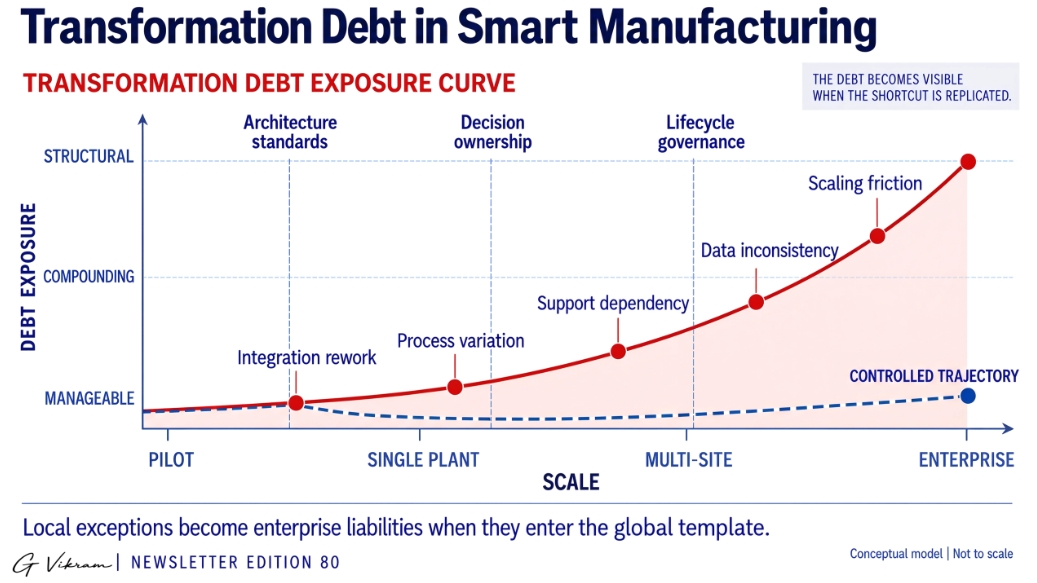 The most dangerous debt in a smart factory isn’t financial.
 Why mission changes everything, leadership lessons from two boardrooms