Jan24
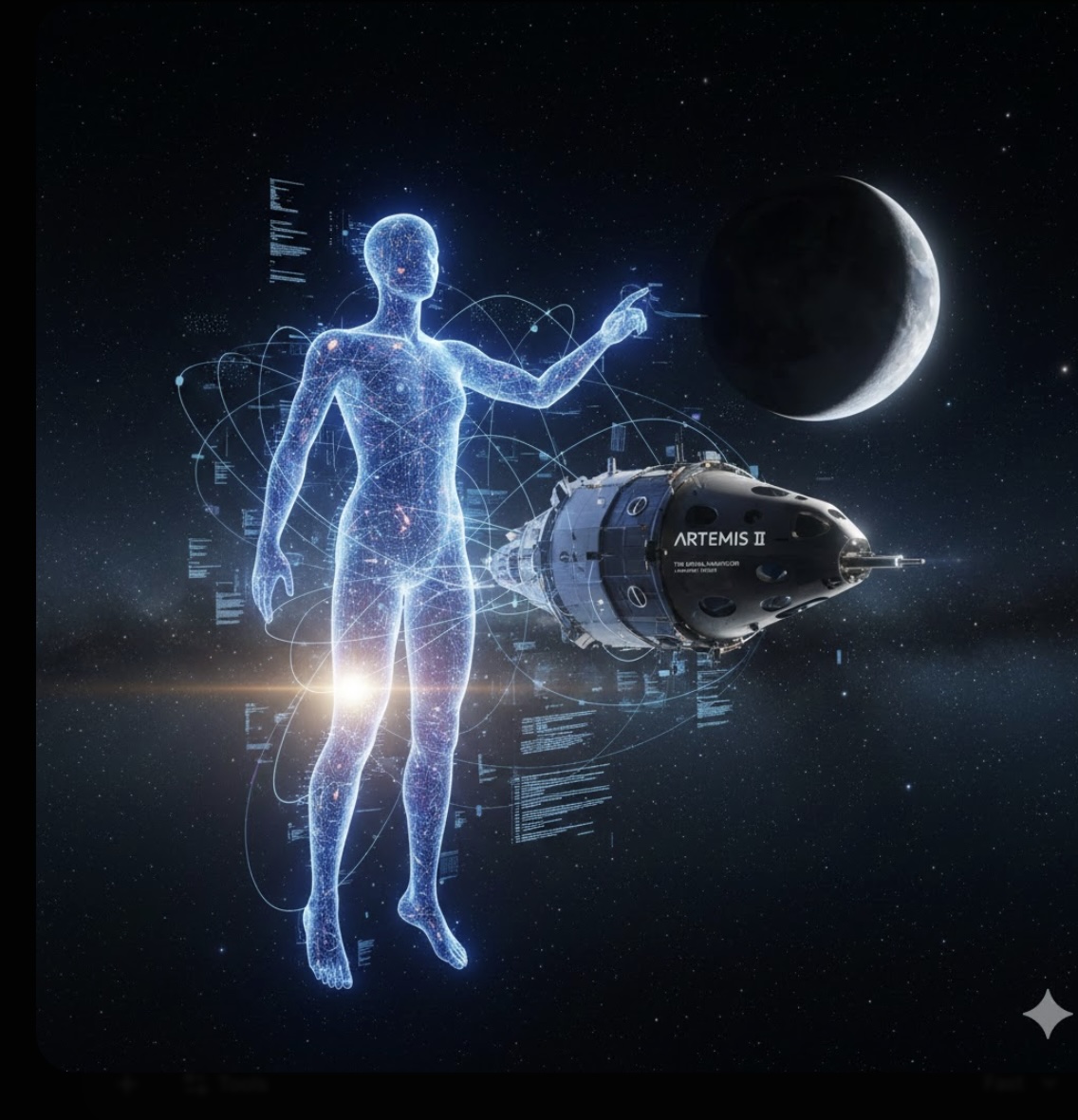
As the Artemis II mission prepares to carry humanity back to the vicinity of the Moon, it represents a fundamental shift in how we explore deep space. While the primary mission objective is to validate the safety and performance of the Space Launch System (SLS) and the Orion spacecraft for human travel, the invisible engine driving this validation is Artificial Intelligence. Unlike the rigid software of the Apollo era, Artemis II utilizes AI as a dy"amic "fifth crew member, bridging the gap between human intuition and the overwhelming data density of modern spaceflight.
The Artemis II mission is currently in its final pre-launch phase at the Kennedy Space Center. As of today, January 19, 2026, the mission has reached a major milestone: the SLS rocket and Orion spacecraft were successfully rolled out to Launch Pad 39B this past weekend, arriving on January 17 after a nearly 12-hour journey from the Vehicle Assembly Building.
The mission is currently tracking toward the following timeline:
This mission carries a diverse crew of four who will be the first humans to travel to the vicinity of the Moon in over 50 years. The crew includes Commander Reid Wiseman, Pilot Victor Glover, and Mission Specialists Christina Koch and Jeremy Hansen. Glover will be the first person of colour, Koch the first woman, and Hansen the first non-American to fly a lunar mission.
Artemis II is a crewed flyby, meaning the astronauts will not land on the Moon. Instead, they will:
The Artemis II mission is supported by a massive industrial base, involving over 3,800 suppliers across all 50 U.S. states and several international partners. While NASA leads the mission, the hardware and ground systems are built and managed by several prime aerospace contractors.
Core Mission Partners
Key Infrastructure and Technology Providers
Beyond the main rocket and capsule, several other companies provide critical mission support. L3Harris provides the mission-critical audio system and various avionics systems. United Launch Alliance provided the upper stage used to propel Orion toward the Moon. MDA Space, a major Canadian partner, provides technical support and is the lead for future lunar robotics. Companies like Bechtel and Jacobs provide the engineering for mobile launchers and ground system support.
Deep space navigation presents a unique challenge: once Orion leaves Earth’s orbit, traditional GPS becomes unavailable. To maintain a precise trajectory, the spacecraft relies on AI-driven Optical Navigation.
This system utilizes high-resolution cameras to capture images of the Moon and Earth against the backdrop of stars. AI algorithms process these data points in real time, identifying celestial bodies and cross-referencing them with preloaded star maps. This allows the spacecraft to determine its position and velocity autonomously, independent of ground control. Furthermore, during proximity operations, AI provides the necessary stabilization logic, ensuring that human steering inputs are executed with precision.
The Orion spacecraft is equipped with hundreds of thousands of sensors monitoring everything from cabin pressure to electrical health. AI-driven anomaly detection systems move beyond simple threshold-based alerts by analyzing nonlinear relationships across multiple sensors. If a slight increase in power draw correlates with a minor temperature shift, the AI can flag a component for degradation well before a failure. This proactive approach to health management allows the team to address issues during quiet flight phases rather than during high-stakes maneuvers.
AI also plays a critical role in managing the health and performance of the astronauts. Using wearable devices, AI analyzes crew members' sleep patterns, stress levels, and cognitive performance to help mission control optimize flight schedules. Additionally, NASA is testing intelligent interfaces that allow the crew to access technical manuals and spacecraft status reports using natural language, significantly reducing their cognitive load.
This mission serves as the ultimate stress test for the hardware and procedures that will be used for Artemis III, which is currently planned to land the first woman and first person of colour on the lunar surface as early as 2027. By integrating AI into its fabric, NASA is ensuring that, as humans travel further into the cosmos, they are supported by a digital infrastructure as resilient and adaptable as the explorers themselves.
This video provides an excellent visual overview of the Artemis II mission timeline and the roles of the various crew members and partner organizations.
Keywords: Agentic AI, Generative AI, Predictive Analytics
 The Empty Chair: a powerful practice in leadership, coaching and self-reflection
 Human Oversight Is Not a Person in the Loop
 Holistic Development: Why Performance Starts with the Whole Human
 The Most Dangerous Leader in the Room May Be the One Everyone Depends On
 What is that Analytical AI?