
Jan10
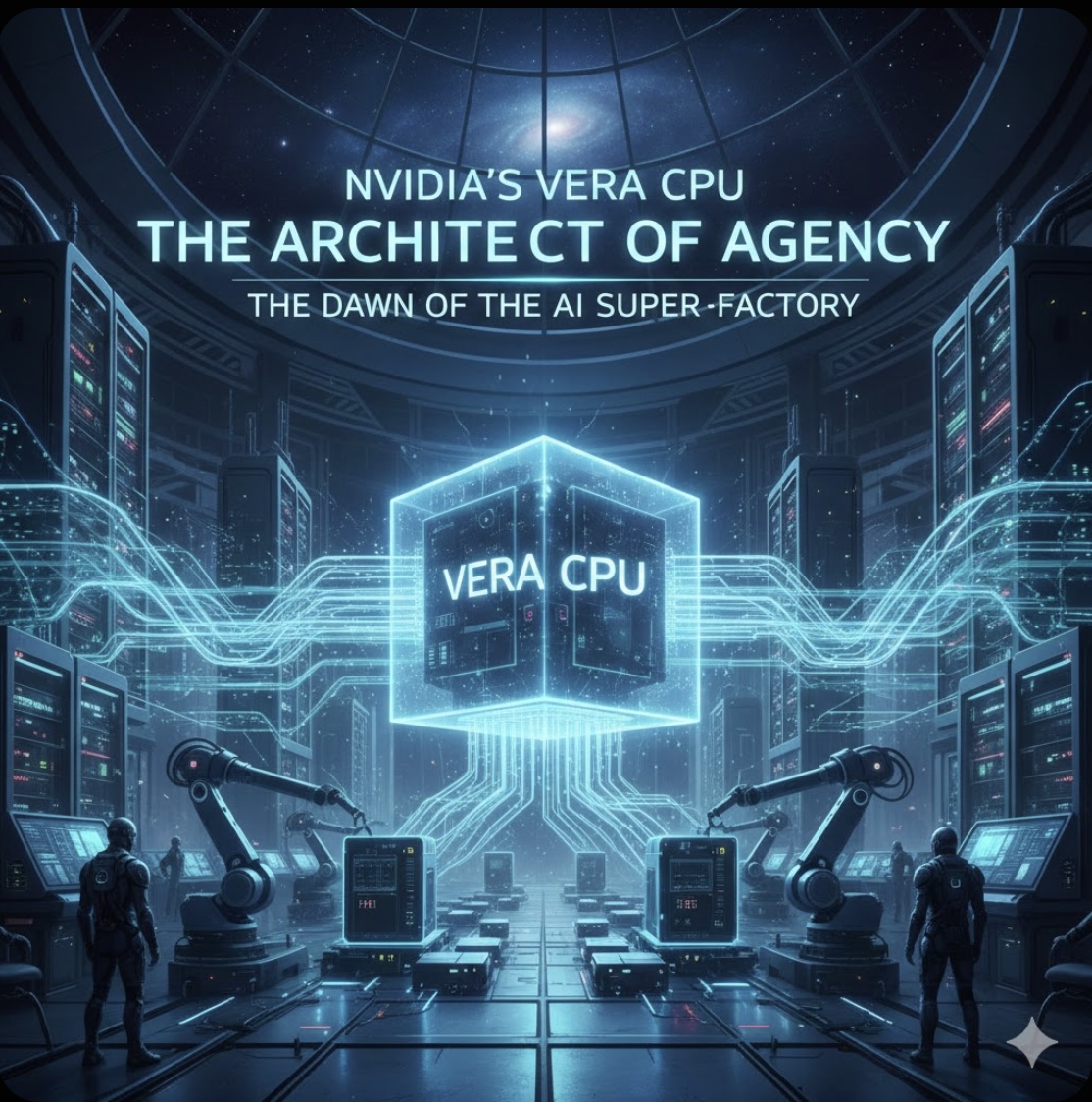
In the rapidly evolving landscape of artificial intelligence, the transition from "chatbots" to "autonomous agents" has necessitated a fundamental rethinking of computer architecture. At CES 2026, NVIDIA signalled the end of the general-purpose era in data centers with the unveiling of the Vera CPU. More than just a processor, Vera is a custom-engineered "data engine" designed to eliminate the bottlenecks that have long prevented AI from achieving actual, real-time reasoning at scale. By moving from off-the-shelf components to the custom "Olympus" core, NVIDIA has not only doubled performance but has redefined the role of the CPU in the modern AI factory.
The defining characteristic of the Vera CPU is the Olympus core, NVIDIA's first fully bespoke implementation of the Armv9.2-A instruction set. While its predecessor, Grace, relied on standard Arm Neoverse designs, Olympus is a ground-up reimagining of what a CPU core should do in an AI-centric world.
The core's efficiency stems from its expanded math capabilities. Each of the 88 Olympus cores features six 128-bit SVE2 vector engines, a 50% increase over Grace. More importantly, it is the first CPU to support FP8 precision natively. By processing data in the same 8-bit format used by the latest GPUs, Vera can move and manipulate AI data without the "translation tax" of converting between different formats, drastically reducing latency during the critical pre-fill stages of model inference.
While the hardware specifications of the Vera CPU are formidable, its impact is felt at the software layer—specifically through native support for FP8 (8-bit floating-point) precision. Historically, CPUs have operated in high-precision formats such as FP32 and FP64. While accurate, these formats are computationally "heavy" and memory-intensive. In contrast, AI training and inference have increasingly shifted toward lower precision to achieve greater speed. By bringing FP8 support to the Olympus core, NVIDIA has effectively taught the CPU and GPU to speak the same mathematical language.
In previous generations, a significant amount of "compute overhead" was wasted on data casting. When a CPU prepared data for a GPU, it often had to convert FP32 numbers down to FP8 or INT8. This conversion layer introduced latency and increased power consumption.
With Vera, the Olympus cores can process FP8 natively. This means that during the pre-fill stage of a Large Language Model—where the CPU parses input text and prepares the initial tensors—the data remains in its optimized AI format from the moment it hits the CPU until it reaches the GPU. This "lossless" transition in format results in a dramatic increase in system-wide efficiency.
For developers, the inclusion of FP8 on the CPU side fundamentally alters the CUDA development workflow. Traditionally, programmers had to manage "precision boundaries carefully"—deciding exactly where to downscale data to avoid losing accuracy while maintaining speed.
Unified Data Types: Developers can now define a single FP8 tensor that spans both CPU and GPU memory spaces. This simplifies the code significantly, as the cudaMemcpy Functions no longer require an intermediate conversion kernel.
Simplified Quantization: NVIDIA's Transformer Engine software can now manage quantization (the process of shrinking data) across the entire NVL72 rack. Because the Vera CPU supports FP8, the Transformer Engine can dynamically scale precision based on the "importance" of the data, keeping critical weights at higher precision while moving transient data to FP8.
Faster Debugging and Profiling: Since the CPU can now run FP8 kernels natively, developers can profile and debug AI logic on the CPU using the same data formats that will eventually run on the GPU. This reduces the "it works on CPU but fails on GPU" errors that have plagued AI engineering.
The switch to FP8 isn't just a software convenience; it radically changes the physics of data movement. On the Vera platform, the benefits of FP8 over traditional 16-bit and 32-bit formats are quantifiable:
| Precision Format | Bits per Value | Relative Memory Footprint | Bandwidth Efficiency | Accuracy Retention (LLMs) |
| FP32 (Single) | 32 bits | 4x | 25% (Baseline) | 100% (Gold Standard) |
| FP16 / BF16 | 16 bits | 2x | 50% | ~99.9% |
| FP8 (Vera Native) | 8 bits | 1x | 100% | ~99.5%* |
> Note: Accuracy retention for FP8 is maintained via NVIDIA's Transformer Engine, which uses dynamic scaling factors to prevent numerical underflow.
Perhaps the most technically provocative feature of the Vera CPU is Spatial Multi-Threading (SMT). Traditional multi-threading, which has dominated computing for decades, works by "time-slicing"—alternating between two tasks so quickly it creates the illusion of simultaneity. However, in high-stakes AI workloads, this can lead to "resource contention," where one thread stalls while waiting for the other to release the core's assets.
Vera's Spatial SMT takes a different approach by physically partitioning the core's internal execution ports. Rather than sharing the same hardware over time, the two threads occupy separate physical lanes within the core. This ensures "deterministic performance," allowing the system to handle 176 simultaneous threads with predictable latency.
The most significant bottleneck in modern Large Language Models (LLMs) is not math, but memory—specifically the KV-cache. As AI conversations grow longer or involve large documents, the "Key-Value" data that represents the model's short-term memory can expand until it overflows the GPU's expensive High Bandwidth Memory (HBM).
The Vera CPU addresses this with a massive 1.5 TB LPDDR5X memory pool, a 3x increase over the previous generation. Through the 1.8 TB/s NVLink-C2C interconnect, Vera functions as a "Context Memory Storage" tier. When a GPU's memory is full, it can offload the KV-cache to the Vera CPU at nearly 7x the speed of traditional PCIe connections. This allows AI agents to "remember" hundreds of pages of context without the performance hit of recomputing data from scratch.
By integrating FP8 into the very heart of the Olympus core, NVIDIA has removed the "translation tax" that has hindered heterogeneous computing for years. This alignment allows the Vera CPU to act as a true co-processor, handling complex logic and data preparation at the same velocity as the GPUs. The result is a software environment where the hardware becomes transparent, allowing developers to focus on the complexity of their AI agents rather than the minutiae of bit-depth management.
Keywords: Agentic AI, Generative AI, Predictive Analytics
 The Corix Partners Friday Reading List - October 16, 2026Friday’s Leadership Reflection Quote – Saeculum Leadership Leaders Separate Known Facts from Fear
 You are not your diagnosis
 Is GenAI good for anything?
 “I didn’t write an award acceptance speech because I didn’t expect to win.”