Mar26
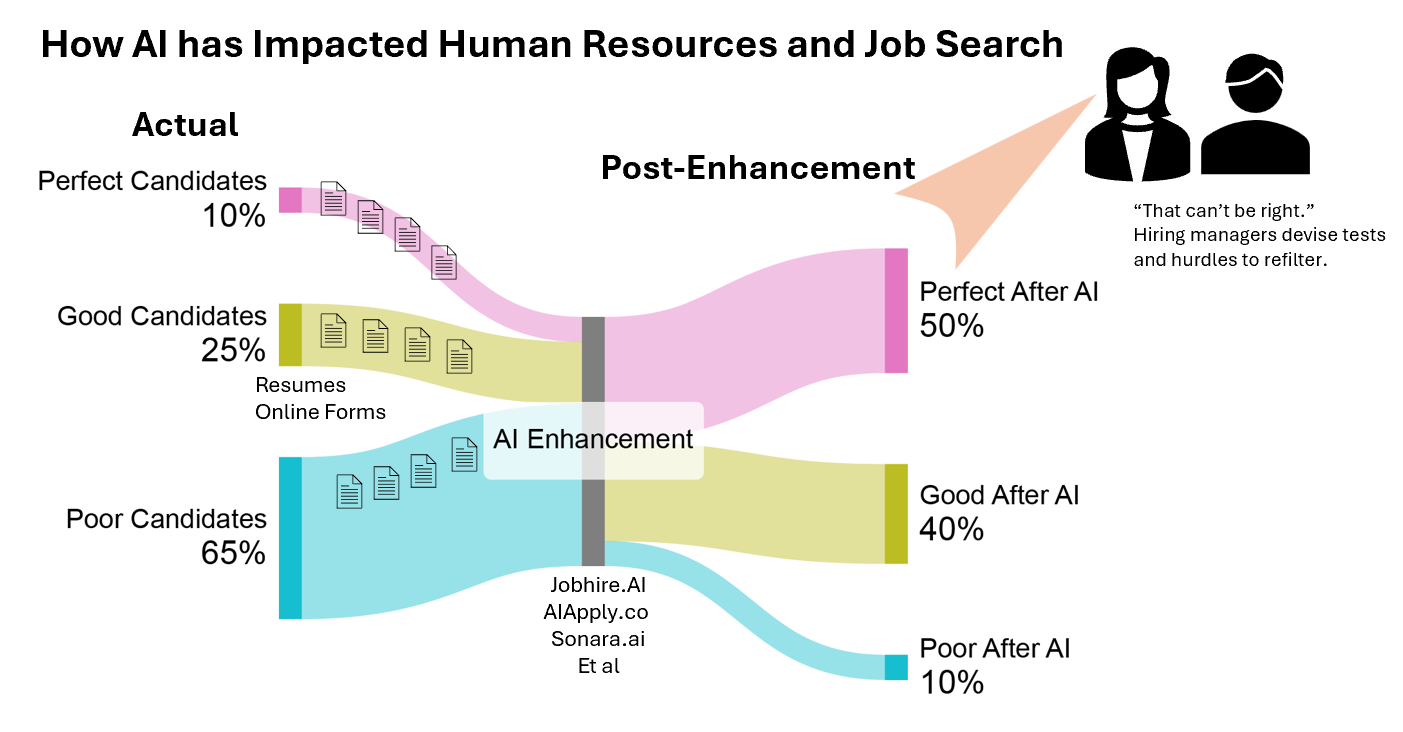
In my series, I examine how AI affects long-standing business processes. This time, let’s look at human resources and job seeking. In this business function today, two truths are now emerging:
1) Job seekers use AI to tailor their resumes to fit more job opportunities. The process is all automated by a new class of products like Jobhire.AI, AIApply.co and Sonara.ai. Seekers can overcome some barriers to job applications, such as lengthy forms and the need to customize resumes for better visibility.
2) HR has long implemented AI screeners (ATS) to filter the top 10% of qualified candidates. Part of the work is to get past ATS when you’re looking for a job.
Given this new reality, it’s interesting to examine how the new AI-powered process disrupts the traditional method of screening top candidates. AI has allowed job seekers to customize and apply for 100 jobs instead of 10, seemingly good for candidates, but for hiring managers, distinguishing between genuinely qualified candidates and those using effective AI to tailor their resumes is problematic. When all the resumes look good, none of them do.
Resumes have lost their reliability as data sources. If AI can craft perfect resumes for any job description, the meaningful signal of resumes disappears.

It’s impacting the way hiring gets done
I’ve noticed that some companies are moving away from focusing on volume to emphasizing verification through new screening methods:
• Harder Application Forms: Many organizations are abandoning “Easy Apply” buttons, instead requiring more open-ended questions to filter out bot-generated resumes and low-intent applicants. A sort of battle between hiring managers and job AI bots ensues, where the bots learn to overcome even the more difficult forms.
• Testing: If the resume is a poor data point for the hiring manager now, they look to evaluations as more meaningful, thereby lengthening the hiring process. Bots today have a harder time taking personality tests, for example, or making a custom video that answers a specific question. At least for now…
• Community Focus: Hiring managers are shifting away from large job boards toward niche communities, specialized forums, and internal referrals. In this way, they can focus on a more likely community to answer their hiring call.
• Semantic Screening: Semantic screening is an AI-driven process that evaluates resumes, LinkedIn profiles, and documents, rather than relying on exact keyword matches. Hiring managers might use it to look across a candidate’s entire body of work for a clearer picture.
Is it broken or just different?
What’s really happening is a drop in trust in resumes as a data point, and both sides are adjusting. Candidates must demonstrate authenticity by producing work, ideas, and results. Hiring teams need to shift from filtering to validating by looking at actual work and the broader context. The system is adjusting based on evidence rather than appearance.
For job seekers, the play is to stop hiding behind volume and start proving you’re real. Show your thinking and proof of value. Lean into portfolios, short videos, specific examples, and places where credibility is harder to fake.
For hiring managers, the shift is away from keyword filtering toward validation. That means tougher applications, practical tests, and looking at a candidate’s broader body of work, not just a well-tuned resume.
#AIGovernance #EnterpriseAI #Leadership #FutureOfWork #HRTech #DigitalTransformation
Keywords: AI, AI Governance, Business Strategy
 The Potter’s Hands: Why Great Leaders Shape Environments, Not People
 The Corix Partners Friday Reading List - October 16, 2026Friday’s Leadership Reflection Quote – Saeculum Leadership Leaders Separate Known Facts from Fear
 You are not your diagnosis
 Is GenAI good for anything?