Jul14

Authored By: Dan Chenok, Executive Director, IBM Center for The Business of Government and Sara Sayyar, Associate, IBM Center for The Business of Government and Consultant, Federal HR and Talent Transformation, IBM
To explore the current and prospective landscape of agentic AI in government, the IBM Center for The Business of Government recently convened leaders from government, industry, and academia to discuss opportunities and challenges that come with successful implementation. Key points from that session appear below, and the Center will publish a more complete report in the coming months.
Digital Transformation Comes First
Roundtable participants emphasized that agencies must have strong digital foundations to realize the benefits of agentic AI – these foundations include supporting infrastructure, data, and processes. Agencies should invest in data quality, system modernization, and workflow automation to put these critical prerequisites in place. Agencies have enabled the progression and benefit of technology investments, as basic task automation has evolved into AI-assisted workflows. Agentic AI can help agencies to build upon existing automation efforts, broadening the value of the technology stack.
One participant highlighted the Veterans Benefits Administration (VBA) as a leading example of how sustained technology investments enable successful agentic AI adoption. Through a steady digital transformation effort, VBA digitized approximately 55 million records and transitioned from paper-based processes to digital-first operations. By modernizing systems, centralizing processing, and automating inefficient workflows, the agency drastically improved its ability to reduce its claims inventory. These investments proved invaluable during the COVID-19 pandemic, enabling VBA to continue serving veterans with their resilient digital infrastructure.
Focus on Subprocesses, Not Full Autonomy
Participants shared several examples of government agencies achieving meaningful results by targeting subprocesses, rather than pursuing end-to-end autonomous systems. At the VBA, automation supports record retrieval, medical evidence gathering, document processing, and data extraction. These targeted investments have helped reduce the claims backlog, reduce labor hours, and decrease claim processing times.
Other agencies identified similar opportunities. Participants from the FDA discussed the potential for automation to support scientific reviews and clinical trial processes to increase the nation’s competitive advantage in medicine creation. The Defense Commissary Agency pointed to supply chain management and the creation of connected data environments as areas where automation projects could drive process improvements.
Participants highlighted that the value of agentic AI and automation lies in resolving operational bottlenecks and enhancing high-value subprocesses, where agencies can deliver observable and measurable improvements.
Keep the “Human-in-the-Loop” Mentality
Participants consistently emphasized the importance of simultaneously maintaining human expertise within government workflows. AI should be viewed as a tool for augmenting, not replacing, the workforce. While agentic AI has significant potential to reduce administrative burdens, participants stressed that final decisions for consequential processes must remain in the hands of human decision-makers.
The VBA provided a practical example of this principle. While AI-generated summaries help claims processors identify key information within veterans’ medical records, human adjudicators remain responsible for final determinations. This process ensures that humans authorize payments. Participants also highlighted the risk of inaccuracies in AI-generated content, reinforcing the lesson that successful implementations use technology to strengthen human judgment, not replace it.
Gaining Workforce Trust Is Key
For agencies seeking to adopt new technology, organizational trust is nearly as important as the performance of the tech itself. Participants noted that many federal employees are hesitant to embrace AI tools because they can perform routine tasks more quickly, creating anxiety about job displacement. Poorly executed pilot programs can undermine confidence and slow broader adoption efforts.
Participants outlined several actions agencies can take to foster trust among federal employees as AI capabilities are introduced. Trust must be intentionally built through leadership transparency, meaningful employee engagement, and clear communication about the role of AI in operations. Additionally, one suggested approach would involve end users early in the process, including participation in testing and pilot programs. By engaging employees in the design and implementation of new tools, agencies can foster a sense of collective decisionmaking.
Participants also emphasized the importance of explicitly communicating how AI tools are intended to be used and the expected outputs. Equally important is reinforcing that these technologies should augment rather than replace the workforce. Ultimately, even technically successful solutions may struggle to achieve widespread adoption if employees do not trust the technology.
Uphold Strong Governance Frameworks
The discussion also highlighted the governance considerations necessary for successful agentic AI adoption. Participants emphasized the importance of addressing cybersecurity, data protection, explainability, and auditability risks. Many have advocated for rules that focus on AI use cases rather than on the underlying models. Policymakers should establish outcome-based objectives and allow agencies the flexibility needed to implement solutions that best align with their unique missions and operating environments.
A common concern raised was around cost models for acquiring AI. As employees become accustomed to using highly advanced AI tools, agencies could see unexpected cost shifts if providers change commercial pricing structures. Participants encouraged agencies to focus AI investments on high-impact use cases, monitor usage patterns, and adequately forecast potential cost changes to ensure sustainable adoption over time.
Looking Forward
Agentic AI presents a promising opportunity for agencies to build upon and enhance existing technology investments. Rather than pushing for fully autonomous government operations, its greatest value lies in improving critical service delivery, reducing processing backlogs, preserving and scaling institutional knowledge, and augmenting the capabilities of the federal workforce. By focusing on mission-critical processes and establishing strong governance frameworks, agencies can position themselves for successful adoption and augmenting-at-scale.
Keywords: AI, GovTech, Agentic AI
 Consumer vs. enterprise AI agents
 Best Supply Chain AI Tools in 2026: SCM SENSEI AI and Ask Lora Compared
 Making Silos Permeable
 The Corix Partners Friday Reading List - October 2, 2026
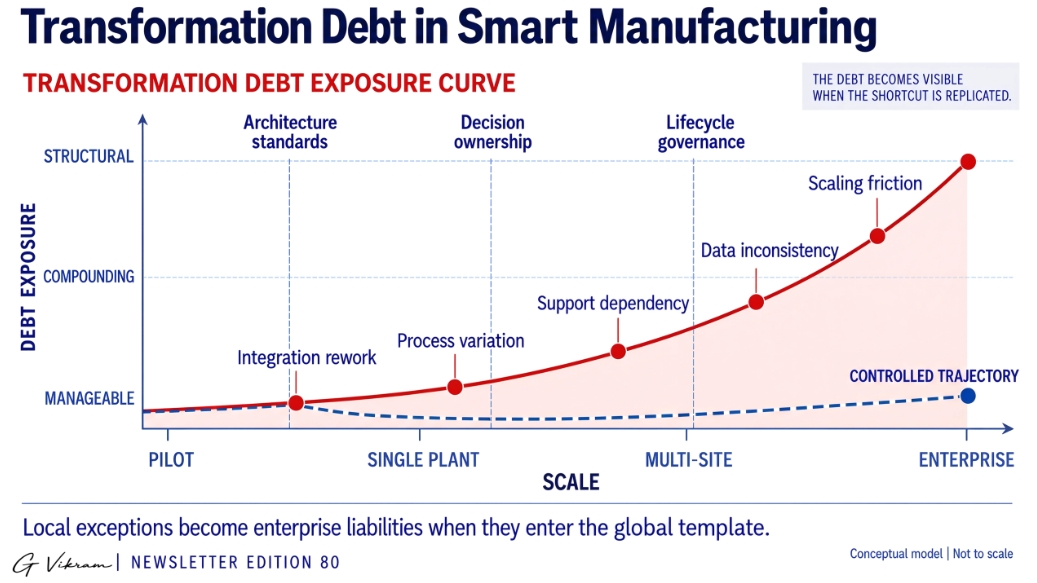 The most dangerous debt in a smart factory isn’t financial.