Dec30
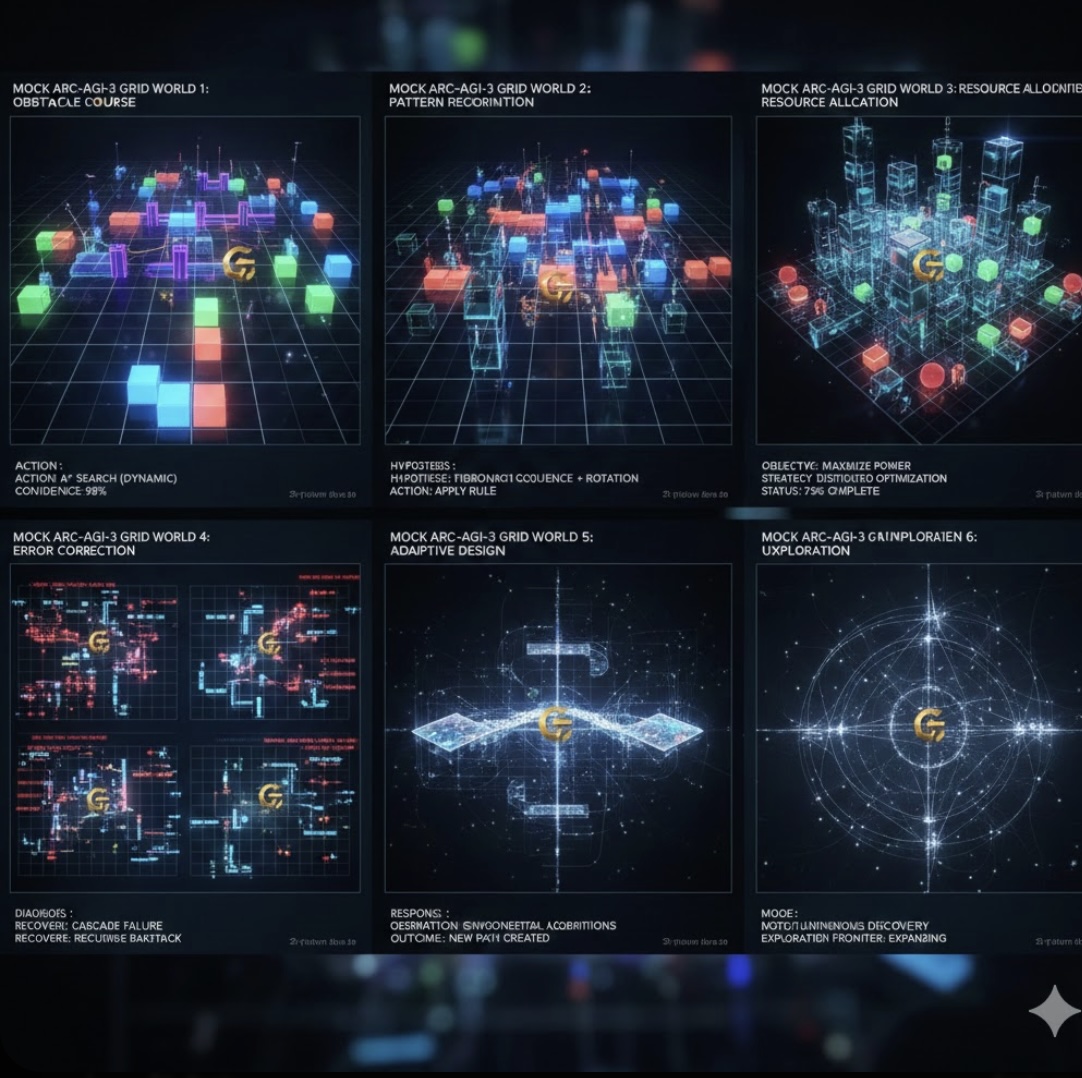
As of late 2025, the pursuit of artificial general intelligence (AGI) remains one of the most profound challenges in computer science. The ARC Prize Foundation, the steward of the Abstraction and Reasoning Corpus (ARC-AGI) benchmark, has steadily refined its evaluations to expose the limitations of current AI systems. While ARC-AGI-1 and ARC-AGI-2 focused on static visual puzzles that test core abstraction and reasoning—tasks humans solve near-perfectly but AI struggles with—the forthcoming ARC-AGI-3, slated for full release in early 2026, introduces a paradigm shift: interactive reasoning in dynamic, game-like environments. These environments demand exploration, planning, adaptation, and goal-directed behaviour over extended trajectories, qualities essential for human-like intelligence but elusive in today's models.
In anticipation of this benchmark, community-created demonstrations have emerged that simulate simplified ARC-AGI-3-style tasks. Two Jupyter notebooks—ARC_AGI_3_DEMO_case10.ipynb(10x10 grid) and ARC_AGI_3_DEMO_case64.ipynb (64x64 grid)—provide compelling offline proofs-of-concept. Both employ Google's newly released Gemini-3-Flash model (preview version, launched in December 2025) as an agent to solve a classic pathfinding problem: navigating a player (colour 1, blue) from a starting position to a goal (colour 2, red) while avoiding walls (colour 5, gray) on a grid. Actions are discrete (up, down, left, right), with collision detection and a win condition upon reaching the goal.
The smaller 10x10 demo features a compact maze: the player starts at [8,1] (near bottom-left), the goal at [1,8] (near top-right), and a horizontal wall barrier in row 4 (columns 2–7). The Manhattan distance—the theoretical minimum steps—is 14. Gemini-3-Flash solves it flawlessly in exactly 14 turns, achieving 100% action efficiency and zero collisions. This demonstrates optimal planning: the agent reasons about the obstacle, detours efficiently, and executes a shortest-path route without backtracking or errors.
Scaling up dramatically, the 64x64 demo places the player at [59,5] (near bottom-left) and goal at [5,59] (near top-right), with a near-complete horizontal wall at row 32 (midpoint) featuring a single gap at column 32. The optimal Manhattan distance balloons to 108 steps. Remarkably, Gemini-3-Flash again achieves perfection: completion in 108 turns, 100% efficiency, and zero collisions. The agent discovers the lone passage through exploration and reasoning, then navigates vast empty spaces with precision, showcasing robust spatial awareness over long horizons.
These results are striking for several reasons. First, they highlight Gemini-3-Flash's strengths in multimodal reasoning and agentic behaviour. The model receives the full grid as text (an extensive 2D list), recent action history, and a simple prompt: "Move 1 to 2. Avoid 5." It outputs structured JSON with a thought trace and action, leveraging high-level thinking modes to plan. In both cases, the agent avoids naive greedy moves (e.g., heading straight into walls) and exhibits foresight—essential for interactive benchmarks where trial-and-error alone would be inefficient.
Second, the flawless performance on optimal paths underscores emerging capabilities in spatial intelligence and obstacle avoidance, even in scaled environments. The 64x64 grid, with its sparse but critical obstacle, mimics the "novel unseen environments" ARC-AGI-3 aims to test: agents must generalize rules (movement, collisions) and adapt without prior training on identical layouts.
Yet, these demos also reveal the benchmarks' intent to probe deeper gaps. The tasks, while interactive, remain highly structured—deterministic physics, discrete actions, and clear goals—far simpler than the hundreds of diverse games planned for the full ARC-AGI-3, which will involve richer mechanics, longer horizons, and skill acquisition from scratch. Current frontier models excel in controlled simulations but often falter in true novelty, as evidenced by ongoing struggles on ARC-AGI-2 (top scores around 50-54% in late 2025). The perfect solves here suggest Gemini-3-Flash is a strong contender for early ARC-AGI-3 previews. Still, they also preview the humbling challenges ahead: humans would solve these intuitively and enjoyably, often faster or with creative shortcuts.
These notebooks, built on open repositories and leveraging accessible tools like Matplotlib for visualization, democratize experimentation with agentic AI. They offer a tantalizing preview of progress toward interactive reasoning—a cornerstone of AGI. As ARC-AGI-3 approaches, such demonstrations remind us that while models like Gemini-3-Flash are closing gaps in planning and navigation, the road to systems that learn and adapt as fluidly as humans remains long and exciting. They fuel optimism: with continued innovation, the agentic era may soon yield breakthroughs that redefine intelligence measurement itself.
Keywords: Agentic AI, Generative AI, Predictive Analytics
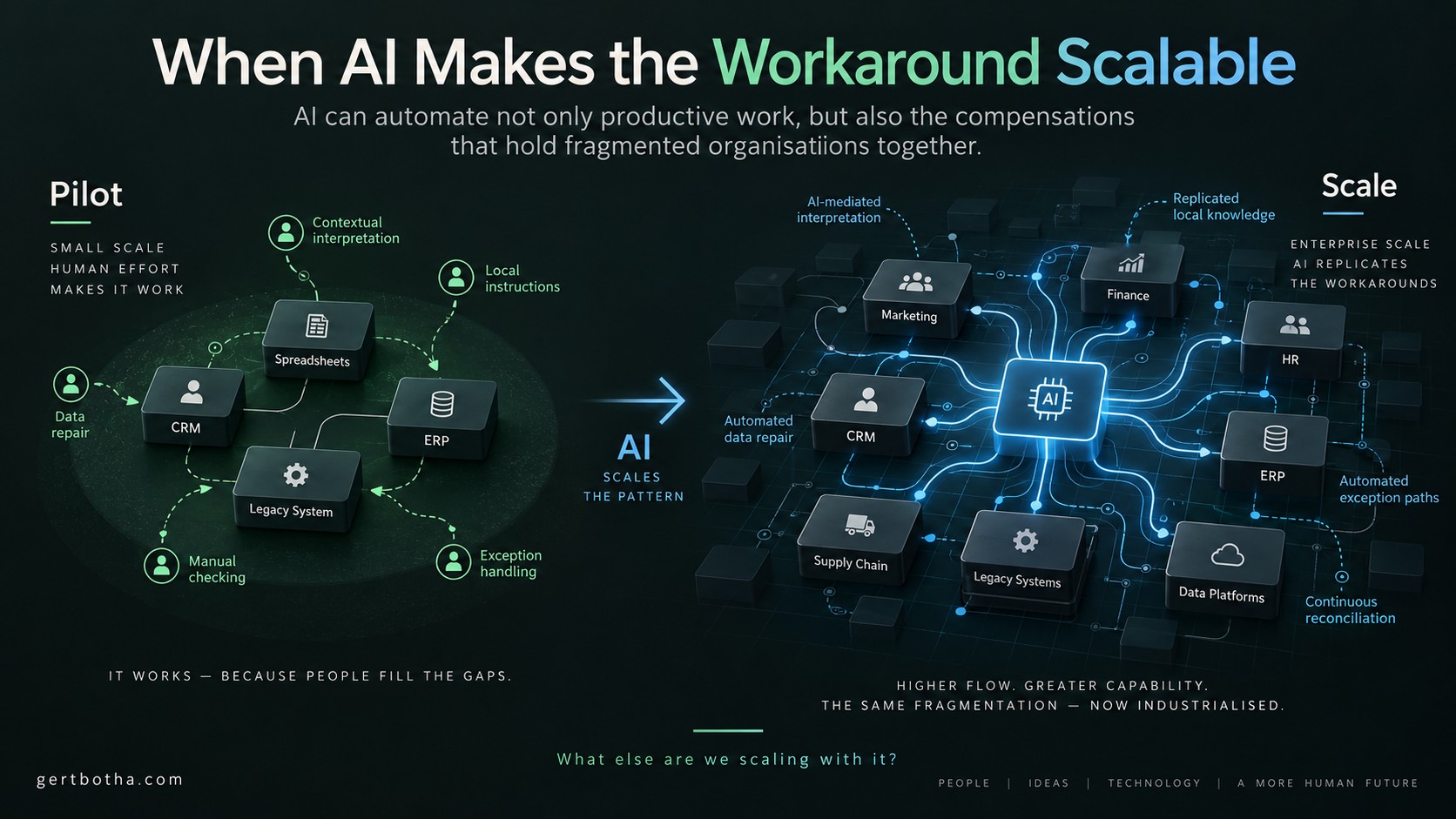 When AI Makes the Workaround Scalable
 The Age of Continuous Shocks: Why the coming downturn will be decided in your supply chain
 Friday’s Leader Reflection Quote – Saeculum Leadership Leaders Accept Decisions Create Responsibilities
 The Corix Partners Friday Reading List - October 9, 2026
 Consumer vs. enterprise AI agents