
Dec21
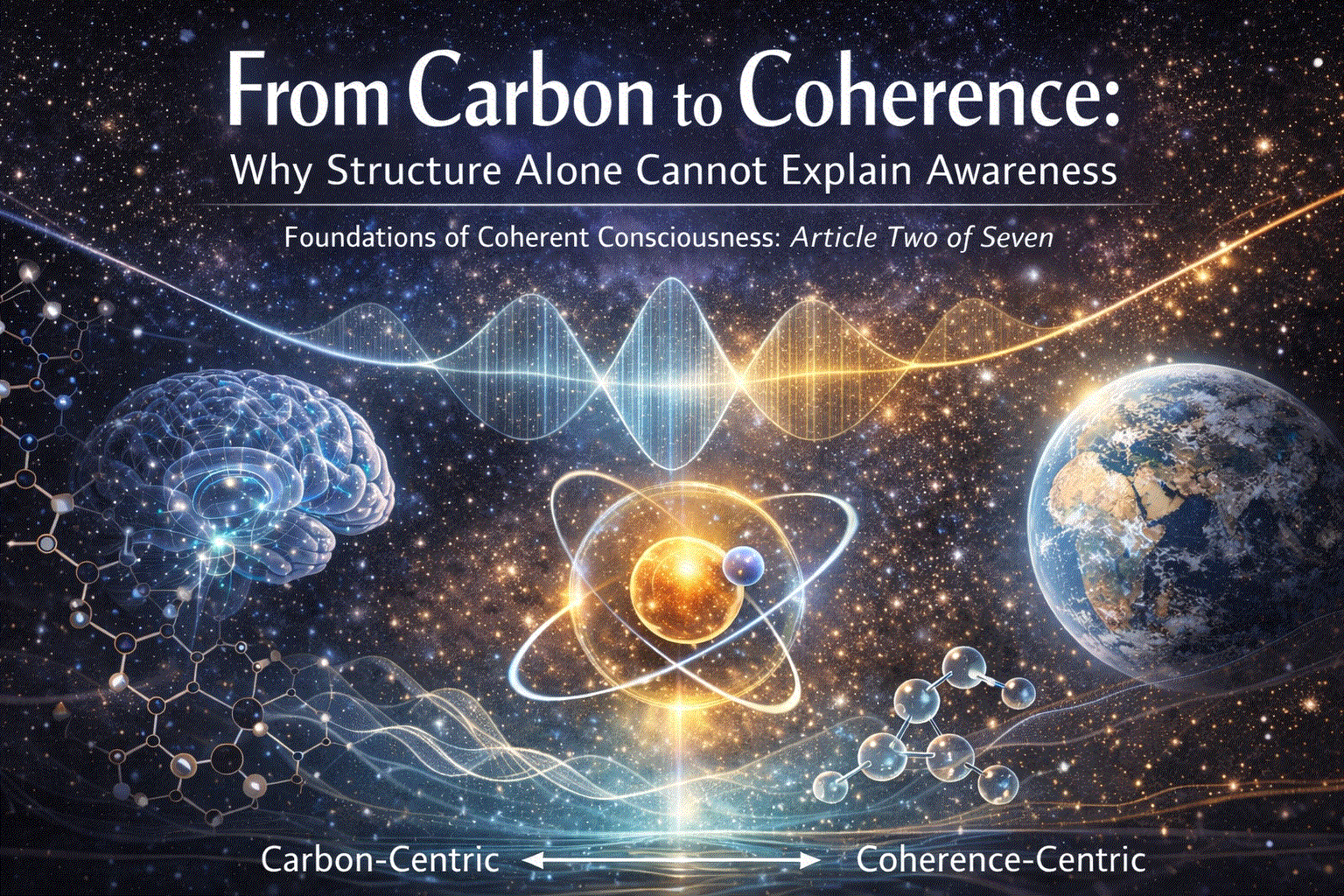
Foundations of Coherent Consciousness
Modern science has been extraordinarily successful at explaining structure. From molecular biology to neuroscience, we have learned how carbon-based compounds assemble into proteins, cells, organs, and brains. We can trace signaling pathways, model neural networks, and simulate increasingly complex forms of intelligence. Yet for all this progress, one central mystery remains unresolved: why any of this is accompanied by experience at all.
The dominant assumption has been that consciousness emerges automatically from sufficient complexity. Build enough structure, connect enough nodes, run enough computations, and awareness will somehow appear. This view—often implicit rather than stated—frames consciousness as a byproduct of carbon-based architecture.
But complexity alone has never been a sufficient explanation in systems science.
In every functioning system—whether biological, technological, or social—structure is necessary but not decisive. What determines whether a system is alive, adaptive, and meaningful is not merely what it is made of, but how coherently it operates over time. Without coherence, even the most sophisticated structures fragment into noise.
Carbon excels at building structure. Its unique bonding versatility allows for vast molecular diversity and stability. DNA, proteins, neural tissue, and the physical brain itself depend on carbon’s capacity to hold form. In this sense, carbon provides the hardware of life and cognition.
But hardware does not explain experience.
A computer with flawless circuitry remains inert without energy, timing, and synchronization. Likewise, a brain composed of exquisitely arranged carbon-based neurons does not explain awareness unless something allows those structures to operate in coherent relationship—internally and with their environment.
This is where the carbon-centric model quietly reaches its limits.
Consciousness is not best described as a static object or stored pattern. It is fluid, continuous, context-sensitive, and field-like. It involves presence, meaning, and immediacy—qualities that cannot be localized to individual components or reduced to isolated interactions. These qualities point not to structure alone, but to coherence across structure.
Coherence is a property of systems that remain phase-aligned—where energy, information, and timing reinforce rather than interfere with one another. It is what allows a system to behave as a unified whole rather than a collection of competing parts. In physics, coherence underlies lasers and superconductors. In biology, it appears in heart rhythms, neural synchrony, and metabolic regulation. In human experience, it manifests as clarity, flow, and presence.
Crucially, coherence is not something carbon provides on its own.
Carbon builds stable frameworks, but it does not inherently enable rapid responsiveness, reversibility, or resonance. Those properties arise from the medium through which carbon structures interact—the dynamic substrate that allows signals to propagate, synchronize, and adapt without destroying form.
This distinction matters because many attempts to explain consciousness conflate structure with operation. They assume that if the architecture is detailed enough, experience must follow. But systems thinking suggests the opposite: without coherence, increasing complexity often reduces intelligibility rather than producing awareness.
The question, then, shifts.
Instead of asking how consciousness emerges from structure, we are invited to ask: what allows structured systems to remain coherently coupled to experience in the first place?
This reframing does not deny the importance of the brain, neurons, or carbon-based chemistry. It simply recognizes that structure enables possibility, while coherence enables participation. Awareness appears not where structure is densest, but where relationship is sustained across scales.
In the previous article, we explored hydrogen as a candidate coherence medium—an elemental participant that supports flexibility, resonance, and energy sensitivity throughout living systems. That exploration sets the stage for a broader realization: consciousness is not an output of isolated components, but a property of systems that remain dynamically aligned with themselves and their surroundings.
Carbon gives us continuity and form.
Coherence gives us flow and presence.
Understanding consciousness requires both—but it begins by recognizing that structure alone is not enough.
In the series on LinkedIn (Zenscapes – Mindful Futures) we will ground this distinction in biology itself, exploring how water, breath, and hydrogen-based networks enable resonance in living systems—revealing consciousness not as an abstract mystery, but as a lived, embodied phenomenon.
By Zen Benefiel
Keywords: Ecosystems, Emerging Technology, Leadership
 When AI Makes the Workaround Scalable
 The Age of Continuous Shocks: Why the coming downturn will be decided in your supply chain
 Friday’s Leader Reflection Quote – Saeculum Leadership Leaders Accept Decisions Create Responsibilities
 The Corix Partners Friday Reading List - October 9, 2026
 Consumer vs. enterprise AI agents