Oct09
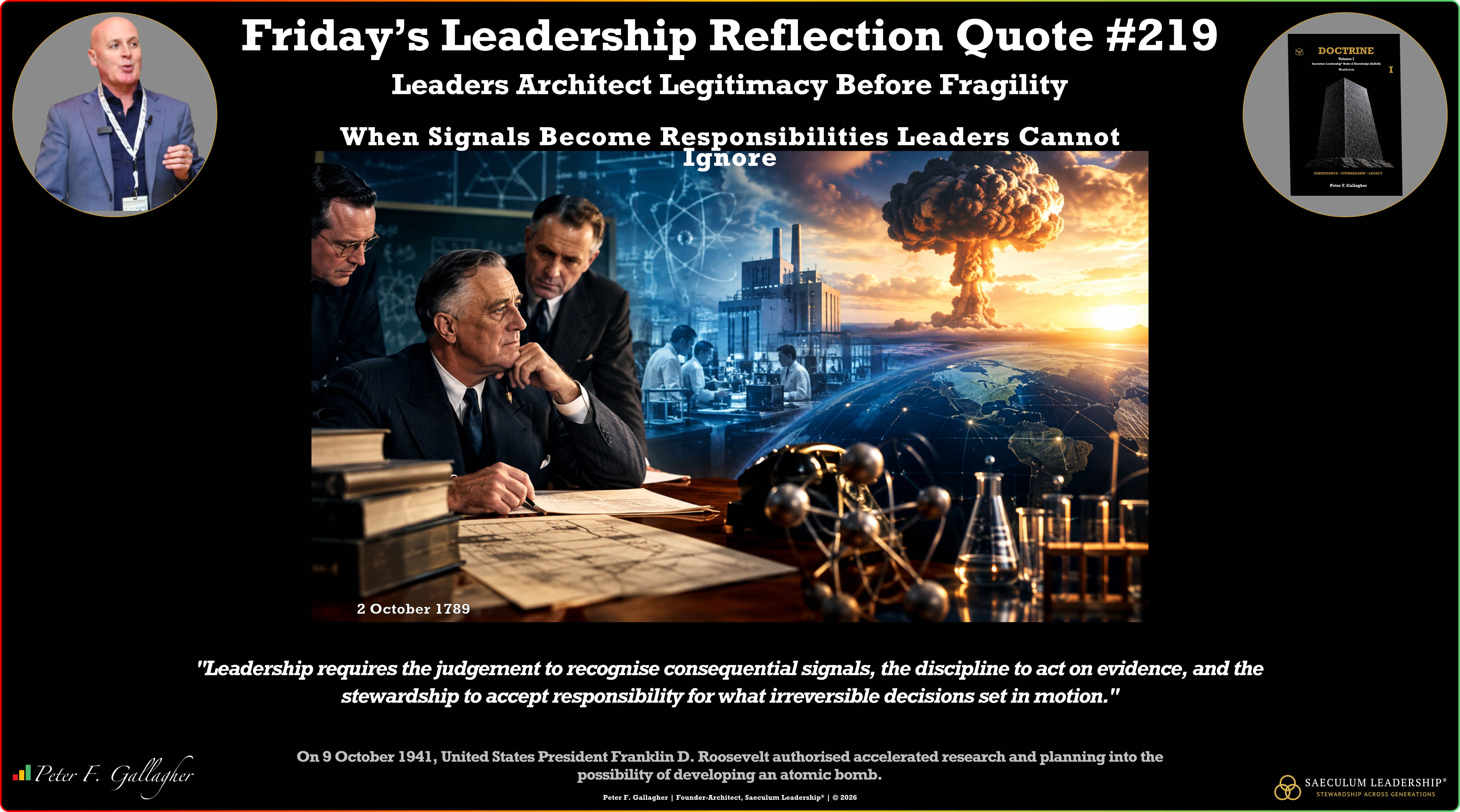
On 9 October 1941, United States President Franklin D. Roosevelt authorised accelerated research and planning into the possibility of developing an atomic bomb. The decision marked a significant turning point in the American response to the emerging military and technological possibilities of nuclear fission during the Second World War.
The decision followed a briefing by Vannevar Bush, director of the Office of Scientific Research and Development, and Vice President Henry A. Wallace. Bush presented findings from British atomic research, including the conclusions of the MAUD Committee, which had assessed the feasibility of developing an atomic weapon. These findings strengthened the case that nuclear research might produce a weapon capable of changing the course of the war.
At this stage, the United States had not yet established the Manhattan Project in its eventual form. Roosevelt authorised further investigation, planning and preparation, including consideration of the resources and industrial capacity a future programme might require. This distinction matters: the decision initiated a process whose scale, organisation and consequences developed over the following months.
The research presented extraordinary scientific, engineering and logistical challenges. Producing an atomic weapon would require advances in nuclear physics, methods of separating uranium isotopes or producing plutonium, specialised industrial facilities, substantial funding and close coordination between scientists, government departments and the military. The undertaking was far beyond the capacity of an individual laboratory or a single organisation working independently.
The international context added urgency. The United States and Britain were concerned that Nazi Germany might develop an atomic weapon first, although the precise status of German nuclear research remained uncertain. American leaders therefore faced a decision involving incomplete intelligence, substantial investment, technical uncertainty and potentially profound consequences for national security.
Following the December 1941 attack on Pearl Harbor and the United States' entry into the war, the programme acquired greater urgency. In 1942, responsibility for major construction and production activities increasingly shifted towards the United States Army Corps of Engineers. The Manhattan Engineer District became the organisational foundation of the programme widely known as the Manhattan Project.
The programme eventually mobilised universities, scientists, engineers, industrial companies and military organisations on an unprecedented scale. Its development culminated in the first successful nuclear test in July 1945 and the use of atomic bombs against Hiroshima and Nagasaki in August 1945.
The significance of 9 October 1941 lies in the decision to move beyond preliminary investigation towards an organised national effort. It was an early authorisation in a sequence of decisions that transformed a scientific possibility into one of the most consequential technological undertakings in modern history. From a Saeculum Leadership® perspective, this represents a consequential Signal in which emerging scientific knowledge, institutional capability and strategic necessity converged to reshape the trajectory of global power, security and technological advancement. It illustrates how leaders who recognise an emerging signal early can alter the course of events long before the full implications become visible.
Saeculum Leadership® Lessons: Viewed through a Saeculum Leadership® lens, this event demonstrates how leaders interpret signals, assess uncertainty and mobilise institutional capability before the full consequences of change are apparent. Saeculum leaders recognise that a consequential signal requires an understanding of how emerging scientific knowledge may alter the strategic environment. They recognise that disciplined judgement demands that credible evidence be distinguished from uncertainty, ensuring that decisions reflect available knowledge rather than assumptions about what competitors may achieve. Saeculum leaders know that effective mobilisation connects strategic vision to institutional architecture by aligning scientific expertise, government authority, funding, industrial capability and security requirements around a defined objective. They recognise that successful execution depends on clear responsibilities, appropriate resources and the capacity to adapt as new evidence changes the scale and direction of the undertaking. Saeculum leaders understand System Stewardship extends this responsibility beyond the immediate decision, requiring leaders to consider the long-term consequences of the capabilities they authorise and the obligations they create. Leaders Accept Decisions Create Responsibilities.
“Leadership requires the judgement to recognise consequential signals, the discipline to act on evidence, and the stewardship to accept responsibility for what irreversible decisions set in motion.”
From the Canon — Practice 5 — System Stewardship. System Stewardship is the disciplined practice of accepting responsibility for the systems, capabilities and consequences that leadership decisions create. It requires leaders to look beyond immediate objectives and consider how emerging capabilities may reshape institutions, societies and future generations. Stewardship therefore concerns not only what leaders seek to achieve, but also what they choose to create, maintain and ultimately hand forward.
The decision of 9 October 1941 illustrates this responsibility. Political leaders authorised research into a capability whose full implications could not yet be understood. Although the decision addressed an immediate strategic challenge, the capability it helped create would transform warfare, global security and international relations.
System Stewardship requires leaders to recognise that significant decisions rarely end when their immediate objectives are achieved. New capabilities create new responsibilities. New systems generate new risks. New forms of power require new forms of governance. The test of stewardship is whether leaders anticipate, govern and accept responsibility for these consequences, including those that emerge beyond their tenure. Through stewardship, leaders seek to ensure that today's solutions do not become tomorrow's vulnerabilities, preserving institutional purpose and long-term societal stability amid continual change.
The Stewardship Reflection Lens:
What are we inheriting? We inherit capabilities, systems and consequences created by decisions made before our time.
How should we steward it? We strengthen what we inherit through responsible decisions, disciplined governance and an understanding of long-term consequences.
What legacy are we creating? Our legacy is shaped by the decisions we make today and the responsibilities we accept for their consequences.
Further Reading: Saeculum Leadership® Body of Knowledge (SLBoK). Saeculum Leadership®: Doctrine – Volume I.
Peter F. Gallagher is the Founder–Architect of Saeculum Leadership®, a doctrine of generational stewardship that equips leaders to strengthen what they inherit and shape what future generations receive. A 21-book author, global keynote speaker, and trusted adviser to boards, CEOs, and executive leadership teams, he helps organisations strengthen leadership capability, institutional stewardship, and transformational change in an increasingly complex world.
For further insights into Saeculum Leadership®, institutional stewardship and leadership across generations, contact Peter.gallagher@a2B.consulting.
#SaeculumLeadership #Leadership #FLRQ #SystemStewardship #InstitutionalStewardship #GenerationalResponsibility #LeadershipDevelopment #ManhattanProjec
Further Reading: Saeculum Leadership® Body of Knowledge (SLBoK). Saeculum Leadership®: Doctrine – Volume I.
Peter F. Gallagher is the Founder–Architect of Saeculum Leadership® - a generational school of thought reframing leadership as a moral, institutional and generational responsibility. After four decades studying why organisational change succeeds or fails, he concluded that the deeper challenge was not change itself, but leadership across generations. He now codifies the Saeculum Canon, equipping leaders to steward institutions and societies across long arcs of time. The Saeculum Canon establishes the doctrine, architecture and standards of generational leadership.
For further insights please visit our websites: https://www.a2b.consulting https://www.peterfgallagher.com Amazon.com: Peter F Gallagher: Books, Biography, Blog, Audiobooks, Kindle
Saeculum Leadership® Body of Knowledge (SLBoK): Volumes 1-10.A-E & 0, I-V
~ Leadership of Change® Volume 1 - Change Management Fables
~ Leadership of Change® Volume 2 - Change Management Pocket Guide
~ Leadership of Change® Volume 3 - Change Management Handbook
~ Leadership of Change® Volume 4 - Change Management Leadership
~ Leadership of Change® Volume 5 - Change Management Adoption
~ Leadership of Change® Volume 6 - Change Management Behaviour
~ Leadership of Change® Volume 7 - Change Management Sponsorship
~ Leadership of Change® Volume 8 - Change Management Charade
~ Leadership of Change® Volume 9 - Change Management Insanity
~ Leadership of Change® Volume 10 - Change Management Dilenttante
~ Leadership of Change® Volume A - Change Management Gamification - Leadership
~ Leadership of Change® Volume B - Change Management Gamification - Adoption
Keywords: Business Strategy, Change Management, Leadership
Friday’s Leader Reflection Quote – Saeculum Leadership Leaders Accept Decisions Create Responsibilities The Corix Partners Friday Reading List - October 9, 2026
 Consumer vs. enterprise AI agents
 Best Supply Chain AI Tools in 2026: SCM SENSEI AI and Ask Lora Compared
 Making Silos Permeable