
Jan23
FCRQ182 Leadership Learning!
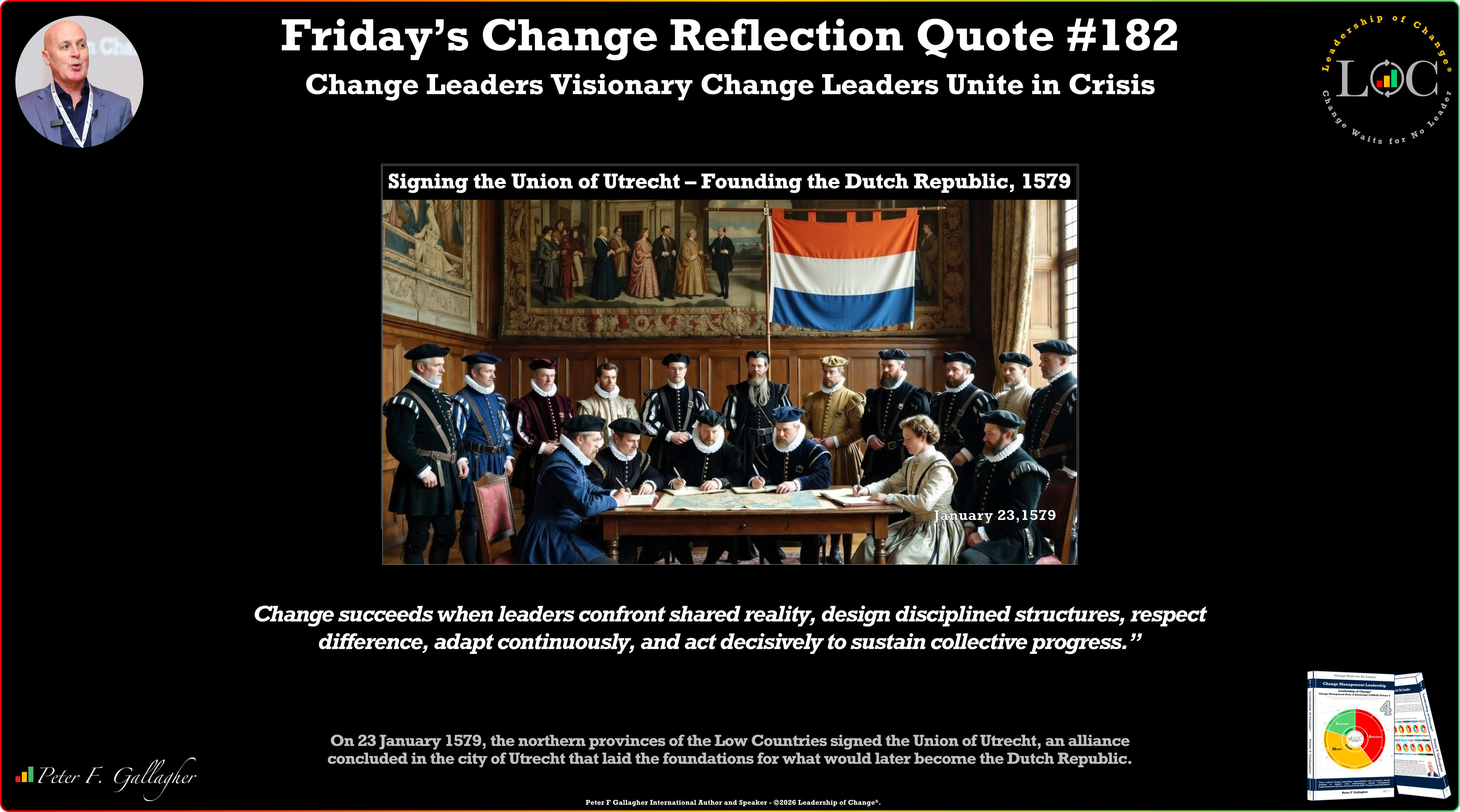
On 23 January 1579, the northern provinces of the Low Countries signed the Union of Utrecht, an alliance concluded in the city of Utrecht that laid the foundations for what would later become the Dutch Republic. Initially signed by Holland, Zeeland, Utrecht, and several northern territories, the agreement responded directly to the Union of Arras signed earlier that month by southern, largely Catholic provinces seeking reconciliation with Spain. The northern signatories aimed to strengthen military cooperation, coordinate taxation and defence, and maintain unity amid escalating Spanish administrative measures and religious persecution. This treaty built upon earlier efforts such as the Pacification of Ghent in 1576, which had sought a broader alliance across the Low Countries against foreign intervention. As religious and political divisions deepened between Protestant-dominated northern regions and Catholic southern areas, the need for a closer confederation became unavoidable. Key provisions included mutual support in war, shared fiscal responsibilities, and notably, provisions for religious tolerance, allowing freedom of conscience and restricting persecution based on faith, which represented an early step towards broader acceptance in Europe. Though framed as a defensive pact rather than a declaration of sovereignty, the Union of Utrecht provided a durable legal and organisational framework for sustained resistance. Over the following months and years, additional provinces and cities joined, expanding its reach. It evolved into the constitutional basis for the Republic of the Seven United Provinces, formalised through subsequent developments including the Act of Abjuration in 1581, which rejected Philip II's sovereignty. Spain did not recognise this independence until the Twelve Years' Truce in 1609. The event marked a critical turning point in the prolonged struggle for autonomy in the region. By prioritising decentralised governance and joint defence over centralised authority, it countered the threat of fragmentation and external domination. This alliance fostered conditions for economic growth, innovation, and cultural flourishing in the northern provinces, contributing to the emergence of a prosperous and influential republic. The historical significance lies in its role as a foundational act that transformed a defensive pact into the enduring structure of an independent entity. This moment represents a clear Saeculum Leadership™ signal: a generational inflection where structural redesign replaced reactive resistance. The Union of Utrecht stands as a Signal—an encoded act of long-cycle leadership that redefined sovereignty, tolerance, and federal cooperation. It demonstrated how collective commitment in crisis could create lasting political and social change, influencing concepts of federalism, tolerance, and self-determination across centuries. In retrospect, the Union of Utrecht stands as a powerful example of strategic foresight amid division and adversity. Its importance extends beyond immediate survival, as it established principles of cooperation and resilience that shaped modern governance models. The impact was profound, enabling the northern Low Countries to evolve into a major European power while preserving regional identities and promoting relative tolerance, outcomes that continue to resonate in discussions of unity and adaptation in turbulent times.
Change Leadership Lessons: The Union of Utrecht illustrates how leadership judgement under pressure determines whether unity fragments or endures. Leaders of change confront structural realities early, recognising that durable progress depends on acknowledging conditions rather than promoting aspiration alone. They establish disciplined governance frameworks that enable cooperation and coordinated action, even when consensus is incomplete and trust remains fragile. Change leaders respect difference across groups and interests, understanding that stability increases when diversity is managed rather than suppressed. They reinforce direction through sustained intervention, knowing that change fails when leadership attention dissipates after initial decisions. Leaders of change treat learning as an ongoing responsibility, refining systems through action and experience rather than assuming any solution is final. Visionary Change Leaders Unite in Crisis.
“Change succeeds when leaders confront shared reality, design disciplined structures, respect difference, adapt continuously, and act decisively to sustain collective progress.”
Application. Change Leadership Responsibility 1 - Articulate a Change Vision: The Union of Utrecht illustrates how enduring transformation begins when leaders articulate a shared future grounded in political reality rather than imposed uniformity. Change falters when future direction is framed around abstract ideals or centralised assumptions that ignore lived conditions across the system. Articulating a credible change vision requires leaders to define the future experience the organisation is committed to deliver before fragmentation or resistance forces reactive compromise. When leaders ground vision in stakeholder insight, historical context, and cultural awareness, they create coherence, discipline, and alignment across the organisation. This approach does not deny uncertainty or complexity; it acknowledges them while remaining unequivocal about direction. A disciplined change vision becomes the reference point that guides judgement, exposes misalignment, and prevents strategic drift as conditions evolve. Leadership of change demands that vision anchors transformation in shared values, ensuring organisational energy flows toward futures shaped by understanding rather than imposition.
Final Thoughts: Sustainable transformation depends on leaders who preserve legitimacy through shared vision, disciplined governance, and responsibility exercised under pressure. As AI and digital acceleration reshape organisations, the danger of imposed, technology-driven change detached from human context intensifies. Leadership that unites people around credible direction during disruption remains the decisive factor separating transformation that endures from change that fractures trust.
Further Reading: Change Management Leadership - Leadership of Change® Volume 4.
For further reading please visit our websites: https://www.a2b.consulting https://www.peterfgallagher.com Amazon.com: Peter F Gallagher: Books, Biography, Blog, Audiobooks, Kindle
Leadership of Change® Body of Knowledge Volumes: Change Management Body of Knowledge (CMBoK) Books: Volumes 1, 2, 3, 4, 5, 6, 7, 8, 9, 10, A, B, C, D & E available on both Amazon and Google Play:
~ Leadership of Change® Volume 1 - Change Management Fables
~ Leadership of Change® Volume 2 - Change Management Pocket Guide
~ Leadership of Change® Volume 3 - Change Management Handbook
~ Leadership of Change® Volume 4 - Change Management Leadership
~ Leadership of Change® Volume 5 - Change Management Adoption
~ Leadership of Change® Volume 6 - Change Management Behaviour
~ Leadership of Change® Volume 7 - Change Management Sponsorship
~ Leadership of Change® Volume 8 - Change Management Charade
~ Leadership of Change® Volume 9 - Change Management Insanity
~ Leadership of Change® Volume 10 - Change Management Dilenttante
~ Leadership of Change® Volume A - Change Management Gamification - Leadership
~ Leadership of Change® Volume B - Change Management Gamification - Adoption
Keywords: Business Strategy, Change Management, Leadership
 Two Clocks, One Truck: The Army's Need for Speed Meets New Defense Sourcing Rules
 Sustainable Transformation: The Elephant and The Mouse In The Room
 The Price of Standing Alone: Strategic Autonomy in a World Where Nobody Can Do It Alone
 The Potter’s Hands: Why Great Leaders Shape Environments, Not People
 The Corix Partners Friday Reading List - October 16, 2026