
Jun12
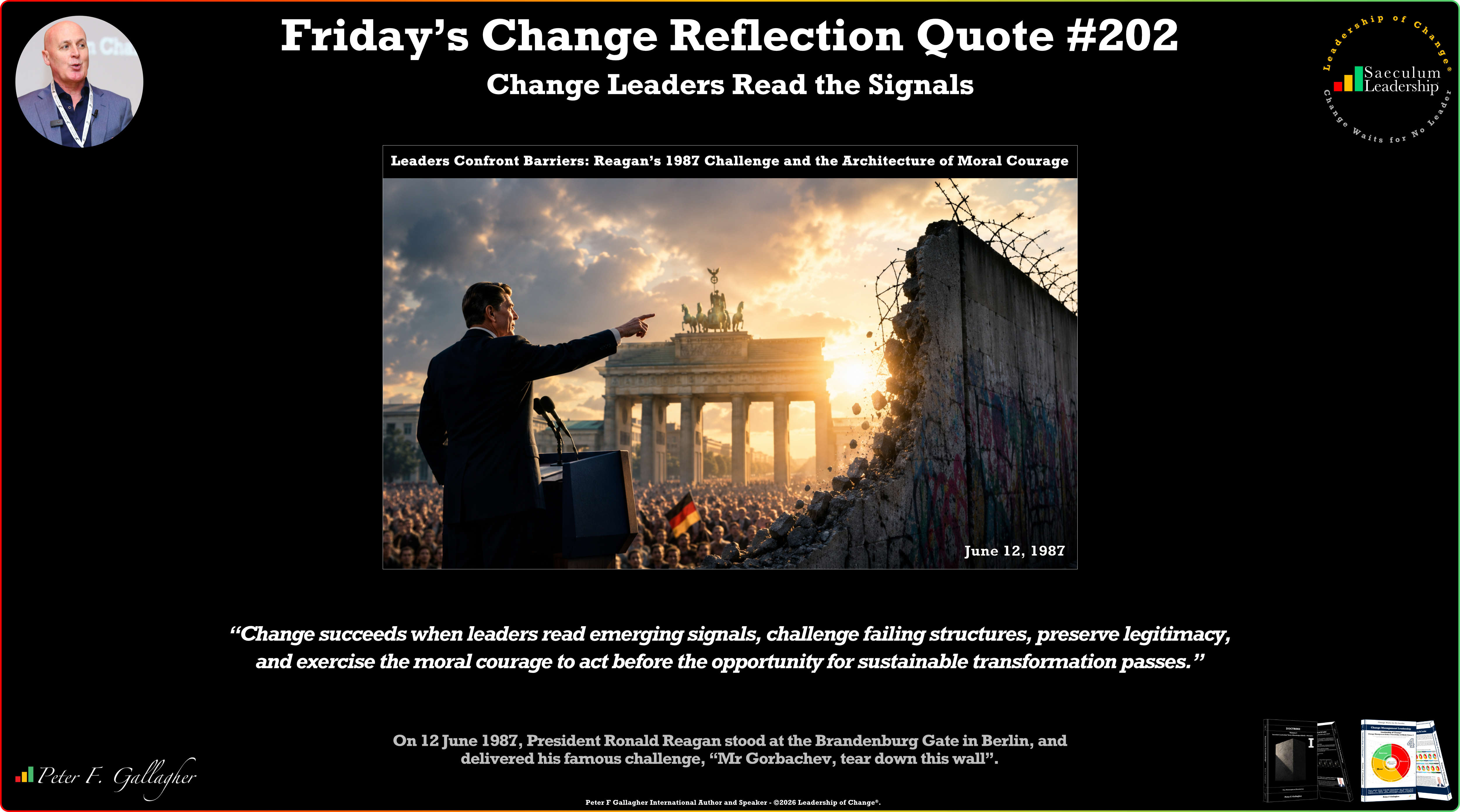
FCRQ202 Leadership Learning!
On 12 June 1987, President Ronald Reagan stood at the Brandenburg Gate in Berlin, and delivered his famous challenge, “Mr Gorbachev, tear down this wall”. Standing within sight of the Berlin Wall, Reagan issued a direct public challenge to Soviet leader Mikhail Gorbachev, calling for the removal of the barrier that had divided Berlin since 1961.
At the time, Europe remained divided between democratic Western nations and communist states aligned with the Soviet Union. The Berlin Wall had become the most visible symbol of that division. Constructed to prevent East Germans from fleeing to the West, it represented political control, restricted freedom, and the wider ideological conflict between competing systems of governance.
The speech occurred during a period of significant change within the Soviet Union. Gorbachev had introduced reforms through policies known as glasnost and perestroika, intended to increase openness and restructure aspects of the Soviet system. While these reforms generated optimism among some observers, uncertainty remained regarding how far change would be permitted and whether existing structures would genuinely adapt.
Reagan’s address was carefully framed within this environment. Rather than focusing solely on diplomacy, the speech challenged the legitimacy of physical and ideological barriers that constrained people, information, and economic development. The message resonated across international audiences because it challenged whether long established structures still served their intended purpose.
Although the Berlin Wall would not fall until November 1989, the Brandenburg Gate speech became one of the defining moments of the late Cold War. Historians continue to debate its direct influence on subsequent events, yet there is broad agreement that it captured growing global expectations for greater openness, accountability, and freedom throughout Eastern Europe.
The significance of this event extends well beyond politics. It demonstrates how visible symbols often reveal deeper institutional realities. Walls, whether physical or organisational, often emerge when institutions prioritise preservation over adaptation. The speech highlighted a growing tension between preserving established structures and responding to emerging societal expectations. In hindsight, the event reminds us that transformational periods are often preceded by signals that institutional arrangements are losing legitimacy and becoming increasingly difficult to sustain. This was a Saeculum Leadership® Boundary‑Breaking Signal, revealing that the Cold War’s structural architecture had reached exhaustion and that only moral courage could trigger the next era.
Change Leadership Lessons: The Brandenburg Gate speech demonstrates that transformational change is rarely triggered by surprise. It is usually preceded by signals that reveal existing structures are approaching their limits. It illustrates that once a Boundary‑Breaking Signal emerges, the leader’s task shifts from observing history to intervening in it. Leaders of change identify emerging barriers early and address them before they restrict future organisational progress. They recognise when visible symbols no longer reflect emerging realities and require purposeful adaptation. Change leaders continuously monitor emerging signals and align decisions with changing environmental conditions. They strengthen institutional legitimacy by demonstrating continued relevance and commitment to future success. Leaders of change intervene at the right moment to convert opportunity into sustainable transformation. Change Leaders Read the Signals.
“Change succeeds when leaders read emerging signals, challenge failing structures, preserve legitimacy, and exercise the moral courage to act before the opportunity for sustainable transformation passes.”
Application - Change Leadership Responsibility 3 - Intervene to Ensure Sustainable Change: The lessons from Brandenburg Gate extend far beyond Cold War politics and speak directly to the leadership responsibility to recognise emerging signals and intervene when institutional barriers have outlived their purpose and begun to obstruct future progress. Sustainable change requires leaders to recognise when structures that once provided stability are now preventing adaptation, innovation and long-term success.
Change leaders must identify the point at which preserving existing arrangements becomes more important than serving the evolving needs of stakeholders, employees or society. Within organisations, this frequently occurs when established processes, legacy systems or deeply embedded assumptions are protected despite growing evidence that they no longer support strategic objectives or operational reality.
Failure to intervene allows organisational walls — formal and informal — to strengthen over time. Information becomes restricted, dissenting perspectives are marginalised, and leadership teams gradually lose visibility of changing conditions beyond their immediate environment. By the time declining legitimacy becomes visible, valuable opportunities for renewal may already have been lost.
Effective intervention demands more than awareness. It requires leaders to challenge outdated practices, remove unnecessary barriers and create the conditions for greater openness, collaboration and adaptability. Leaders of change are responsible for ensuring that capability, legitimacy and organisational direction remain aligned with emerging realities. They must act before institutional inertia becomes institutional decline, ensuring that sustainable change remains both achievable and enduring.
Final Thoughts: Reagan's speech was a Saeculum signal, the moment a civilisational cycle turned and an exhausted old order discovered its walls could no longer contain the future. AI can model scenarios and map consequences, but no algorithm can substitute for the leader who overrules cautious consensus and speaks change into existence. The moment institutional resistance is loudest is precisely when change leaders must find their clearest, most courageous, and least compromised voice.
Further Reading: Change Management Leadership® - Leadership of Change® Volume 4 and Saeculum Leadership®: Doctrine – Volume I.
Peter F. Gallagher, a 20‑book author, consults, speaks, and writes on Saeculum Leadership® and Leadership of Change®. He works exclusively with boards, CEOs, and senior leadership teams to prepare and align them to effectively and proactively lead their organisations through transformation in a rapidly evolving epoch.
For further insights please visit our websites: https://www.a2b.consulting https://www.peterfgallagher.com Amazon.com: Peter F Gallagher: Books, Biography, Blog, Audiobooks, Kindle
Saeculum Leadership® Body of Knowledge (SLBoK): Volumes 1-10.A-E & I-V
~ Leadership of Change® Volume 1 - Change Management Fables
~ Leadership of Change® Volume 2 - Change Management Pocket Guide
~ Leadership of Change® Volume 3 - Change Management Handbook
~ Leadership of Change® Volume 4 - Change Management Leadership
~ Leadership of Change® Volume 5 - Change Management Adoption
~ Leadership of Change® Volume 6 - Change Management Behaviour
~ Leadership of Change® Volume 7 - Change Management Sponsorship
~ Leadership of Change® Volume 8 - Change Management Charade
~ Leadership of Change® Volume 9 - Change Management Insanity
~ Leadership of Change® Volume 10 - Change Management Dilenttante
~ Leadership of Change® Volume A - Change Management Gamification - Leadership
~ Leadership of Change® Volume B - Change Management Gamification - Adoption
Keywords: Leadership, Change Management, Business Strategy
 Two Clocks, One Truck: The Army's Need for Speed Meets New Defense Sourcing Rules
 Sustainable Transformation: The Elephant and The Mouse In The Room
 The Price of Standing Alone: Strategic Autonomy in a World Where Nobody Can Do It Alone
 The Potter’s Hands: Why Great Leaders Shape Environments, Not People
 The Corix Partners Friday Reading List - October 16, 2026