Oct17

FCRQ168 Leadership Learning!
On this day, 17 October 1931, Al Capone was convicted of income tax evasion, demonstrating that even the most powerful organisations can fall through systemic weaknesses. He was found guilty on several counts of failing to pay tax on income earned illegally and was sentenced to eleven years in prison, fined US$50,000 plus court costs, and held liable for back taxes and interest. Capone had long wielded political influence, controlled local law enforcement, intimidated witnesses, and paid bribes to secure impunity. His criminal enterprise flourished under Prohibition, with organised operations in gambling, bootlegging and extortion. The federal government, however, marshalled the power of tax law to bypass the more violent crimes that proved harder to prosecute. The U.S. Treasury’s Special Intelligence Unit, led by agents who traced his extravagant spending and linked it to unreported income, eventually erected a case too strong to evade. In the courtroom, the presiding judge quietly replaced a jury—to forestall tampering—and discarded a plea bargain Capone thought would deliver a lighter sentence. The result was a blow to the myth of invincibility that criminal organisations often cultivate. Although Capone’s name is long associated with gangland violence, his downfall underscores that no system, however powerful, is immune from internal vulnerabilities. Corruption, intimidation or dominance do not safeguard an organisation from cumulative neglect of oversight, accountability or legal constraints. The weight of unexamined risk, financial opacity, and overreach can erode legitimacy and expose even mighty structures to collapse. That historical moment invites reflection on change leadership. Capone’s empire was sustained by fear, informal power, and the suppression of dissent, yet those same forces concealed its fragility and prevented adaptive correction. When external scrutiny intensified, the weaknesses internalised over years were exposed, and the structure crumbled. In many organisations, overly centralised authority and cultural immunity to scrutiny may ensure short-term stability—but they conceal systemic brittleness. Over time, Capone’s incarceration and the public spectacle of his downfall reshaped the narrative of law enforcement capability. It demonstrated that even the most deeply entrenched power can be challenged when institutions muster expertise, perseverance and the will to enforce accountability. The case became emblematic of how a rule-of-law system could triumph over brute force. This episode demonstrates that dominance built on secrecy and impunity is inherently fragile. It reminds us that systemic integrity, transparency, and vigilance are essential to correct internal weakness before external forces intervene. That is a powerful lesson for change leadership.
Change Leadership Lessons: These historical insights translate directly into contemporary change leadership imperatives that demand structural vigilance and systemic accountability. The downfall of Capone’s empire highlights the need for systemic integrity, transparency, and vigilance to address weaknesses before external enforcement intervenes. Leaders of change embed accountability by replacing secrecy with clear structures that ensure responsibility cannot be bypassed. They insist on transparency, knowing that hidden practices weaken trust and can ultimately destroy institutions. Change leaders guard procedural integrity by ensuring that systems are resilient against manipulation and maintain fairness in all circumstances. They build structural resilience through reinforcing governance frameworks that strengthen organisations beyond the influence of any single individual. Leaders of change phase out privilege gradually, rebalancing influence to sustain equity and embed long-term cultural transformation within the organisation. Change Leaders Embed Structural Resilience.
“Change leaders replace secrecy with accountability, protect processes from manipulation, and dismantle privilege through structural resilience to avoid corporate failure.”
Application - Change Leadership Responsibility 3 - Intervene to Ensure Sustainable Change: The downfall of Al Capone's empire illustrates how leaders must intervene to ensure sustainable change when hidden weaknesses threaten organisational integrity. This responsibility demands vigilance and decisive action to expose and correct systemic fragility before external forces impose accountability through the erosion of trust and governance. To intervene effectively, change leaders must go beyond surface-level reforms and confront the deeper structural causes of organisational vulnerability. This involves strengthening governance frameworks, embedding transparent decision making, and institutionalising accountability mechanisms that resist distortion or undue influence. In modern organisations, this responsibility manifests when informal power networks or legacy hierarchies undermine fairness and adaptability. The intervention imperative requires courage to dismantle entrenched privilege and replace it with resilient systems that sustain equity and integrity. Leaders who intervene to ensure sustainable change turn accountability, transparency, and structural resilience into enduring capabilities that safeguard the organisation and sustain change success.
Final Thoughts: In an era where artificial intelligence accelerates organisational complexity, the imperative for structural resilience and transparent governance becomes exponentially more critical. Effective leaders embed adaptive accountability systems that evolve with technological transformation while safeguarding human-centred integrity. True change leaders understand that sustainable success depends not on concentrated control but on distributed resilience that endures both internal fragility and external disruption.
Further Reading: Change Management Leadership - Leadership of Change® Volume 4.
Peter F. Gallagher is a top 7 Global Leadership Guru, the World’s #1 Ranked Change Management Thought Leader, and a 15-time author known internationally for advancing the Leadership of Change® the discipline that transforms leadership from managing the present to serving the possible.
For insights on navigating organisational change, feel free to reach out at Peter.gallagher@a2B.consulting.
#LeadershipofChange #Leadership #ChangeLeadership #GlobalGurus #ChangeManagement #AlCapone #TaxEvasion
For further reading please visit our websites: https://www.a2b.consulting https://www.peterfgallagher.com Amazon.com: Peter F Gallagher: Books, Biography, Blog, Audiobooks, Kindle
Leadership of Change® Body of Knowledge Volumes: Change Management Body of Knowledge (CMBoK) Books: Volumes 1, 2, 3, 4, 5, 6, 7, 8, 9, 10, A, B, C, D & E available on both Amazon and Google Play:
~ Leadership of Change® Volume 1 - Change Management Fables
~ Leadership of Change® Volume 2 - Change Management Pocket Guide
~ Leadership of Change® Volume 3 - Change Management Handbook
~ Leadership of Change® Volume 4 - Change Management Leadership
~ Leadership of Change® Volume 5 - Change Management Adoption
~ Leadership of Change® Volume 6 - Change Management Behaviour
~ Leadership of Change® Volume 7 - Change Management Sponsorship
~ Leadership of Change® Volume 8 - Change Management Charade
~ Leadership of Change® Volume 9 - Change Management Insanity
~ Leadership of Change® Volume 10 - Change Management Dilenttante
~ Leadership of Change® Volume A - Change Management Gamification - Leadership
~ Leadership of Change® Volume B - Change Management Gamification - Adoption
Keywords: Business Strategy, Change Management, Leadership
 You are not your diagnosis
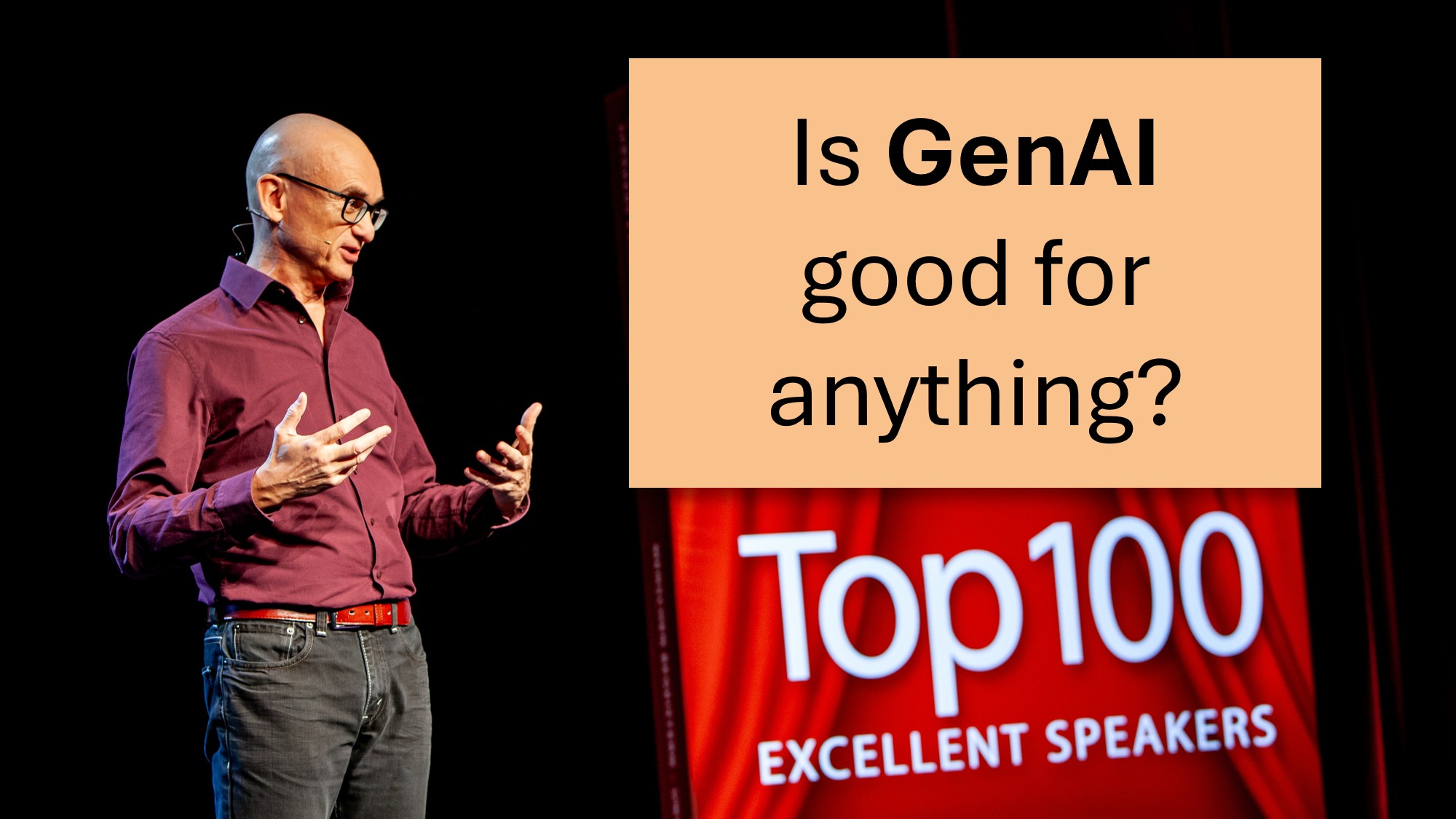 Is GenAI good for anything?
 “I didn’t write an award acceptance speech because I didn’t expect to win.”
 AI Is Exposing the Data Problems Humans Used to Hide
 "The AI may in fact be conscious." Really?