
Dec19
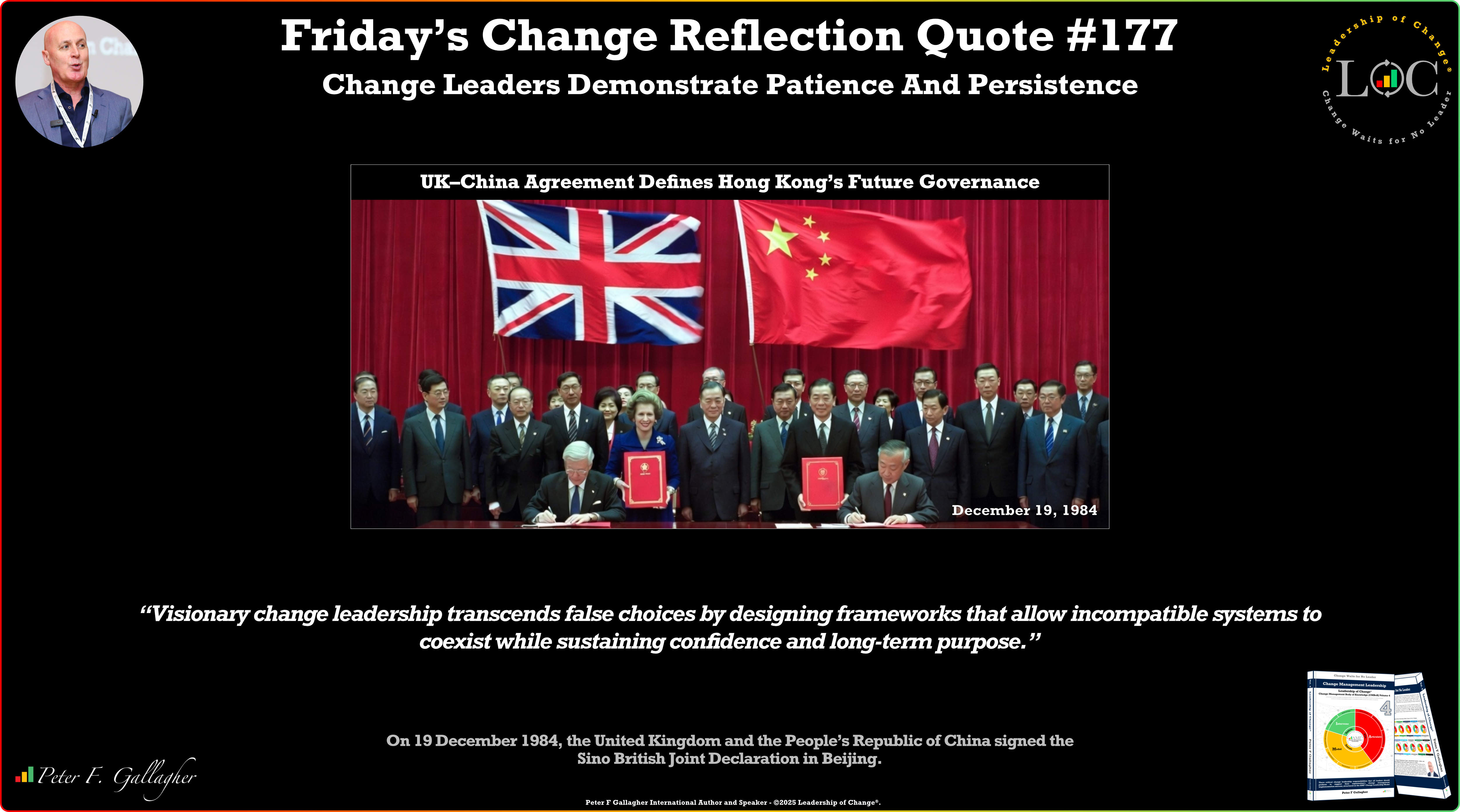
FCRQ177 Leadership Learning!
On 19 December 1984, the United Kingdom and the People’s Republic of China signed the Sino-British Joint Declaration in Beijing. The agreement set out the terms under which Hong Kong would return to Chinese sovereignty on 1 July 1997, ending 156 years of British rule. It established the principle that Hong Kong would retain a high degree of autonomy its capitalist system, and its existing rights and freedoms for fifty years after the handover. This commitment was articulated by Deng Xiaoping as the ‘one country, two systems’ framework, later codified in Hong Kong’s Basic Law (1990). The signing ceremony took place in the Great Hall of the People, attended by senior leaders, diplomats, and representatives who had shaped the negotiations. The agreement followed two years of complex and often tense discussions between the two governments. Earlier attempts to reach consensus had stalled, and both sides had faced internal and external pressures that made compromise difficult. The eventual breakthrough required a shared recognition that the future of Hong Kong demanded clarity, predictability, and a mutually acceptable framework that could withstand political, economic, and social pressures over time. The declaration was therefore not only a diplomatic achievement but also a structural commitment to manage a long-term transition with global implications. It was registered at the United Nations in 1985 and remains a legally binding treaty under international law. The historical significance of the agreement lies in its scale, ambition, and the geopolitical context in which it was forged. It represented a rare moment when two very different political systems agreed to codify a future arrangement that would last decades beyond the tenure of the leaders who signed it. It also reflected the shifting balance of global power in the late twentieth century, as China’s economic reforms accelerated and its international engagement deepened. For the United Kingdom, the agreement marked the end of an era and the beginning of a new relationship with China, shaped by diplomacy, trade, and evolving global interdependence. The declaration also carried profound significance for the people of Hong Kong, whose future was being determined without direct participation in the negotiations. Its provisions were intended to anchor expectations around the continuity of legal institutions, economic freedoms, and everyday life throughout a prolonged transition. By formally committing to a high degree of autonomy for fifty years, the agreement sought to reduce uncertainty and stabilise confidence across institutions, markets, and the international community. This emphasis on predictability reflected a recognition that leadership credibility during major change is not secured by intent alone, but by codified commitments that are clear, durable, and capable of being sustained over time. They expose legitimacy risks when affected populations are excluded from negotiation, requiring leaders to pair patience with sustained and visible efforts to maintain trust. This event remains one of the most studied diplomatic agreements of the twentieth century because of its implications for governance, markets, and institutional continuity. By codifying expectations rather than leaving outcomes ambiguous, it enabled global businesses, investors, and financial institutions to plan across decades. The declaration illustrates how leadership clarity can influence behaviour far beyond government, shaping confidence, investment, and stability across borders.
Change Leadership Lessons: The declaration reveals how leadership responsibility shifts when change cannot be prevented and must instead be deliberately shaped. The agreement demonstrates that patience is not passivity, but disciplined restraint exercised in pursuit of a defined future state. Leaders of change often navigate severe political, historical, and practical constraints that limit their available options. They create innovative frameworks that allow fundamentally incompatible political systems to coexist within one sovereign state. Change leaders find ways to transcend the false choice between traditional administration and immediate control by forming hybrid governance models. They also expose legitimacy risks when affected populations are excluded from negotiation, requiring leaders to pair patience with sustained and visible efforts to maintain trust over time. Leaders of change establish international legal obligations and accountability mechanisms that extend beyond the negotiating governments. Change Leaders Demonstrate Patience And Persistence.
“Visionary change leadership transcends false choices by designing frameworks that allow incompatible systems to coexist while sustaining confidence and long-term purpose.”
Application. Change Leadership Responsibility 1 - Articulate a Change Vision: The Sino British Joint Declaration demonstrates that change leadership begins with defining a credible and shared future before attempting to manage transition. The leaders involved articulated a long-term vision that converted an unavoidable geopolitical shift into a deliberate and structured destination. By clearly defining the future state, they enabled institutions, markets, and communities to align planning, investment, and behaviour around a common outcome. A change vision must recognise complexity, uncertainty, and risk while remaining unequivocal about the future the organisation is committed to deliver. This clarity provides leaders with a stable reference point for decision-making, accountability, and sustained alignment throughout prolonged transformation.
Final Thoughts: Major transitions are not sustained by speed, but by leadership that remains anchored when pressure intensifies. As artificial intelligence accelerates organisational change, patient and persistent leadership anchored in clear vision becomes a strategic necessity. Leaders who define credible futures and hold course through uncertainty create the conditions for trust, confidence, and enduring transformation.
Further Reading: Change Management Leadership - Leadership of Change® Volume 4.
For further reading please visit our websites: https://www.a2b.consulting https://www.peterfgallagher.com Amazon.com: Peter F Gallagher: Books, Biography, Blog, Audiobooks, Kindle
Leadership of Change® Body of Knowledge Volumes: Change Management Body of Knowledge (CMBoK) Books: Volumes 1, 2, 3, 4, 5, 6, 7, 8, 9, 10, A, B, C, D & E available on both Amazon and Google Play:
~ Leadership of Change® Volume 1 - Change Management Fables
~ Leadership of Change® Volume 2 - Change Management Pocket Guide
~ Leadership of Change® Volume 3 - Change Management Handbook
~ Leadership of Change® Volume 4 - Change Management Leadership
~ Leadership of Change® Volume 5 - Change Management Adoption
~ Leadership of Change® Volume 6 - Change Management Behaviour
~ Leadership of Change® Volume 7 - Change Management Sponsorship
~ Leadership of Change® Volume 8 - Change Management Charade
~ Leadership of Change® Volume 9 - Change Management Insanity
~ Leadership of Change® Volume 10 - Change Management Dilenttante
~ Leadership of Change® Volume A - Change Management Gamification - Leadership
~ Leadership of Change® Volume B - Change Management Gamification - Adoption
Keywords: Leadership, Change Management, Business Strategy
 Best Supply Chain AI Tools in 2026: SCM SENSEI AI and Ask Lora Compared
 Making Silos Permeable
 The Corix Partners Friday Reading List - October 2, 2026
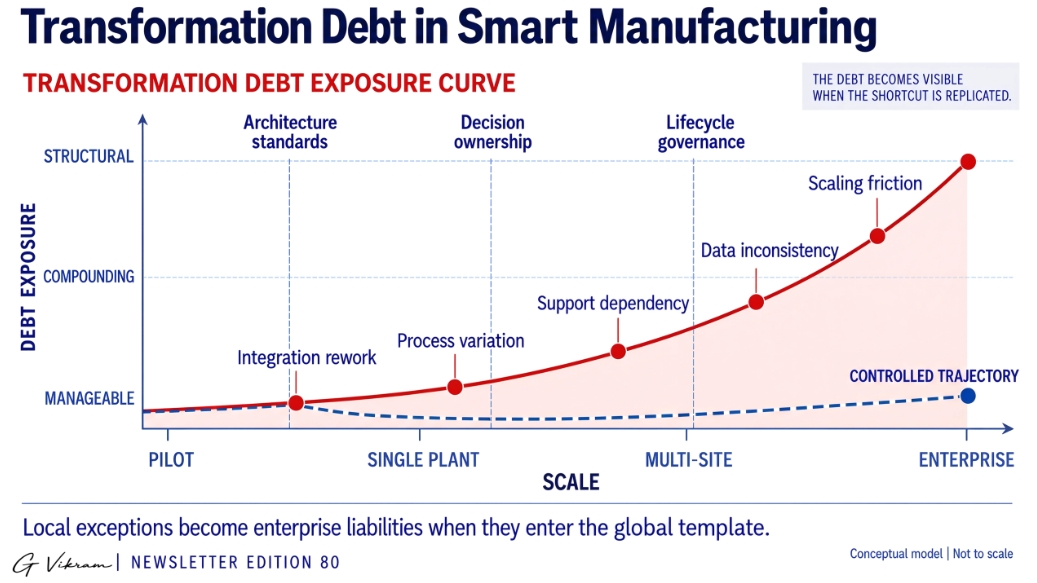 The most dangerous debt in a smart factory isn’t financial.
 Why mission changes everything, leadership lessons from two boardrooms