
Dec12
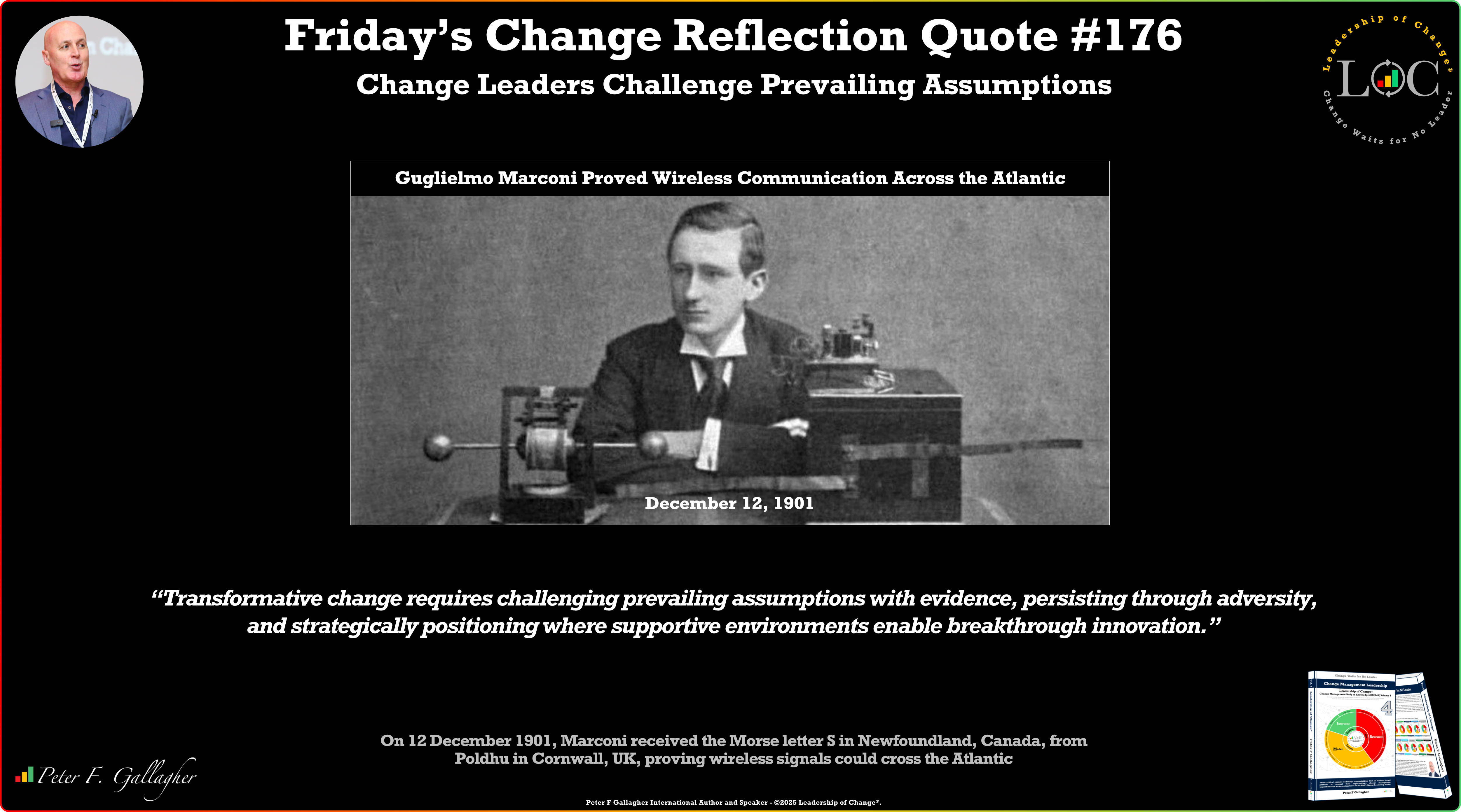
FCRQ176 Leadership Learning!
On 12 December 1901, Guglielmo Marconi proved wireless communication across the Atlantic was possible when he received three faint clicks representing the Morse code letter S at Signal Hill in St John’s, Newfoundland. The Italian radio pioneer and inventor transformed global communication through his development of practical wireless telegraphy. Transmitted from Poldhu, Cornwall, more than 2,100 miles away, these simple signals shattered prevailing scientific assumptions and opened an entirely new chapter in human communication. Using a 50- foot kite supported antenna and a telephone earpiece connected to a coherer, Marconi heard the prearranged signal at 12.30, 1.10 and 2.20 that December afternoon, forever changing humanity's relationship with distance and information. The achievement arrived amidst considerable scepticism from leading physicists who insisted radio waves travelled in straight lines, rendering transmission beyond the horizon impossible. Thomas Edison voiced scepticism about the long‑distance reception, though the specific claim about atmospheric static lacks reliable historical evidence. At the time, no scientific model could account for long distance wireless propagation, leaving Marconi’s results without a theoretical explanation. Yet Marconi persisted, driven by conviction that wireless telegraphy could compete commercially with the expensive transatlantic telegraph cables that monopolised international communication. Since 1866, undersea telegraph cables had carried almost all transatlantic messages, creating powerful commercial interests determined to protect their investments from emerging wireless competition. When Marconi achieved his breakthrough, the Anglo American Telegraph Company immediately threatened legal action for violating their Newfoundland communication monopoly, forcing him to relocate his experiments within days. The December 1901 reception occurred under particularly challenging conditions. After storms destroyed the Cape Cod antenna and earlier damage at Poldhu limited his options, Marconi arrived in Newfoundland already working with improvised equipment. On Signal Hill, fierce gales carried away the first kite and balloon attempts. The second kite barely stayed aloft long enough for those historic receptions. Marconi's diary entry for that day contains just seven words: “Sigs at 12.30, 1.10 and 2.20.” This understated record belied the magnitude of what had occurred. Debate continues about what precisely happened that day, with modern radio scientists noting that daytime long wave transmission across such distances should have been impossible. Some historians suggest Marconi may have detected short wave harmonics rather than the primary transmission frequency. Others maintain atmospheric conditions, whilst improbable, were not impossible. What remains undisputed is that within two months, during February 1902 aboard the SS Philadelphia, Marconi conducted carefully documented tests with multiple witnesses, receiving signals up to 2,100 miles from Poldhu, definitively proving transatlantic wireless communication's viability. The 1901 breakthrough fundamentally altered strategic thinking about global communication. Prior to Marconi's success, international communication required physical infrastructure vulnerable to enemy interdiction. A nation's undersea cables could be cut, isolating it completely. Wireless technology offered resilience through redundancy, making it impossible to sever all communication channels simultaneously. This military implication was not lost on governments, particularly navies, which rapidly adopted wireless technology.
Change Leadership Lessons: Marconi’s determination offers clear insights for contemporary change leaders seeking to advance bold visions despite resistance. Leaders of change challenge prevailing assumptions through empirical evidence rather than accepting theoretical limitations others believe impossible. They persist through adversity by adapting when obstacles arise, improvising simpler solutions that ultimately prove viable. Change leaders enable sustainable innovation by focusing strategically on initial markets that generate revenue whilst supporting broader research. They respond to scepticism through enhanced demonstration with documented trials and witnesses rather than arguing defensively against critics. Leaders of change accelerate progress by repositioning geographically when current environments resist, seeking supportive institutions that enable breakthrough. Change Leaders Challenge Prevailing Assumptions.
“Transformative change requires challenging prevailing assumptions with evidence, persisting through adversity, and strategically positioning where supportive environments enable breakthrough innovation.”
Application. Change Leadership Responsibility 1 - Articulate a Change Vision: Marconi articulated a vision that connected a technical possibility with a compelling human purpose: overcoming the limits of distance. This vision resonated because it spoke not only to scientific progress but to society’s desire for faster, more open communication. He acknowledged the uncertainties and the gaps in theoretical understanding, yet he maintained clarity about the destination. This balance of ambition and realism created alignment among engineers, investors, and government institutions who recognised the scale of the opportunity. For today’s change leaders, vision must similarly unite diverse stakeholders by providing meaning that stretches beyond immediate challenges. When leaders communicate change with conviction, transparency, and a steady focus on long-term outcomes, they generate the trust and commitment needed to move from experimental breakthroughs to sustainable organisational transformation.
Final Thoughts: Wireless communication reshaped society by expanding what people believed was possible, and today artificial intelligence is creating a similar inflection point. Leaders who articulate bold visions grounded in evidence and purpose will guide their organisations through this accelerating era of change. When leaders combine technological insight with disciplined execution, they create the conditions for sustained, credible, and transformative progress.
Further Reading: Change Management Leadership - Leadership of Change® Volume 4.
For further reading please visit our websites: https://www.a2b.consulting https://www.peterfgallagher.com Amazon.com: Peter F Gallagher: Books, Biography, Blog, Audiobooks, Kindle
Leadership of Change® Body of Knowledge Volumes: Change Management Body of Knowledge (CMBoK) Books: Volumes 1, 2, 3, 4, 5, 6, 7, 8, 9, 10, A, B, C, D & E available on both Amazon and Google Play:
~ Leadership of Change® Volume 1 - Change Management Fables
~ Leadership of Change® Volume 2 - Change Management Pocket Guide
~ Leadership of Change® Volume 3 - Change Management Handbook
~ Leadership of Change® Volume 4 - Change Management Leadership
~ Leadership of Change® Volume 5 - Change Management Adoption
~ Leadership of Change® Volume 6 - Change Management Behaviour
~ Leadership of Change® Volume 7 - Change Management Sponsorship
~ Leadership of Change® Volume 8 - Change Management Charade
~ Leadership of Change® Volume 9 - Change Management Insanity
~ Leadership of Change® Volume 10 - Change Management Dilenttante
~ Leadership of Change® Volume A - Change Management Gamification - Leadership
~ Leadership of Change® Volume B - Change Management Gamification - Adoption
Keywords: Business Strategy, Change Management, Leadership
 AI Is Exposing the Data Problems Humans Used to Hide
 "The AI may in fact be conscious." Really?
 When AI Makes the Workaround Scalable
 The Age of Continuous Shocks: Why the coming downturn will be decided in your supply chain
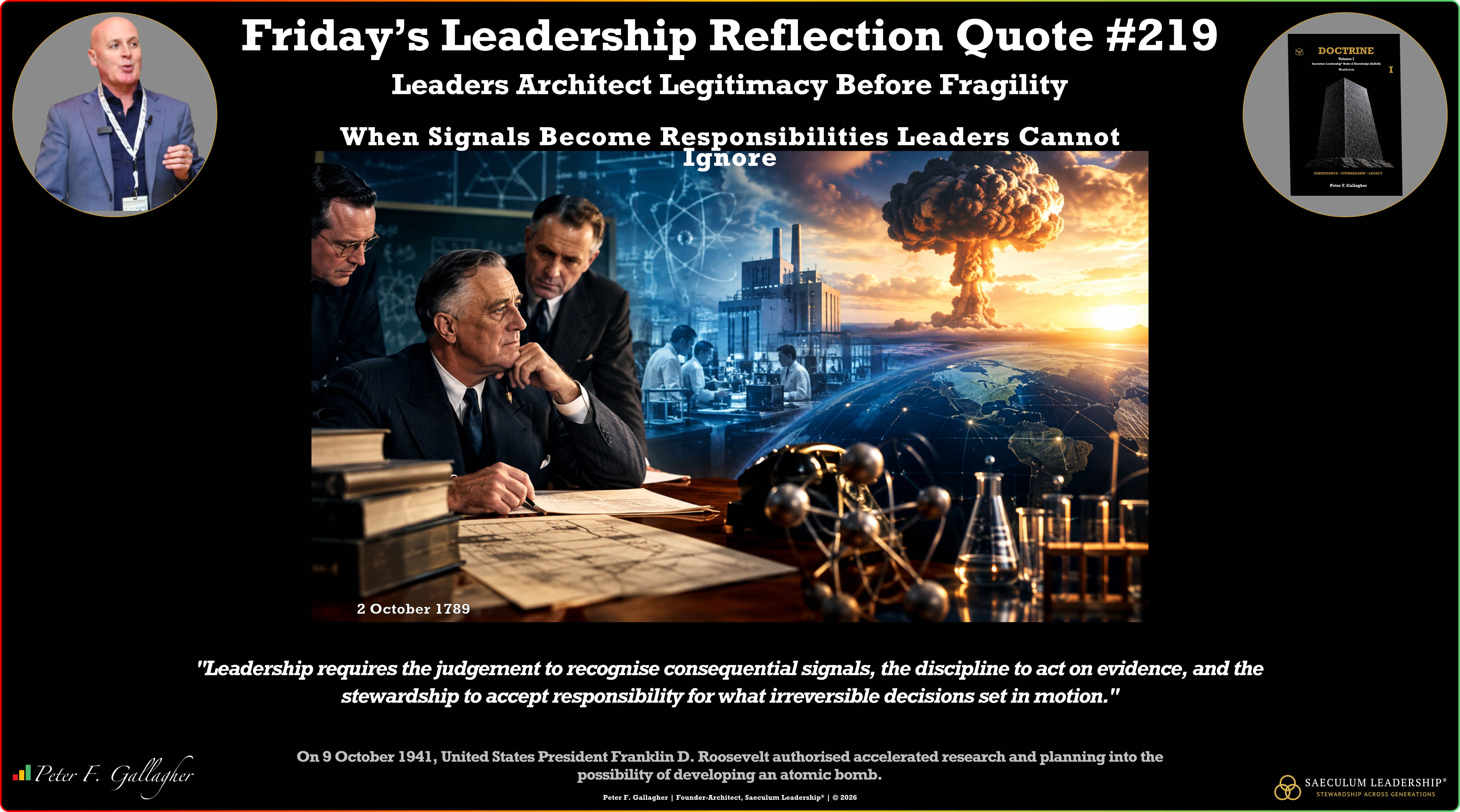 Friday’s Leader Reflection Quote – Saeculum Leadership Leaders Accept Decisions Create Responsibilities