Apr24
FCRQ195 Leadership Learning!
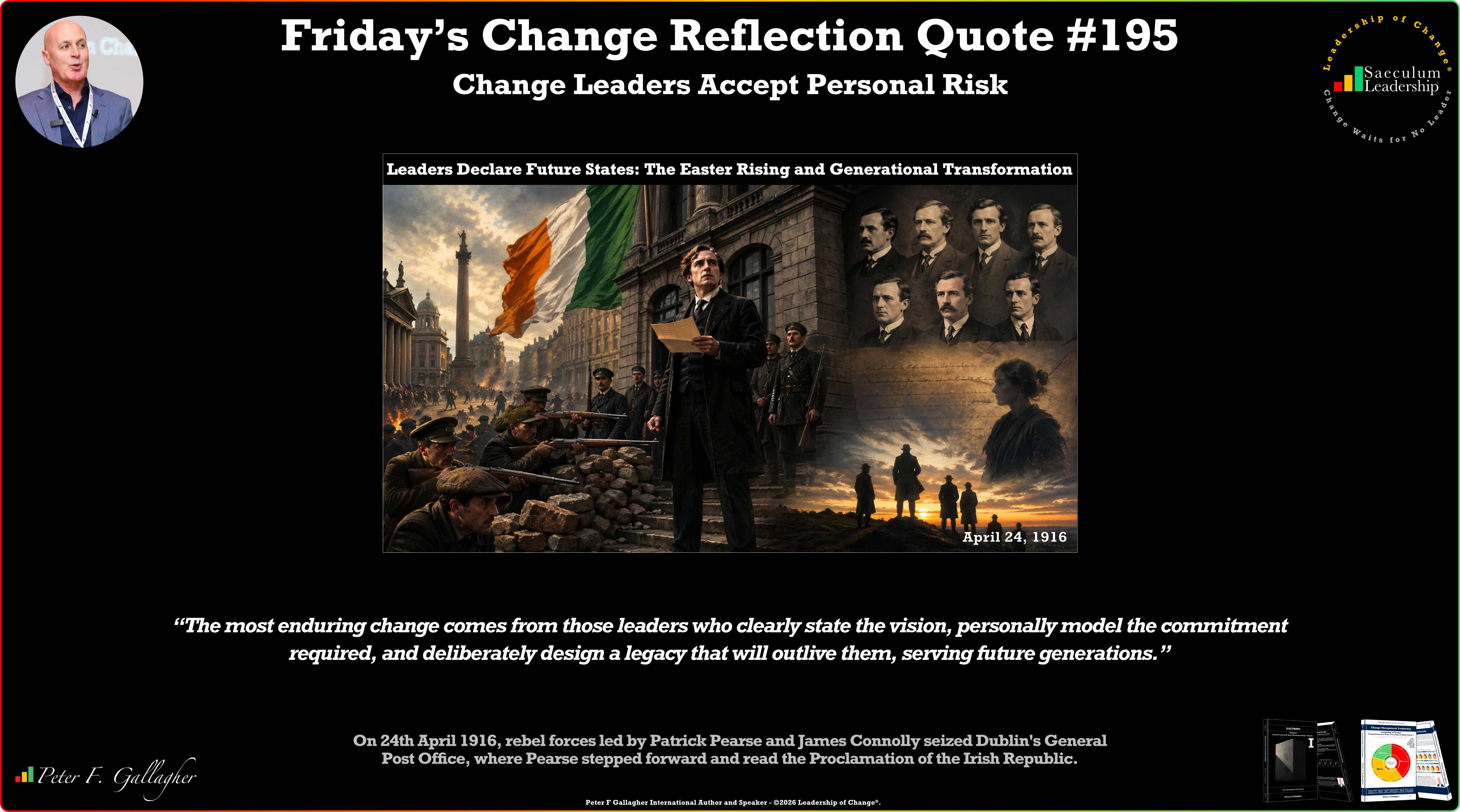
On 24th April 1916, rebel forces led by Patrick Pearse and James Connolly seized Dublin's General Post Office, where Pearse stepped forward and read the Proclamation of the Irish Republic. That single act, carried out on the main thoroughfare of an occupied city, signalled to Ireland and to the world that a small group of determined men and women were willing to stake their lives on a future most people did not yet believe was possible.
The Rising had been planned in extraordinary secrecy by the seven-member Military Council of the Irish Republican Brotherhood (IRB). The Rising began on Easter Monday, 24th April 1916, and lasted for six days, as members of the Irish Volunteers, led by schoolmaster and Irish language activist Patrick Pearse, joined by the smaller Irish Citizen Army of James Connolly, seized strategically important buildings in Dublin and proclaimed the Irish Republic. Beyond the GPO, rebel garrisons occupied key positions across the city, including the Four Courts, Boland's Mill, Jacob's Biscuit Factory, and the South Dublin Union, establishing a dispersed network of resistance across the capital.
The Proclamation itself was a remarkable and forward-looking document. It united the republicanism of the Irish Volunteers, the socialism of the Irish Citizen Army, and the feminism of Cumann na mBan, forming a genuinely coalitional statement of intent decades ahead of its time in addressing the equal rights of all citizens regardless of gender. On that same day, seven Irishmen proclaimed the establishment of the Irish Republic: Éamonn Ceannt, Thomas Clarke, James Connolly, Seán MacDiarmada, Thomas MacDonagh, Patrick Pearse, and Joseph Plunkett. All seven were subsequently executed.
Although the uprising was initially unpopular, the British response of mass arrests, martial law, and the rapid execution of its leaders transformed public opinion within weeks. What had been dismissed as a reckless act became a defining moment of national sacrifice.
As a military campaign, the Rising was ultimately a failure, but it had an important legacy: the British response to the event turned the majority of the Irish public away from the idea of Home Rule and towards the concept of a fully independent Irish Republic. Within five years, the Irish War of Independence had begun and ended, culminating in the Anglo-Irish Treaty of 1921 and the establishment of the Irish Free State.
The Easter Rising of 1916 endures not simply as a military event, but as a masterclass in how a small group of committed leaders, united by a clearly articulated vision and willing to act at great personal cost, can shift the arc of history. The Proclamation remains one of the most studied leadership and governance documents of the 20th century — a declaration of values, a statement of future intent, and a commitment to equality that prefigured much of what modern democratic leadership strives to achieve. Its authors did not survive to see the republic they proclaimed, yet the framework they set out on one printed page became the foundational knowledge architecture of a nation. The Rising was a clear Saeculum Leadership® signal — the ignition point of a Fourth‑Turning rupture that exposed the brittleness of the existing order. From that moment, the direction of Ireland’s future could no longer be contained by the institutions of the past.
Change Leadership Lessons: History records the event. Leadership interprets its meaning. The 1916 Irish Easter Rising stands as a defining example of how leaders sacrifice themselves for future generations. Leaders of change who articulate the vision with precision give followers a foundation that endures long after the leader has gone. They model the commitment personally, demonstrating through visible sacrifice that the change they champion is genuine and not merely aspirational. Change leaders who build coalitions across diverse groups and ideologies are significantly more powerful than those who act with a single constituency alone. They anticipate that disproportionate institutional resistance will often strengthen rather than suppress the change movement they have set in motion. Leaders of change who deliberately design and communicate their legacy ensure that the vision they initiate continues to be carried forward by those who follow. Change Leaders Accept Personal Risk.
“The most enduring change comes from those leaders who clearly state the vision, personally model the commitment required, and deliberately design a legacy that will outlive them, serving future generations.”
Application - Change Leadership Responsibility 1 – Articulate the Change Vision: Sustained organisational transformation rarely begins with consensus. It begins with the courage to name a future that others have not yet chosen to see. It emerges when leaders read the conditions around them with clarity and translate that reading into a direction that others can follow with conviction. A credible change vision does more than declare intent. It establishes a clear causal connection between the forces already in motion, the capability available to respond, and the long-term opportunity that disciplined action can unlock. The leaders of the Easter Rising of 1916 did precisely that, interpreting political conditions, cultural suppression, and the failure of gradualism as clear signals that a bolder direction was both necessary and urgent. That interpretation is a central leadership responsibility, not a peripheral one. Stakeholders sustain commitment when the reasoning behind a change is visible and when today's actions are credibly connected to tomorrow's outcomes. Leaders therefore carry the responsibility of translating complexity into structured, honest explanation, ensuring uncertainty is recognised as a condition of disciplined discovery rather than a reason for delay. When people understand the forces shaping future conditions, they move forward with coherence, discipline, and sustained intent.
Final Thoughts: The Easter Rising of 1916 reflects a recurring civilisational pattern in which small, committed leadership groups redefine national direction through acts of visible sacrifice and long-term vision. In an AI-accelerated world, the ability to clearly articulate and evidence a change vision becomes more critical, as technology amplifies both weak narratives and disciplined leadership intent at unprecedented speed and scale. Change leaders must define and communicate the future state with precision, personally model commitment, and sustain alignment so the change endures beyond the initial act of leadership.
Further Reading: Change Management Leadership® - Leadership of Change® Volume 4 and Saeculum Leadership®: Doctrine – Volume I.
For further insights please visit our websites: https://www.a2b.consulting https://www.peterfgallagher.com Amazon.com: Peter F Gallagher: Books, Biography, Blog, Audiobooks, Kindle
Leadership of Change® Body of Knowledge Volumes: Change Management Body of Knowledge (CMBoK) Books: Volumes 1-10.A-E & I-5
~ Leadership of Change® Volume 1 - Change Management Fables
~ Leadership of Change® Volume 2 - Change Management Pocket Guide
~ Leadership of Change® Volume 3 - Change Management Handbook
~ Leadership of Change® Volume 4 - Change Management Leadership
~ Leadership of Change® Volume 5 - Change Management Adoption
~ Leadership of Change® Volume 6 - Change Management Behaviour
~ Leadership of Change® Volume 7 - Change Management Sponsorship
~ Leadership of Change® Volume 8 - Change Management Charade
~ Leadership of Change® Volume 9 - Change Management Insanity
~ Leadership of Change® Volume 10 - Change Management Dilenttante
~ Leadership of Change® Volume A - Change Management Gamification - Leadership
~ Leadership of Change® Volume B - Change Management Gamification - Adoption
Keywords: Business Strategy, Change Management, Leadership
 Consumer vs. enterprise AI agents
 Best Supply Chain AI Tools in 2026: SCM SENSEI AI and Ask Lora Compared
 Making Silos Permeable
 The Corix Partners Friday Reading List - October 2, 2026
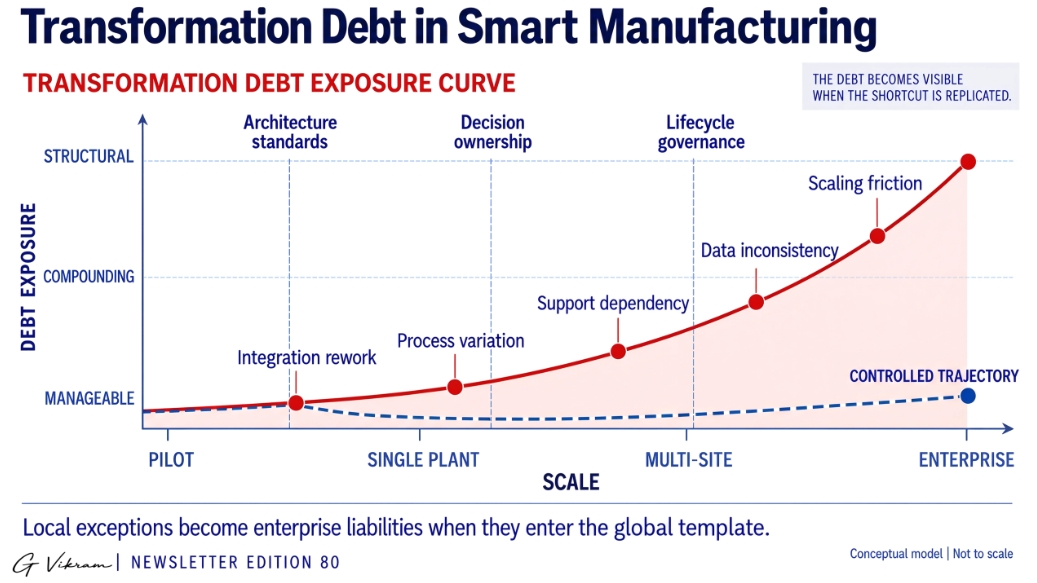 The most dangerous debt in a smart factory isn’t financial.