Sep01
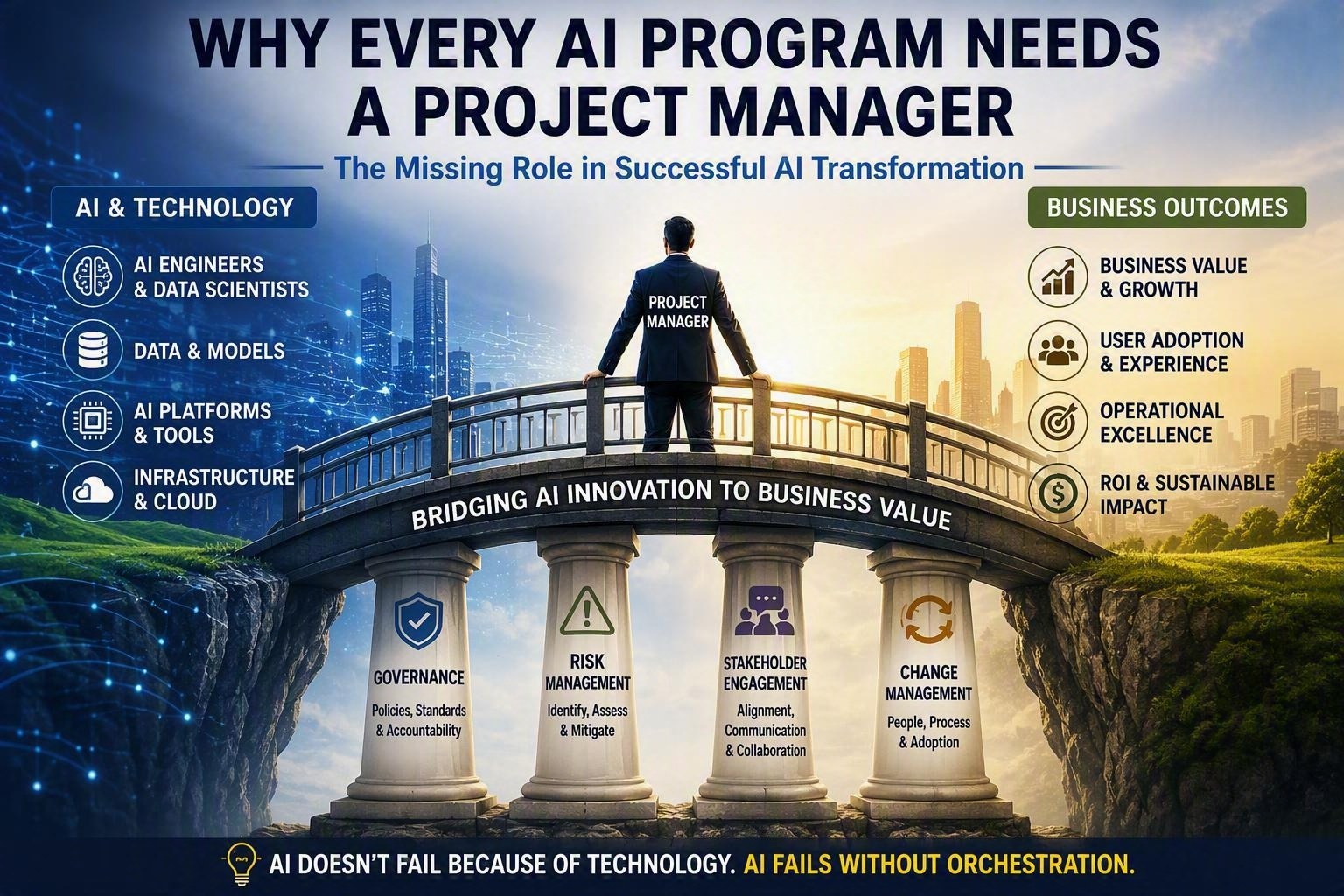
Artificial Intelligence has rapidly moved from experimentation to boardroom discussion. Organizations worldwide are deploying AI copilots, intelligent agents, predictive analytics platforms, and Generative AI solutions to improve productivity, enhance customer experience, and accelerate innovation.
Yet despite significant investments, many AI initiatives struggle to move beyond proof-of-concept stages.
When executives discuss AI failures, the conversation often focuses on model accuracy, technical complexity, or data quality. While these factors are important, another problem frequently goes unnoticed:
Many AI programs are launched without effective project management.
Organizations assemble teams of data scientists, AI engineers, architects, cybersecurity specialists, and business stakeholders. However, the role responsible for aligning these groups toward measurable business outcomes is often overlooked.
Ironically, the same discipline that determines the success of traditional transformation programs is sometimes considered optional for AI initiatives.
That assumption is becoming increasingly expensive.
A common misconception is that AI is essentially a technology deployment exercise.
If that were true, every organization with access to AI tools would already be realizing transformational benefits.
In reality, AI initiatives are complex business change programs.
Consider a typical enterprise AI deployment:
Each group operates with different priorities, objectives, and success criteria.
Without coordination, even technically successful AI implementations can fail to deliver business value.
This is precisely where project management becomes indispensable.
Industry discussions often focus on technical shortcomings, but practical experience suggests that many AI projects struggle because of familiar project delivery challenges.
These include:
Many organizations launch AI initiatives because competitors are doing so.
The result is enthusiasm without direction.
Questions such as:
remain unanswered.
Project managers bring structure by defining scope, objectives, deliverables, and measurable outcomes.
AI programs frequently impact multiple departments simultaneously.
An AI-powered solution may involve Human Resources, Technology, Security, Compliance, Procurement, and Business Operations.
Without active stakeholder management, conflicting expectations emerge.
Project managers help build consensus while maintaining focus on strategic objectives.
Generative AI projects are particularly vulnerable to expanding expectations.
A chatbot project intended to support one department quickly turns into a request for enterprise-wide deployment, multilingual support, workflow automation, analytics integration, and agentic capabilities.
Without disciplined scope control, timelines become unrealistic and benefits become difficult to measure.
Technology adoption is ultimately a people challenge.
Employees may resist AI because they fear job displacement, lack confidence in the technology, or simply prefer existing ways of working.
Project managers play a critical role in communication, training, stakeholder engagement, and adoption planning.
One of the most overlooked aspects of AI transformation is governance.
Organizations must address questions such as:
These are not purely technical questions.
They involve organizational accountability, policy implementation, risk management, and executive oversight.
Effective project managers already possess many of the skills needed to coordinate governance frameworks across multiple stakeholders.
As AI regulation evolves globally, governance will become an increasingly important differentiator between successful and unsuccessful AI programs.
The traditional project manager role is evolving.
Today's AI project managers must understand areas beyond schedules and budgets.
Key responsibilities increasingly include:
Projects must identify and track risks related to:
A structured AI risk register should become as common as a RAID log.
Success should not be measured by the number of AI tools deployed.
Instead, organizations should evaluate:
Project managers help ensure AI investments remain tied to measurable business outcomes.
Responsible AI principles must move beyond policy documents.
AI project managers can help operationalize these principles by ensuring fairness, transparency, accountability, security, and privacy considerations are incorporated into project governance.
AI transformation requires unprecedented collaboration across disciplines.
Project managers act as translators between technical specialists and business leaders, ensuring everyone works toward shared objectives.
The future of project management is not threatened by AI.
It is being expanded by AI.
Routine activities such as status reporting, meeting summaries, dashboard creation, and administrative tracking are increasingly automated through AI assistants and copilots.
This shift creates an opportunity for project managers to focus on higher-value activities:
The project manager of the future will spend less time collecting information and more time enabling decisions.
Artificial Intelligence may be powered by algorithms, but successful AI transformation is powered by people, governance, and execution discipline.
Organizations often invest heavily in data scientists, engineers, and AI platforms while underestimating the importance of project and program management.
Yet AI initiatives succeed or fail for many of the same reasons traditional transformation programs do: unclear objectives, poor stakeholder engagement, unmanaged risks, weak governance, and inadequate change management.
The project manager is uniquely positioned to bridge these gaps.
As organizations move from AI experimentation to enterprise-scale adoption, one fact is becoming increasingly clear:
AI does not replace project management. AI makes effective project management more important than ever.
Keywords: AGI, AI Governance, Project Management
 AI Is Exposing the Data Problems Humans Used to Hide
 "The AI may in fact be conscious." Really?
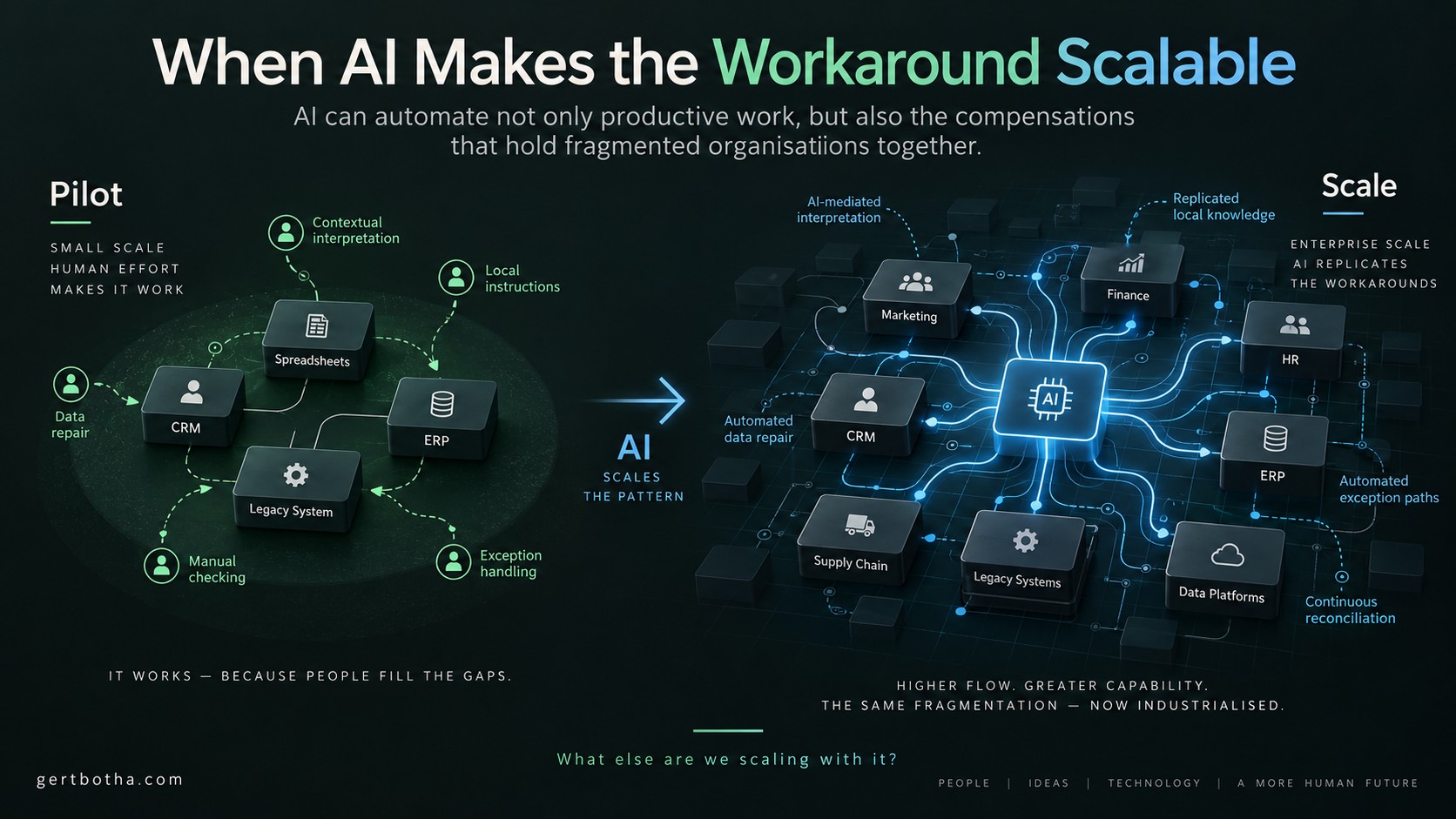 When AI Makes the Workaround Scalable
 The Age of Continuous Shocks: Why the coming downturn will be decided in your supply chain
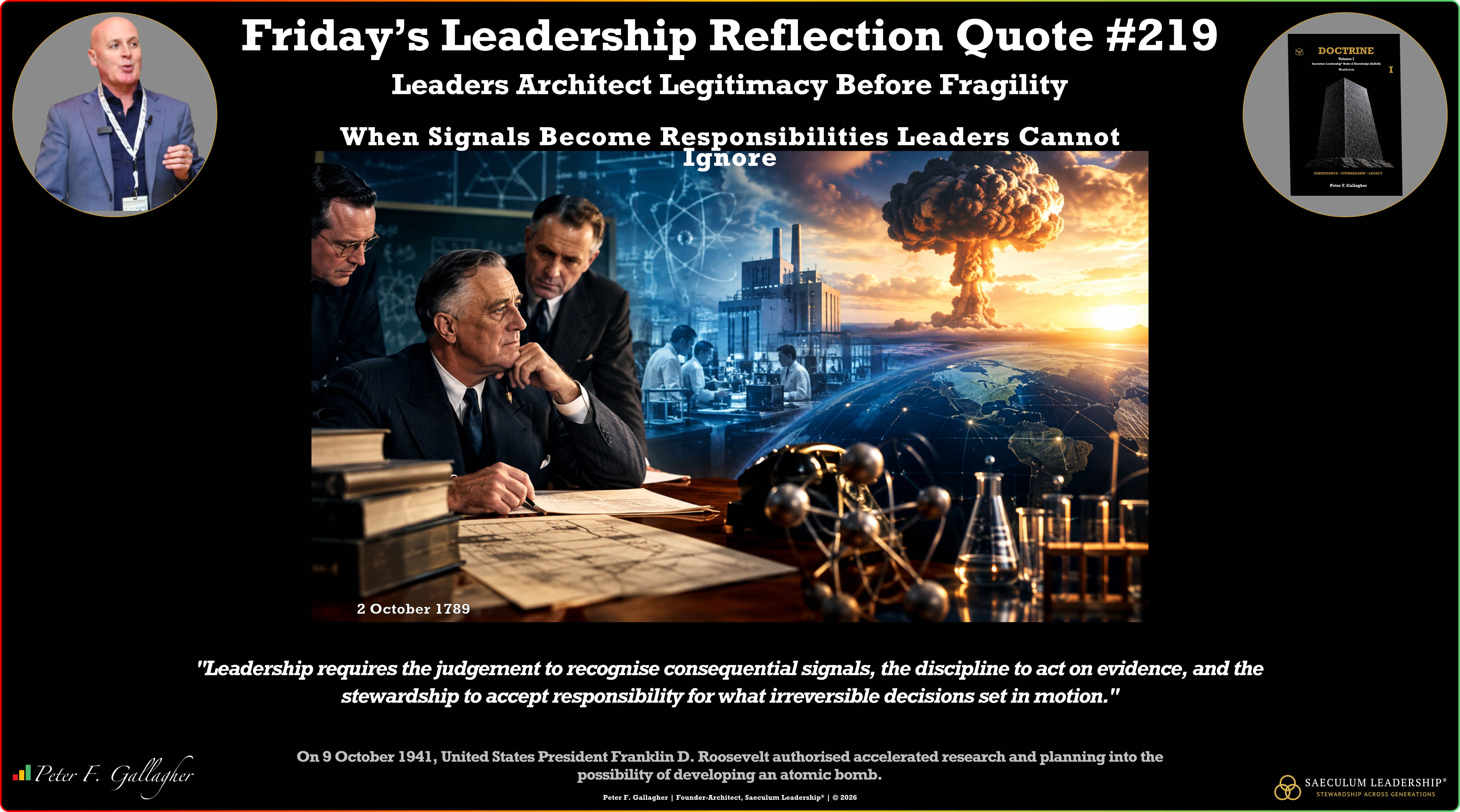 Friday’s Leader Reflection Quote – Saeculum Leadership Leaders Accept Decisions Create Responsibilities