Oct18

Every few years a new word or sentence enters the boardroom and everyone nods as if the meaning were obvious. Strategic autonomy is this years' sentence. Governments use it when they talk about energy, chips and defence. Executives use it when they talk about cloud platforms, critical suppliers and data. Yet ask ten people what it means and you get ten answers, most of them quietly assuming that autonomy is something you can simply decide to have.
My work puts me in the middle of collaborations between organisations: contracts, suppliers, customers, partners. In all of them the same questions rise sooner or later. Who actually controls this? What happens if the other side changes course? What would it cost us to leave? This article argues two things that seem to contradict each other. You should want strategic autonomy, and you will never fully have it.
Strategic autonomy is hard to pin down, so here is my definition. It is the degree of control you have over a service or a product that you depend on, set against what other actors are able to do to that service or product. Those actors can be states, but they can just as well be a single supplier, a platform owner, a regulator, a competitor or the customer who happens to be your largest source of revenue.
Two things follow. First, autonomy is not binary. It is a spectrum, and every organisation sits somewhere on it for every critical service it uses. Second, it is relative. A hospital, a bank and a small design agency will not want the same degree of it, because the consequences of an interruption differ so widely. Some organisations are simply more sensitive to dependency than others.
The case for autonomy rests on one uncomfortable observation: in a world where everything is connected, monolithic dependency is dangerous. When one cloud provider hosts your applications, your data, your identity management and your backups, you have not built an architecture. You have built a single point of failure with a service level agreement attached.
This is not limited to cloud. It applies to a sole source for a key component, one logistics partner on one trade lane, a software platform whose data model has become the backbone of your processes, or a single country supplying a raw material nobody else can deliver at scale. The pattern is always the same. Efficiency pushes you to consolidate, consolidation creates concentration, and concentration turns a commercial relationship into a continuity risk.
The price of not managing this is rarely a higher invoice. It is paid in continuity. Consider what happens when a dominant supplier nation or platform owner wakes up one morning and changes its policy abruptly and without consultation. In a highly interdependent economy the lights do not go out in one place. They flicker in dozens of places at once, because the same dependency hides behind many different organisations. Those who never asked themselves the question find out the answer at the worst possible moment.
Now the other side. Autonomy is expensive, and the bill is larger than most strategy papers admit.
Building your own version of something means duplicating capacity that the market already provides at scale. It means carrying knowledge, staff, tooling and maintenance that you previously rented, and giving up the economies of scale that made the shared solution cheap.
The collective scenario is more interesting. Imagine banks pooling their funds, or countries pooling theirs, to build an alternative together. Now the numbers start to work. A bloc that combines its resources can create its own payment rail, energy network or data infrastructure and reduce its exposure to a single outside actor. That is real autonomy, and it is achievable.
But notice what has happened. The route to autonomy ran through cooperation. The bloc did not become independent of everyone. It became dependent on a different set of partners, under different terms, which it now has to govern. And the bill has not gone away, it has been shared. Parallel capacity at this scale is a structural cost, and structural costs find their way into prices. Autonomy that is paid for shows up as inflation somewhere in the chain, in higher tariffs, higher margins, higher taxes or lower returns. We should say this out loud rather than pretend that resilience is free.
That is why complete autonomy is a utopia. The more you pursue it, the more it costs, and at some point you are paying a premium to remove a risk smaller than the premium. The sensible question is never “can we be fully autonomous?” but “how much autonomy is worth how much money, for which services, and with whom?”
There is a persistent belief that the strongest party in a relationship can simply impose its will. A dominant supplier, a monopolist, a powerful customer, even a state with military means can set terms, and for a while those terms hold.
But look at what compulsion actually produces. It does not create lasting obedience. What it creates is a conversation about strategic autonomy on the other side of the table. The harder one party pushes, the more motivated the other becomes to find alternatives, to diversify, to build, to wait. Organisations comply when they have to and leave when they can. Even with force or a monopoly you do not obtain genuine obedience. You force the debate about autonomy upon everyone who depends on you.
The party that squeezes hardest during the contract term often finds itself in a very different position at the end of it. The other side has used the years to prepare, so the renewal is no longer a formality but a decision, and the squeezed party now has options. The harder you push, the greater the chance that you are the one left holding the bill when the contract ends.
This leads to a principle that I think is underrated. You must always think from your own interests, because that is your job. But if you fail to include the perspective of the other party, you lose at the tipping point. A strategy that only models your own position is not a strategy, it is a hope.
Both arguments only make sense once we step back from the single relationship and look at the whole system. For me a business ecosystem is defined as the dynamic whole of an organisation’s relationships with other actors and the relationships among those actors, which together, within a physical and digital infrastructure, influence the realisation of the organisation’s objectives.
Note that the relationships among the other actors count too: your supplier has suppliers, and a shock far from you travels along those lines. The physical and digital infrastructure underneath, from cables to platforms, is where concentrated dependencies tend to sit unnoticed.
Specialisation, technological development, growing regulation, rising societal expectations and accelerating change all make ecosystems more complex, and more complexity means that no single organisation can deliver the whole value chain on its own. That is not a temporary condition we can engineer away. It is the nature of the modern economy. Neither a country nor an organisation can do it alone.
Seen this way, strategic autonomy is not about escaping the ecosystem. It is about holding a deliberate position within it: knowing where you want control, where you accept dependency, and where you want to be able to switch.
If autonomy is the degree of control you have over what you depend on, the place to find it is in the agreements that define that dependence. Contracts are where the relationship becomes concrete: scope, service levels, data ownership, exit rights, change mechanisms, liability, term and termination.
No single contract tells you how autonomous you are. A contract with one cloud provider may look perfectly acceptable on its own. It is the sum of all your agreements that reveals the pattern: the same provider appearing under three brands, the same subcontractor in five supply chains, the same jurisdiction behind a dozen services. So manage your agreements, add them up, and look at what the total says. The gaps are your risks. The overlaps are your opportunities, for consolidation where it is safe and for diversification where it is not.
This is why contract management and supplier relationship management belong in the strategic conversation. They turn “we depend on this” from a feeling into a fact. Strategy sets how much autonomy you want, the process secures it in daily execution, and what you learn in execution flows back into strategy again.
Make it visible. Map your dependencies across contracts, suppliers, customers and infrastructure, including the hidden ones: the subcontractors behind your suppliers, the platforms behind your platforms. You cannot weigh what you cannot see.
Run scenarios. Plot what happens if a critical party disappears, changes its terms, raises its prices or becomes unreachable for a week, a month or a year. Actually run them, and look at both continuity and cost.
Decide what to do with each dependency. Sometimes the answer is to accept it and secure it with better terms, exit support and monitoring. Sometimes it is to build a second source. For a few it is to invest, perhaps together with peers, in your own capability. Weigh continuity against cost and be explicit about the trade.
Talk about it honestly. Do so with internal stakeholders, who often see criticality differently than the contract owner, and with external parties, who respond better to a transparent conversation about shared risk than to a sudden demand. Autonomy debated openly builds trust. Autonomy pursued in secret looks like hostility and invites the very behaviour you wanted to avoid.
Strategic autonomy is worth wanting and impossible to complete. Both statements are true at once, and the skill lies in holding them together. Want it, because monolithic dependency in a connected world is a continuity risk you can see coming. Doubt it, because autonomy is costly, its price returns as inflation, and the most ambitious versions can only be built together with others. Respect the other party, because force teaches your partners to leave. And manage your agreements, because that is where autonomy is won or lost, one clause at a time.
We live in a world where nobody can do it alone. So we make agreements. Those agreements are contracts, and a contract must be managed as a document, as a relationship and as an expectation. Strategic autonomy is simply what that management looks like when you add it all up.
Keywords: Economics, Ecosystems, Risk Management
The Price of Standing Alone: Strategic Autonomy in a World Where Nobody Can Do It Alone The Potter’s Hands: Why Great Leaders Shape Environments, Not People
 The Corix Partners Friday Reading List - October 16, 2026
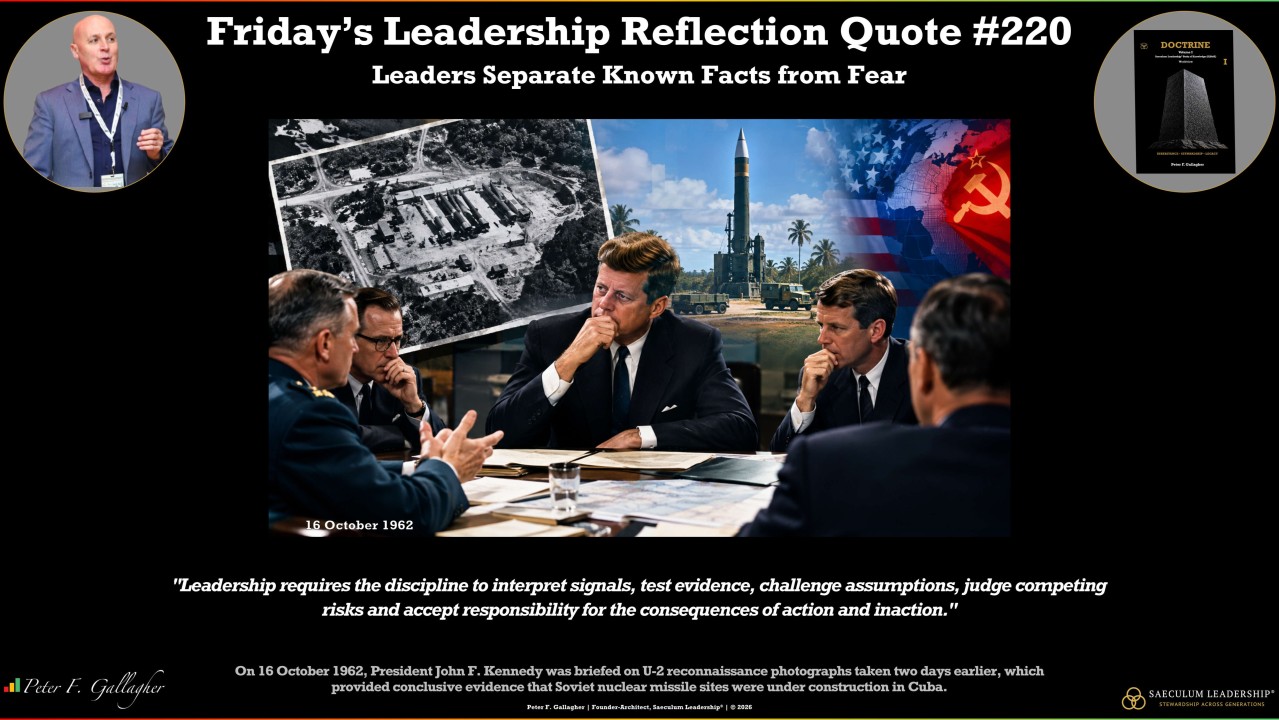 Friday’s Leadership Reflection Quote – Saeculum Leadership Leaders Separate Known Facts from Fear
 You are not your diagnosis