You've reached your limit for this session. Upgradefor2questions per session /5monthly and deeper insights.
Upgrade for more features
Unlock investment topics functionality via joining any of our paid plans.
Upgrade for more features
Unlock access to Thinkers360 AI to fast-track your search for analysts and influencers.
This feature is available for Enterprise Lite and Enterprise Members Only.
Upgrade for more features
Upgrade to create your own analyst relations newsroom and interact with over 10K B2B analysts and influencers on Thinkers360.
Upgrade for more features
Unlock all social handles for all members via joining any of our paid plans.
Upgrade for more features
Upgrade to Enterprise Lite or Enterprise to see complete company ranking data for your organization and competitors. Plus, elevate your profile with always-on content amplification engineered to boost your SEO, AIO, and generative search footprint.
Unlock Company Rankings
You have been temporarily restricted. Please be more thoughtful when adding content for your portfolio. Your portfolio and digital media kit and should be reflective of the professional image you wish to convey. Accounts may be temporarily restricted if we receive reports of spamming or if the system detects excessive entries.
Publish your original ideas on the Thinkers360 platform!
This feature is available for Pro and Pro-Plus Members Only.
Upgrade for more features
Speaker Bureau functionality whereby individuals can be featured speakers within our Speaker Bureau service and enterprises can find and work with speakers.
This feature is available for Pro, Pro-Plus, Premium and Enterprise Members Only.
Upgrade for more features
Highlight your featured products and services within our company directory for enhanced visibility to active B2B buyers worldwide as well as improved
SEO, AIO and generative search footprint.
This feature is available for Pro, Pro Plus, Premium and Enterprise Members Only.
Upgrade for more features
You’ve reached your limit for this feature.
Upgrade for more features
Publish on the Web’s #1 Thought Leadership Blog.Join the elite. Ranked the top thought leadership blog by Feedspot (2021–2025), Thinkers360 offers you more than just a platform - it offers authority. Share your insights with our community and tap into a combined network of over 100M followers through our peer-to-peer marketplace.
Upgrade to Publish & Scale Your Reach
You’ve reached your daily limit for entering quotes. Please only add personally-authored content which is reflective of your digital media kit and thought leadership portfolio.
For full access to the Thinkers360 content library, please join ourContent Planor become a contributor by posting your own personally-authored content into the system viaAdd PublicationorImport Publication.
Unlock your personalized dashboard including metrics for your member blogs and press releases as well as all the features and benefits of our member plans!
Upgrade for more features
ExploreFeatures & BenefitsPage
Sep09
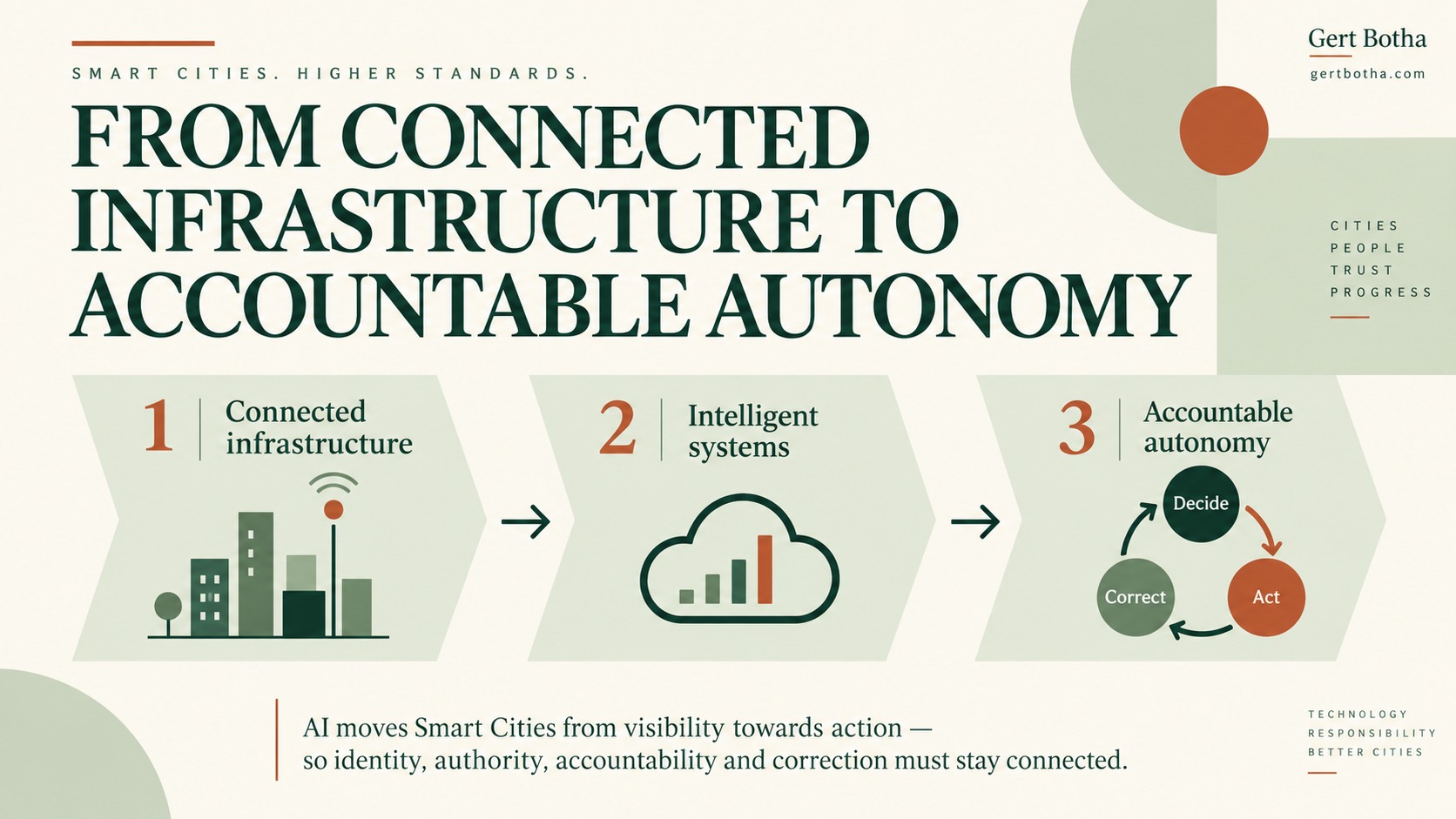
Why the shift from connected infrastructure to increasingly autonomous urban systems changes the management problem.
For much of the past two decades, the Smart City conversation has centred on connectivity. Cities installed sensors, connected infrastructure, digitised services, built data platforms, and looked for ways to make transport, utilities, public safety, environmental management, and citizen services more responsive. The underlying proposition was simple: if a city could see more of what was happening, it could make better decisions. That proposition remains valid, but AI changes the next question.
As urban systems become more capable of interpreting information, coordinating activity and acting without continuous human intervention, the challenge is no longer how to collect more data or connect more infrastructure. It is how to govern systems that may increasingly act on the city's behalf.
The next Smart City challenge is not connectivity. It is accountable autonomy.
The first generation of Smart City infrastructure was largely about visibility. Traffic sensors could show congestion. Environmental systems could monitor air quality. Connected meters could reveal energy or water consumption. Asset-monitoring systems could provide evidence of infrastructure condition.
Analytics added interpretation. Systems could identify patterns, predict failures, optimise routes, or highlight unusual conditions, but in many cases the technology still stopped short of action. A person reviewed the information and decided what to do. AI is beginning to change that boundary.
A traffic-management system may increasingly adjust signals dynamically rather than recommend a change. A utility platform may rebalance demand, initiate maintenance activity or interact with distributed energy assets. A municipal service agent may respond to citizens, initiate workflows and coordinate across departments. Systems may eventually negotiate with other systems, allocate resources or take action within predefined authority.
This does not mean cities are about to become fully autonomous, nor should greater autonomy be treated as the inevitable destination for every public service. But the available spectrum is widening:
Automate → Assist → Delegate → Act Autonomously
At one end, technology executes a defined task. At the other, a system may interpret circumstances and act within delegated authority. The management significance lies not in pushing every service towards the right-hand side, but in deciding deliberately where each activity should sit.
This question is harder in a Smart City than inside a single enterprise because a city is an overlapping system of systems. Municipal departments, utilities, transport authorities, emergency services, private operators, citizens, property owners, service providers, infrastructure owners and regulators all interact.
The same physical asset may sit inside several relationships at once. A vehicle can belong to one person, be operated by another, use public infrastructure, consume privately supplied services and interact with municipal systems. A connected building may involve an owner, tenant, facilities operator, energy provider, security company and city authority.
Once AI agents begin acting inside these environments, identity alone is not enough. The city needs to know not simply what something is, but who or what it represents, what it is authorised to do, under which conditions, and who remains accountable for the consequences.
That makes Smart City architecture increasingly an authority problem, not merely a data problem.
Smart Cities have invested heavily in sensing and data integration, often assuming that better information will naturally lead to better outcomes. Sometimes it does, but evidence is only one part of a decision loop.
A city operates through overlapping loops:
sense → interpret → decide → authorise → act → observe consequence → correct
Much Smart City thinking has historically concentrated on the first two stages: sensing and interpretation. AI increases the importance of everything that follows.
If a system can move directly from interpretation into action, then evidence quality, decision assumptions and delegated authority become inseparable. Consider a traffic system that automatically changes signal priorities based on congestion. The optimisation may appear straightforward until the city must balance traffic flow against pedestrian safety, emergency access, public transport priorities, local air quality or a major event.
The question is no longer simply whether the algorithm can optimise traffic. It is what objective it has authority to optimise, what trade-offs it may make, what evidence it should consider, and under what conditions that authority must stop.
The smarter the system becomes, the less sufficient it is to describe it merely as an optimisation tool.
One of the most important design principles for increasingly autonomous systems is that consequential action should not become operationally orphaned.
If a city agent acts, it should be possible to determine whose authority it is exercising. If a municipal AI system commits resources, changes access, issues an instruction or communicates a public commitment, somebody needs to remain accountable for that authority.
This is easy to obscure because technical systems often make actions appear impersonal: "the system rejected it", "the algorithm prioritised this", "the agent scheduled it". Those statements may describe the mechanism. They do not resolve responsibility. A city cannot delegate accountability merely by delegating execution.
This becomes especially important when public and private systems interact. A mobility platform may communicate with city infrastructure. A building-management agent may negotiate energy use with a utility platform. A logistics system may request access or alter routing based on urban conditions.
Machine-to-machine interaction may become normal, but every consequential action still sits inside a chain of authority, responsibility and consequence. The technical actor may be software; the accountable principal still needs to be resolvable.
This is where Smart City identity also needs to evolve.
Traditional digital identity has often focused on authentication: proving that a person, organisation or device is what it claims to be. That remains necessary, but increasingly autonomous urban environments require something richer.
A city may need to understand who owns an asset, who currently operates it, who is authorised to use it, who is responsible for maintaining it, who pays for the service it consumes and who carries compliance responsibility. Those relationships may be permanent, temporary or conditional, and they may change independently. Ownership, operation, custody, risk, payment responsibility and authority are not necessarily the same thing.
That distinction matters when systems need to resolve these conditions automatically. A municipal system deciding whether an autonomous vehicle may enter a restricted zone may need more than the vehicle's identity. It may need to understand the current operator, purpose, authority, compliance status and conditions under which access has been granted.
In that world, identity becomes less about a static record and more about a network of accountable relationships.
With emerging technology, the tendency is often to ask what is possible. Cities will need a different discipline: deciding what autonomy is appropriate.
A system capable of changing a traffic signal every second does not automatically deserve unlimited authority to do so. A public-service agent capable of interacting with a citizen should not necessarily be authorised to make every decision connected to that interaction.
Different decisions carry different consequences, so authority boundaries need to be explicit. What may the system decide? What may it recommend but not execute? What requires human approval? Which exceptions trigger escalation? What evidence must be present before an action is allowed? Under what conditions is authority reduced or revoked?
These are not merely AI-governance questions. They are operating-model questions about where human and machine authority meet.
A decision can be right when made and wrong later. Weather changes. Traffic patterns shift. Infrastructure fails. A public event alters demand. A new safety condition emerges. A rule changes. The evidence that justified an earlier decision may no longer hold.
Human organisations already struggle with this. Autonomous systems can make the problem more consequential because they can continue acting consistently and continuously on yesterday's interpretation.
Cities therefore need return paths. Changed reality has to reach the decisions and systems still depending on the old condition. An earlier authority may need to be reduced, an automated rule suspended, or a previously valid action reconsidered.
This is the difference between a system that can act and a system that can remain correct. The more autonomy cities introduce, the more important this correction architecture becomes.
This also creates a larger design opportunity.
Many municipal processes were created around historical constraints. Citizens had to visit offices because they could not exchange documents securely online. Departments operated separately because they could not share data easily. Public-service processes became standardised because contextual decision-making was expensive. Information travelled slowly through hierarchies because leaders had no direct access to operating evidence.
Those arrangements may once have been necessary. AI should not simply make them faster.
If AI can maintain context across interactions, perhaps public services can become more responsive rather than more generic. If evidence can be interpreted continuously, some decisions may move closer to where consequence occurs. If systems can coordinate across organisational boundaries, some hand-offs that exist mainly because of old institutional silos may be redesigned.
That opportunity only appears if the city treats AI as an organisational-design question rather than another technology layer.
The next phase of Smart Cities will therefore be less about technology portfolios and more about management architecture.
Cities will still need sensors, networks, platforms, digital twins and data infrastructure. Those capabilities matter, but the difficult questions increasingly sit above them: what evidence should drive a decision, who or what may interpret it, which decisions may be delegated, whose authority an AI system exercises, how citizens and assets are related, who remains accountable when a system acts, and how changed reality returns when an earlier assumption no longer holds.
These questions connect directly to a broader AI-era organisational problem. As technology moves from sensing and assisting towards greater delegated agency, organisations — and cities — need to design how they know, decide, delegate, act and learn.
For cities, the stakes are particularly high because the consequences are public, shared and often difficult to reverse.
The ambition should not be to create the most autonomous city possible. It should be to create the most capable city whose use of autonomy remains appropriate, bounded and accountable.
In some services, that may mean extensive autonomous action. In others, AI may remain a powerful assistant to human judgement. The right answer will depend on consequence, evidence quality, reversibility, public trust, legal authority and operating context. What matters is that the choice is deliberate.
The Smart City conversation began with connectivity and moved towards data and intelligence. AI now pushes it towards agency. Once systems can increasingly act on behalf of institutions, the central question changes again.
The challenge is no longer simply whether the city is connected or intelligent. It is whether the city can remain accountable while it becomes more autonomous. That, I believe, is the next Smart City challenge.
By Gert Botha
Keywords: Agentic AI, AI Governance, Smart Cities
 2027 Predictions for Cybersecurity: The Agent Is the New Insider
 FROM THE AISLE Field Notes on AI Implementation
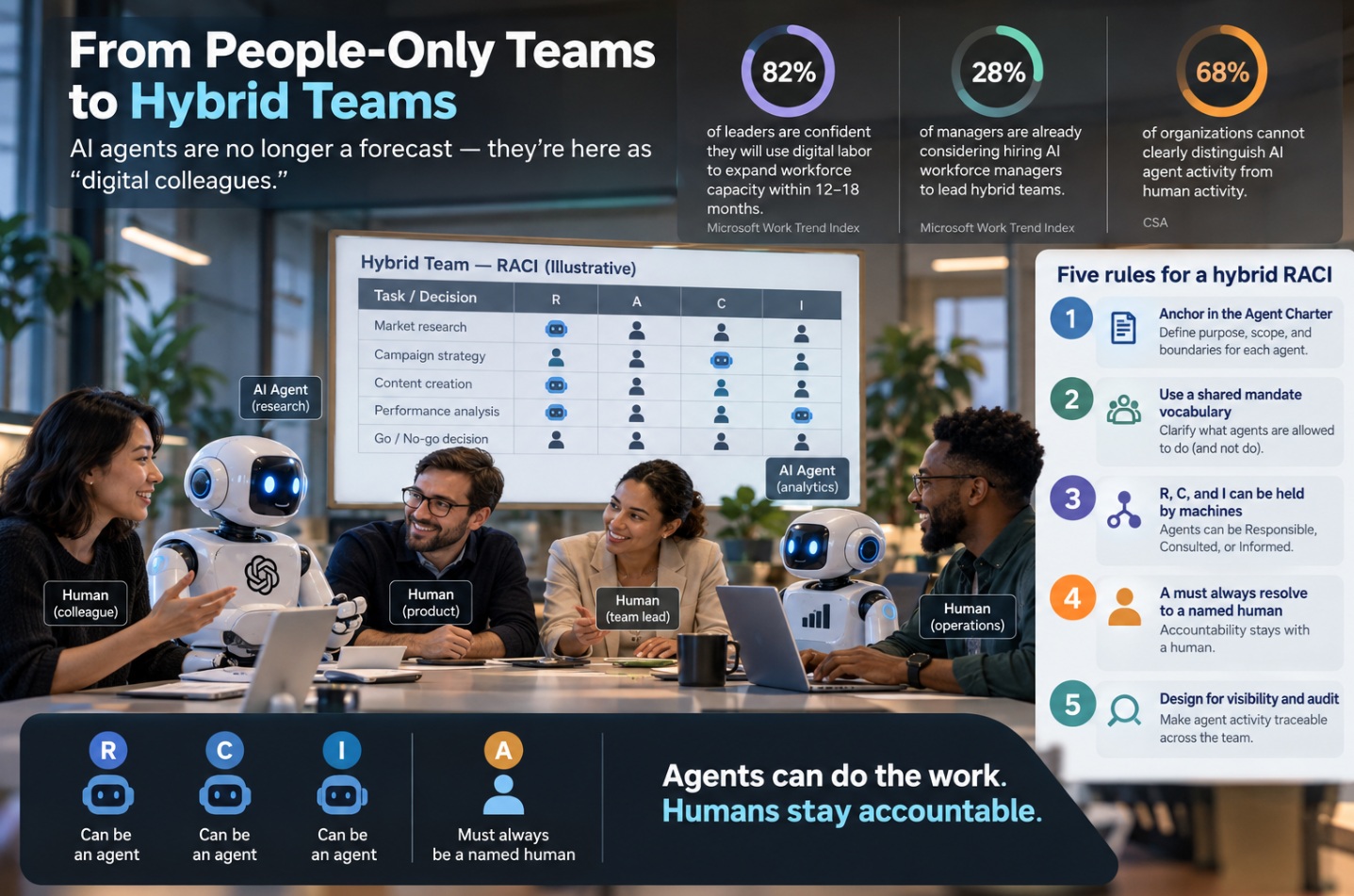 The Hybrid Team: Rethinking RACI When Some of Your Team Members Are Machines
 Two Clocks, One Truck: The Army's Need for Speed Meets New Defense Sourcing Rules
 Sustainable Transformation: The Elephant and The Mouse In The Room