Sep15
Too often, leaders treat strategy as a master plan: define it, cascade it through the organisation, allocate resources and execute it. Once the strategy has been agreed, attention shifts towards delivering the plan.
But this approach overlooks a fundamental truth.
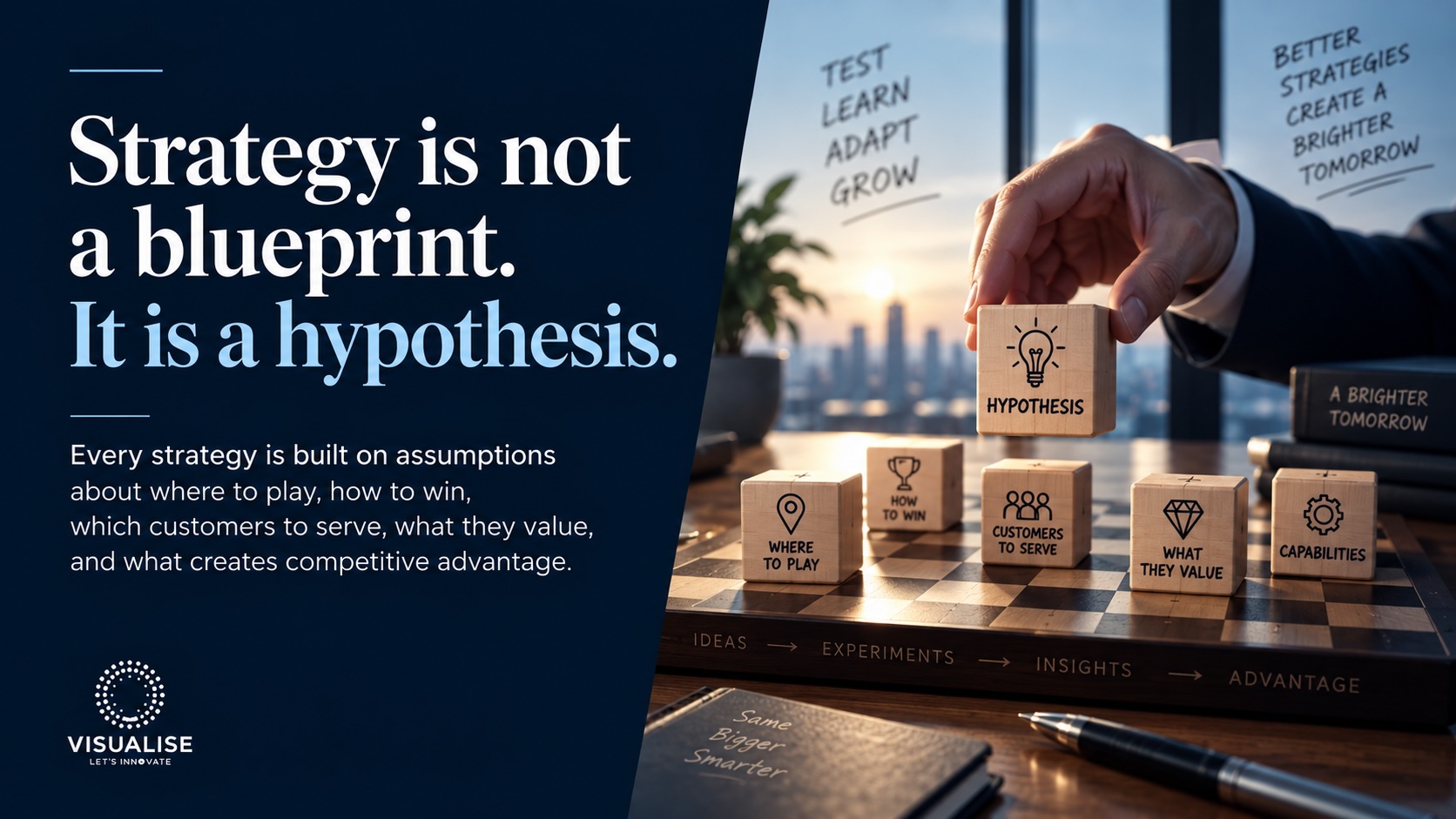
Strategy is not a blueprint. It is a hypothesis.
Every strategy is built on assumptions. Leaders make choices about where to play, how to win, which customers to serve, what those customers will value, and which capabilities will create competitive advantage.
Those choices may be supported by research, analysis and experience. But they are still assumptions about an uncertain future.
Nothing is proven until strategy meets reality.
This changes how organisations should think about execution. Execution cannot simply mean delivering activities, completing initiatives and hitting milestones. Execution must also be a process of learning.
The most effective organisations create a continuous strategic loop:
Plan → Execute → Learn → Adapt
They formulate a strategy, translate it into action, observe what happens and use the evidence to refine their thinking. When assumptions prove correct, they invest with greater confidence. When assumptions prove wrong, they adapt before significant time, money and organisational energy are wasted.
This is where strategy execution frameworks can become particularly powerful.
Approaches such as Palladium’s Execution Premium Process (XPP) connect strategy formulation with execution, measurement and adaptation. Tools such as strategy maps and Balanced Scorecards should therefore be viewed as more than mechanisms for communicating priorities or reporting performance.
Used effectively, they become strategic learning systems.
They enable leadership teams to move beyond asking, “Are we delivering the plan?” and start asking more valuable questions:
Are customers responding as we expected?
Are improvements in our capabilities producing the outcomes we predicted?
Are our strategic initiatives creating genuine competitive advantage?
And, perhaps most importantly, what evidence would convince us that our original assumptions were wrong?
This distinction matters because organisations can execute a flawed strategy extremely well.
Projects can be delivered on time. Budgets can be controlled. KPIs can turn green. Teams can work harder and faster.
Yet none of this guarantees that the underlying strategic hypothesis is correct.
As Roger Martin famously argues, “A plan is not a strategy.”
Planning feels comfortable because it creates an impression of certainty. Strategy is fundamentally different. Strategy requires choices. And meaningful choices involve uncertainty, trade-offs and risk.
That means strategic execution should not be judged solely by how faithfully an organisation follows its original plan. It should also be judged by how quickly the organisation discovers what is actually true.
At your next strategy review, therefore, add two questions to the agenda:
What assumptions are we making?
How will we know whether they are true?
Those questions transform strategy reviews from exercises in performance reporting into opportunities for strategic learning.
Because the real value of strategy does not lie in producing an elegant plan or an impressive presentation. It lies in an organisation’s ability to test its thinking, interpret the evidence and adapt faster than its competitors.
Strategy is not static. It is a continuous process of discovery.
To explore practical resources, strategic facilitation techniques, and visual tools that support better strategic thinking, visit Visualise Solutions: https://visualisesolutions.co.uk/.
By Andrew Constable MBA, XPP, BSMP
Keywords: Business Strategy
 Consumer vs. enterprise AI agents
 Best Supply Chain AI Tools in 2026: SCM SENSEI AI and Ask Lora Compared
 Making Silos Permeable
 The Corix Partners Friday Reading List - October 2, 2026
 The most dangerous debt in a smart factory isn’t financial.