Jul31
Most organisations don't struggle because people resist change. They struggle because people resist uncertainty, poorly designed systems, and transformation efforts that happen to them rather than with them.
After more than two decades working with leaders and organisations across multiple industries supporting transformation efforts impacting 320,000+ people, I've come to a confronting conclusion:
Change management doesn't work at the depth or scale people and modern organisations need.
The intent behind change management isn't flawed. It fails because it largely focuses on managing reactions rather than engineering conditions for success.
If organisations want meaningful transformation, they must move beyond readiness, communication plans, and training schedules and develop the capability to create trust at scale through Adaptive Excellence. This is the discipline of continuously improving how people lead, make decisions, and deliver outcomes.
One of the most persistent myths in business is that people resist change.
The truth is that most people embrace change when they can see the benefit, understand the purpose, and trust the process.
What they resist is uncertainty.
They resist investing effort into something they can't influence and aren't convinced will improve their experience, performance, or outcomes.
I know that's true because I'm no different.
I don't like change unless I have some level of confidence that it will be beneficial, and some degree of influence over how it happens.
Most people feel the same way. That's why trust is repeatedly identified as essential during transformation efforts, yet it remains one of the hardest things to establish and sustain.
The challenge isn't change itself. The challenge is whether people believe the effort, disruption, and cost required to achieve it will be worth it.
Over the years I've led or managed change ranging from team and service improvement initiatives to complex enterprise-wide transformations.
I've worked with organisations that spent months refining communication plans, roadshows and training materials, only to find adoption stalled because the underlying process had not improved.
In other organisations, earlier involvement in design with people who would be most impacted uncovered flaws faster, made implementation safer, accelerated broader adoption, and reduced rework.
Across sectors, change approaches often focus on bringing people on the journey, yet overlook what I call the Change Participation Gap.
The gap emerges when people are informed about change but aren't meaningfully involved in designing it.
They're trained on new processes but have little influence over whether those processes are practical.
They're told why change is necessary but are given limited opportunity to shape how it will be implemented.
Traditional change management attempts to manage responses to change rather than address the systemic conditions that determine whether change will succeed in the first place.
Change activities happen, and project teams might tick the implementation box, but without full organisational commitment and adoption, the investment produces limited or no value.
Every transformation succeeds or fails through three interconnected systems:
When trust breaks down in any one of these areas, participation declines and uncertainty increases. Change is inevitable. Trust is engineered.
The breakthrough with my clients comes when they expand beyond traditional change disciplines and develop a deeper understanding of constraints, operational systems thinking, and how to engineer the way leaders and teams work for success.
Successful transformation requires more than people capability. People can only operate at the level of business system capability and maturity.
Adaptive Excellence is the discipline of continuously improving how people lead, make decisions, and deliver outcomes. It moves away from asking "How do we manage this change?" to the more powerful question:
"How can we create more trust across our entire delivery system?"
This shift changes where leaders focus their effort and where organisations create value.
In Trust, I argue that trust isn't a soft skill, but an operational capability.
It influences decisions, speed, collaboration, accountability, innovation, and ultimately performance.
What many organisations miss is that trust cannot be communicated into existence.
Trust is created through experience. Our ability to trust is often biased toward past failures. Organisationally, people trust when they consistently observe:
In more succinct terms trust forms through a triad of experience, participation, and performance.
Better experiences build trust, trust improves participation, and participation drives performance. Over time, this strengthens organisational capacity to adapt, evolve, and deliver results.
Leaders create or break trust through the systems they tolerate, the decisions they make, and the experiences they provide teams.
This means that:
Most importantly, trust is personal, contextual, and any weakness or absence of trust needs to be acknowledged.
The answer to the trust question must be worked through with the people ultimately responsible for implementing and sustaining the change.
The best leaders recognise that people development and business engineering are complementary disciplines that must operate together.
One develops human potential. The other removes systemic barriers to performance.
Together they create the conditions for trust at scale.
Before launching another transformation initiative, ask:
People support what they help create.
Design participation before designing communication.
Trust grows when organisations do what they say they'll do.
Focus less on messaging and more on reducing friction, improving experiences, and achieving early wins.
Visible progress creates confidence. Confidence creates momentum.
Small successes in the right direction provide compounding benefits.
Develop leaders and teams who understand both human behaviour and system performance.
Success depends on people's ability to improve culture, decisions, processes, and delivery simultaneously.
This is the foundation for Adaptive Excellence and trust at scale.
Change is inevitable and uncertainty will always accompany transformation.
The responsibility of leadership is managing uncertainty by creating the conditions that allow people to move through it with confidence.
Performance is built through the quality of leadership, decisions, delivery and trust that organisations choose to engineer and sustain.
In partnership for your success,
Melanie
Keywords: Change Management, Leadership, Transformation
 Best Supply Chain AI Tools in 2026: SCM SENSEI AI and Ask Lora Compared
 Making Silos Permeable
 The Corix Partners Friday Reading List - October 2, 2026
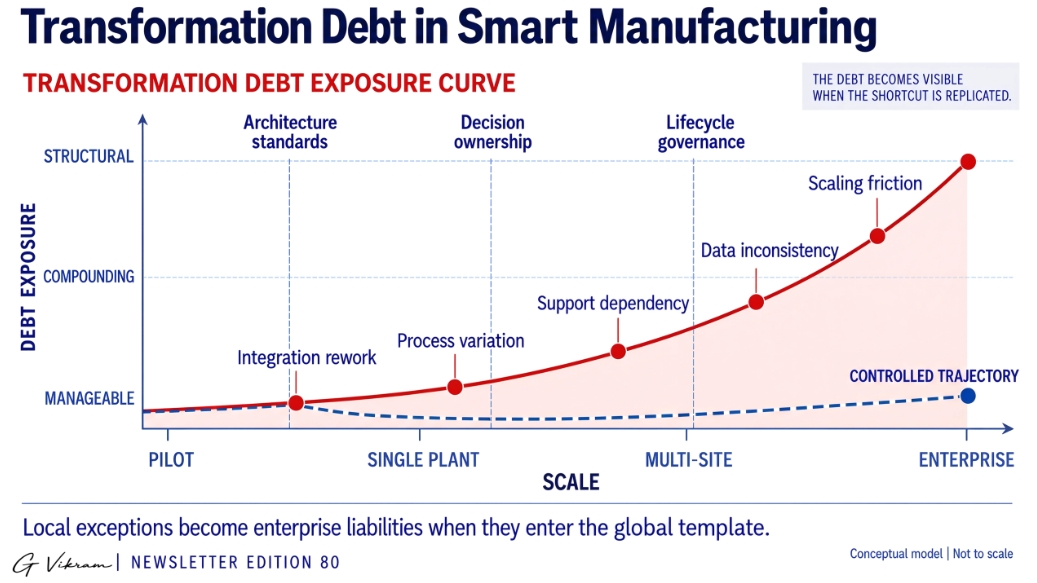 The most dangerous debt in a smart factory isn’t financial.
 Why mission changes everything, leadership lessons from two boardrooms